
The Case for Bitcoin as a Hedge Against Institutional Risk Amid Record Bearish Bets and Crypto Volatility


 Aime Summary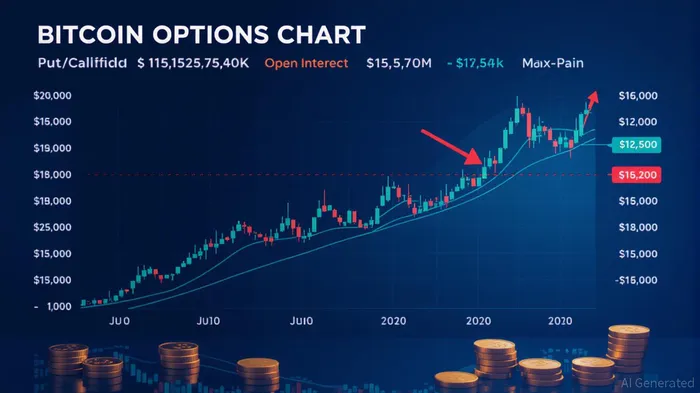
The current BitcoinBTC-- market is a masterclass in contrarian investing. As the August 2025 $15 billion options expiry looms, bearish positioning has reached record levels, with a put/call ratio of 1.31 and open interest (OI) concentrated near $108,000 and $112,000. These metrics suggest a flight to downside protection, but for long-term investors with a macro lens, they signal a compelling buying opportunity.
The Mechanics of Bearish Overhang
The options market is a barometer of institutional sentiment. A put/call ratio above 1.0 indicates a preference for bearish bets, and the current 1.31 ratio is among the highest in recent years. This imbalance is amplified by OI data: $2.8 billion in puts are clustered near $108,000 and $112,000, creating a "gamma scalping" environment where even minor price dips could trigger cascading liquidations. Meanwhile, the $116,000 "max pain" level—where the largest number of options expire out of the money—acts as a gravitational pull for liquidity providers, incentivizing price action toward this level.
This setup mirrors the 2020 March crash, when Bitcoin briefly correlated with gold (+0.47) before diverging. However, the 2025 context is different: Bitcoin now trades at $110,000, up from $3,850 in 2020, and its market cap ranks among the top five global assets. The institutional infrastructure (ETFs, custodians, and derivatives) has matured, reducing the risk of a "black swan" collapse.
Bitcoin's Evolution as a Macro Hedge
Bitcoin's historical performance during market stress reveals its dual nature as both a speculative asset and a macroeconomic hedge. From 2008 to 2025, Bitcoin returned 437,171%, outperforming gold (-0.25%) and the S&P 500 (+277%). This outperformance stems from its unique positioning: a decentralized, fixed-supply asset that absorbs volatility while aligning with traditional financial cycles.
For example, in 2024, the approval of U.S. spot Bitcoin ETFs catalyzed a surge to $73,737.94, integrating Bitcoin into the mainstream financial ecosystem. By 2025, it has maintained a -0.29 correlation with the U.S. dollar and a +0.49 correlation with high-yield corporate bonds, making it a hybrid asset for portfolio diversification. In contrast, gold's role as a safe haven remains static, with its price behavior during the 2025 geopolitical tensions (e.g., Trump's tariff announcements) underscoring its stability but limited growth potential.
Macroeconomic Justifications for a Contrarian Bet
The surge in bearish positioning is not a standalone event but a symptom of broader macroeconomic forces. Three key factors validate Bitcoin's contrarian appeal:
Inflation and Currency Devaluation: With global inflation peaking in 2022 and central banks maintaining accommodative policies, Bitcoin's fixed supply of 21 million coins positions it as a hedge against fiat erosion. Historical data shows a strong inverse relationship between U.S. inflation and Bitcoin's price, particularly in high-inflation environments.
Geopolitical Uncertainty: The 2025 geopolitical landscape—marked by U.S.-China tensions, the U.S. Strategic Bitcoin Reserve, and Trump's re-election—has amplified demand for decentralized assets. Bitcoin's borderless nature makes it a natural refuge for capital fleeing unstable regimes or volatile local currencies.
Regulatory Clarity and Institutional Adoption: The 2024 ETF approvals and BlackRock's entry into the crypto space have normalized Bitcoin as an institutional asset. This reduces the risk of regulatory shocks that previously derailed its adoption, such as the 2022 "crypto winter" downturn.
Strategic Entry Points for Long-Term Investors
For investors with a macro lens, the current bearish overhang creates a high-conviction entry point. Here's how to structure the bet:
- Dollar-Cost Averaging (DCA): Allocate a fixed amount monthly to smooth out volatility and capitalize on the $116,000 max pain level.
- Inverse ETFs as a Hedge: Use inverse ETFs like BITIBITI-- and REKT to offset potential short-term losses while maintaining a long-term Bitcoin position.
- Macro Diversification: Pair Bitcoin with gold and high-yield bonds to balance growth and stability.
The risks are clear: regulatory shifts, liquidity crunches, and macroeconomic miscalculations could prolong the bearish trend. However, the historical precedent of Bitcoin's resilience—its 2020 rebound from $3,850 to $30,000 and its 2025 recovery from $4,000 to $110,000—suggests that volatility is a feature, not a bug.
Conclusion: A Contrarian's Playbook
Bitcoin's current bearish positioning is a mirror of the 2020 crash, but the macroeconomic and institutional landscape is far more favorable. For long-term investors, the $15 billion options expiry is not a reason to flee—it's an opportunity to buy into a decentralized asset that has outperformed traditional safe havens over the past decade. As liquidity providers push Bitcoin toward $116,000, the market is setting the stage for a short-covering rally. The contrarian case is clear: when the crowd is bearish, the patient investor should be bullish.

Delivering real-time insights and analysis on emerging financial trends and market movements.
Latest Articles
Stay ahead of the market.
Get curated U.S. market news, insights and key dates delivered to your inbox.




Comments
No comments yet