
The Case for 5-Year T-Bills as a Strategic Hedge Ahead of Fed Rate Cuts
 Aime Summary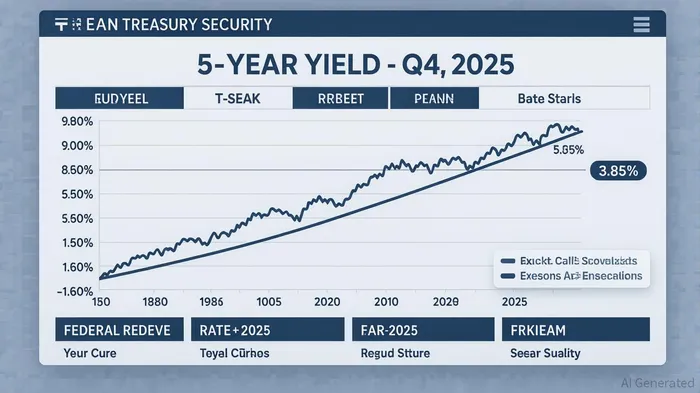
The U.S. Treasury market is at a pivotal juncture. With the Federal Reserve poised to cut interest rates in Q4 2025, investors are recalibrating their portfolios to balance capital preservation and yield optimization. At the heart of this recalibration lies the 5-year Treasury Bill (T-Bill), a security that has emerged as a strategic hedge in a volatile rate environment. This article examines why the 5-year T-Bill, as advocated by Schiffrin's framework, aligns with broader market expectations and how it compares to alternatives like corporate bonds and shorter-term Treasuries.
Market Expectations and the Fed's Easing Cycle
The Federal Reserve's rate-cut probabilities for Q4 2025 are now firmly embedded in market pricing. As of August 2025, the CME FedWatch tool shows a 90% probability of a 25-basis-point cut at the September 17 meeting, with a 54.3% chance of three cuts by year-end. These cuts would extend the easing cycle initiated in late 2023, driven by moderating inflation and softening growth signals.
Schiffrin's preference for 5-year T-Bills reflects a tactical response to this anticipated easing. Shorter-term T-Bills (e.g., 1- or 3-month) will see their yields decline sharply post-cuts, eroding returns for new investors. Conversely, 5-year T-Bills offer a middle ground: they lock in current yields (3.85% as of August 15, 2025) while retaining sensitivity to rate changes. This duality makes them ideal for investors seeking to capitalize on the Fed's easing while mitigating the risks of reinvestment at lower rates.
Yield and Risk Profile: 5-Year T-Bills vs. Alternatives
The 5-year T-Bill's appeal lies in its unique position on the yield curve. As of August 2025, it yields 3.85%, outperforming the 3.90% yield on 1-year T-Bills and trailing the 4.26% yield on 10-year Treasuries. This positioning offers a compelling risk-return trade-off:
- Capital Preservation: The 5-year T-Bill's medium-term maturity reduces duration risk compared to 10-year bonds, which are more volatile in a rate-cutting environment. For example, a 10-year Treasury's price sensitivity to rate changes (duration) is roughly double that of a 5-year T-Bill.
- Yield Optimization: While corporate bonds offer higher yields (e.g., 5.2% for investment-grade bonds), they come with credit risk. The 5-year T-Bill, backed by the U.S. government, eliminates default risk while still providing a yield above cash equivalents.
- Reinvestment Risk Mitigation: Shorter-term T-Bills face reinvestment risk as new issues will carry lower yields post-cuts. The 5-year T-Bill avoids this by locking in current rates for a medium-term horizon.
Tactical Positioning for Q4 2025
For investors anticipating Fed easing, the 5-year T-Bill offers a dual strategy:
- Buy-and-Hold: Purchasing 5-year T-Bills before rate cuts locks in current yields. If rates fall as expected, these securities will appreciate in value, offering both income and capital gains.
- Rolling Over: Investors can adopt a Schiffrin-style approach, rolling over maturing T-Bills into new issues as yields decline. This strategy requires timing—selling before cuts to capture price appreciation and reinvesting at lower rates later.
However, timing is critical. The Fed's rate-cut timeline is not certain, and premature exits could miss gains. Investors should monitor the FedWatch tool and macroeconomic data (e.g., CPI, PCE) to refine entry and exit points.
Conclusion: A Strategic Hedge in a Shifting Landscape
The 5-year T-Bill is more than a yield play—it is a strategic hedge against the Fed's easing cycle. Its balance of capital preservation, yield optimization, and risk mitigation makes it a superior choice to alternatives in a rate-cutting environment. As the Fed's Q4 2025 cuts loom, investors would be wise to allocate a portion of their portfolios to 5-year T-Bills, leveraging their unique position on the yield curve to navigate the uncertainties ahead.

Stay ahead of the market.
Get curated U.S. market news, insights and key dates delivered to your inbox.






Comments
No comments yet