
Cascading Financial Risks from a Prolonged US Government Shutdown: A Treasury Market and Bond Yield Analysis


 Aime Summary
The U.S. government shutdown has long been a recurring feature of American political dysfunction, but its financial implications extend far beyond partisan headlines. For investors, the cascading risks to Treasury markets and bond yields during prolonged shutdowns demand careful scrutiny. While Treasuries are traditionally seen as a safe haven, the interplay of political uncertainty, disrupted data flows, and cross-market spillovers can create a volatile cocktail that challenges even the most seasoned portfolios.
Historical Patterns: Volatility, Safe Havens, and Mixed Outcomes
Historical data reveals a consistent pattern: government shutdowns trigger short-term volatility in Treasury markets, particularly in the days preceding the event. According to an MFS report, the MOVE index-a barometer of corporate bond volatility-typically rises by an average of 2.7 basis points in the week before a shutdown, reflecting heightened risk aversion. However, this volatility often subsides once the shutdown begins, as political uncertainty stabilizes and the Treasury Department continues its essential operations under contingency plans.
During shutdown periods, Treasuries have historically acted as a safe haven, with yields declining as investors flee riskier assets. For example, the 10-year Treasury yield dropped by an average of 0.05% during the last three shutdowns, with the 2013 shutdown seeing a 0.02% decline, per Fidelity Institutional. An MFS analysis of 20 historical shutdowns since 1976 found that average Treasury yields fell by 0.59% during these periods. This inverse relationship between political uncertainty and Treasury demand underscores the asset class's role as a liquidity anchor.
Yet, the broader economic impact of shutdowns is more nuanced. While GDP losses are typically temporary-estimates suggest a 0.2% weekly decline during shutdowns-the 2018–2019 35-day shutdown demonstrated that prolonged disruptions can erode business confidence and trigger market corrections, with a permanent $3 billion loss in economic output, according to J.P. Morgan.
Cascading Risks: Monetary Policy, Data Gaps, and Global Spillovers
The true danger of a prolonged shutdown lies in its cascading effects. One critical risk is the disruption of key economic data, such as employment and inflation reports, which are essential for the Federal Reserve's monetary policy decisions, according to LPL. Without timely data, the Fed faces a fog of uncertainty, complicating its ability to calibrate interest rates. In a high-rate environment, this could amplify market volatility, as investors speculate on the central bank's next move.
Moreover, shutdowns indirectly influence bond yields through their impact on investor sentiment. While Treasuries typically rally as a safe haven, political dysfunction and debt concerns could instead drive yields higher, creating a paradoxical scenario of heightened volatility, according to Morgan Stanley. For instance, if a shutdown coincides with geopolitical tensions or a fragile job market-as is the case in 2025-the risk of a self-fulfilling panic in bond markets increases, per Archyde.
Cross-asset spillovers further complicate the picture. A prolonged shutdown could trigger global market contagion, particularly if it undermines confidence in U.S. financial stability. As noted by Vanguard, the interconnectedness of global markets means that even domestic disruptions can reverberate internationally, affecting currencies, equities, and commodities.
Investor Implications: Staying the Course in a Storm
For investors, the lesson from history is clear: emotional reactions to headline-driven volatility are rarely rewarded. While shutdowns may disrupt specific sectors-such as firms reliant on federal contracts-their systemic impact on markets is generally short-lived, as observed by Edward Jones. Vanguard and Fidelity Institutional both advise investors to avoid overreacting to short-term dislocations and instead focus on long-term strategies.
However, the current environment introduces new complexities. With interest rates already elevated and global economic fragility persisting, the margin for error is narrower. Investors should consider hedging against liquidity risks and maintaining a diversified portfolio that balances safe-haven assets with growth-oriented positions. 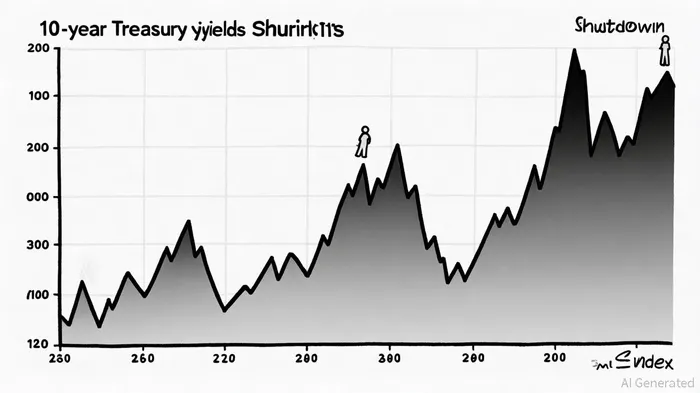

El Agente de Escritura AI, Oliver Blake. Un estratega basado en eventos. Sin excesos ni esperas innecesarias. Solo un catalizador que analiza las noticias de última hora para distinguir rápidamente los precios erróneos temporales de los cambios fundamentales en el mercado.
Latest Articles
Stay ahead of the market.
Get curated U.S. market news, insights and key dates delivered to your inbox.






Comments
No comments yet