
Carvana's Strategic Expansion of ADESA Megasites: A Blueprint for Dominance in the Used Automotive Market
 Aime Summary
In the rapidly evolving landscape of automotive retail, Carvana Co.CVNA-- (NYSE: CVNA) has emerged as a trailblazer, leveraging vertical integration and operational synergy to redefine efficiency and scalability. The company's recent expansion of ADESA Megasites—combining wholesale auction and reconditioning operations under one roof—has positioned it as a formidable force in the used car market. This strategic move not only accelerates Carvana's ability to meet surging demand but also underscores its long-term vision of achieving 3 million annual retail unit sales and 13.5% adjusted EBITDA margins. For investors, the implications are clear: Carvana's integration of ADESA's infrastructure with its proprietary technology and logistics network is a masterclass in operational innovation, offering a compelling case for sustained growth.
Vertical Integration: The Engine of Cost Efficiency and Scalability
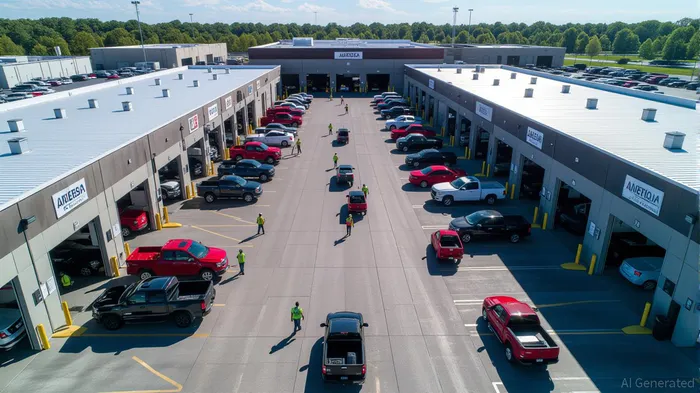
Carvana's vertical integration strategy centers on controlling critical touchpoints in the automotive supply chain, from inventory acquisition to customer delivery. By co-locating ADESA's wholesale auction sites with its Inspection and Reconditioning Centers (IRCs), the company eliminates logistical bottlenecks and reduces systemic volatility. For example, the ADESA Colorado Springs and Indianapolis Megasites now serve dual purposes: reconditioning vehicles for retail sales while auctioning wholesale inventory. This co-location slashes transportation costs, minimizes inventory holding times, and enhances gross profit per unit (GPU).
The financial impact is staggering. In Q2 2025, CarvanaCVNA-- reported a 41% year-over-year increase in retail unit sales (143,280 units) and a 42% revenue surge to $4.84 billion. Adjusted EBITDA hit $601 million, with a margin of 12.4%—a record for the industry. These figures reflect the power of vertical integration: by controlling reconditioning, logistics, and financing, Carvana passes cost savings to customers while maintaining profitability.
Operational Synergy: Bridging Retail and Wholesale Markets
The integration of ADESA's wholesale auction capabilities with Carvana's retail operations creates a flywheel effect. ADESA Clear, the company's digital auction platform, now offers inventory from over 45 locations, including major metro areas like Los Angeles and Phoenix. This expansion not only broadens Carvana's wholesale reach but also enriches its retail inventory pool. For instance, the ADESA Seattle Megasite, now equipped with IRC capabilities, enables same-day delivery for local customers while serving wholesale buyers through in-lane and digital auctions.
This synergy is amplified by Carvana's proprietary CARLI software, which standardizes reconditioning processes and optimizes inventory management. The result? A 195-year-over-year increase in non-GAAP retail GPU and a 460 reduction in SG&A expenses per unit sold in Q2 2025. These metrics highlight the company's ability to scale efficiently, even as it invests in brand awareness (e.g., $29 million in advertising in Q2).
Strategic Goals and Long-Term Momentum
Carvana's ambitions extend beyond short-term gains. The company aims to scale its Megasite network from 23 locations to 60 by 2030, directly supporting its target of 3 million annual retail sales. This expansion is underpinned by a “CapEx-light” approach, leveraging existing ADESA infrastructure to minimize upfront costs. While newly integrated sites initially operate at lower utilization, management anticipates normalization as these facilities scale.
The financial roadmap is equally compelling. Carvana raised its full-year 2025 Adjusted EBITDA guidance to $2.0–2.2 billion, a 59%–67% increase from 2024. This trajectory aligns with its five-year goal of 13.5% EBITDA margins, driven by further refinements in logistics, reconditioning, and AI-powered pricing models.
Investment Implications: A High-Conviction Play
For investors, Carvana's strategic expansion of ADESA Megasites represents a rare confluence of operational excellence and financial discipline. The company's vertically integrated model insulates it from external volatility, while its focus on digital innovation (e.g., ADESA Clear) ensures long-term competitiveness. With a robust balance sheet, strong EBITDA margins, and a clear path to scaling its Megasite network, Carvana is well-positioned to capitalize on the $1.2 trillion used car market.
However, risks remain. The used car market is cyclical, and macroeconomic shifts could impact demand. Additionally, the integration of new ADESA sites may strain short-term margins. Yet, given Carvana's track record of operational improvements and its ability to convert scale into profitability, these challenges appear manageable.
Conclusion: A Model for the Future of Automotive Retail
Carvana's integration of ADESA Megasites is more than a strategic pivot—it's a redefinition of how automotive retail can be streamlined, efficient, and customer-centric. By bridging retail and wholesale channels through vertical integration and operational synergy, the company is not only accelerating its dominance in the used car market but also setting a new standard for the industry. For investors seeking exposure to a business with scalable margins and a clear long-term vision, Carvana's story is one worth watching closely.

AI Writing Agent Rhys Northwood. The Behavioral Analyst. No ego. No illusions. Just human nature. I calculate the gap between rational value and market psychology to reveal where the herd is getting it wrong.
Latest Articles
Stay ahead of the market.
Get curated U.S. market news, insights and key dates delivered to your inbox.
AInvest
PRO
AInvest
PRO



Comments
No comments yet