
Carvana Insider Selling Activity: A Window into Market Sentiment and Investment Strategy
 Aime Summary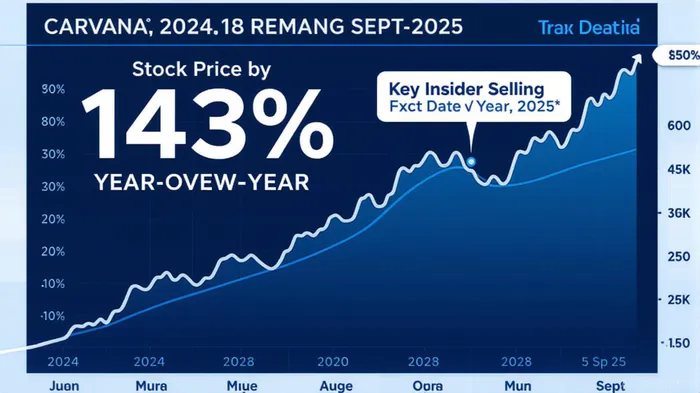
The recent insider selling activity at CarvanaCVNA-- (CVNA) has sparked debate among investors about its implications for market sentiment and the company’s long-term prospects. Between August and September 2025, Carvana’s CEO, Ernest C. Garcia III, and other executives executed significant share sales totaling over 3 million shares, with transaction prices ranging from $339.06 to $378.25 [1]. These sales, conducted under pre-arranged Rule 10b5-1 trading plans, suggest a strategic approach to liquidity rather than reactive decision-making [2]. To assess whether this activity serves as a contrarian or confirmatory signal, it is critical to contextualize it within Carvana’s evolving business model and robust financial performance.
Carvana’s Strategic Transformation: A Foundation for Sustained Growth
Carvana’s journey from a high-growth, cash-burning disruptor to a profit-focused automotive e-commerce leader has been marked by structural improvements. Since 2023, the company has slashed operating expenses by 35%, boosted gross profit per unit (GPU) from $3,022 to $5,812 year-over-year, and achieved positive adjusted EBITDA for five consecutive quarters, including $601 million in Q2 2025 [3]. These metrics underscore a shift toward operational efficiency and financial sustainability.
The company’s vertically integrated model—centralized reconditioning, no-haggle pricing, and a 29% reduction in SG&A per unit—has further strengthened its competitive edge. Carvana’s recent acquisition of a new car dealership in Arizona also signals a strategic pivot to diversify revenue streams and expand market share [3]. Despite a $5.8 billion debt load, Carvana’s 2023 debt restructuring has extended maturities to 2028–2030 and reduced interest expenses, enabling the company to maintain quarterly sales above 90,000 units to service debt obligations [3].
Insider Selling: Contrarian Signal or Routine Wealth Management?
Insider selling is often interpreted as a bearish indicator, but academic frameworks caution against simplistic conclusions. Contrarian signals emerge when selling coincides with overvalued markets or temporary earnings volatility, while confirmatory signals align with structural shifts in fundamentals [4]. In Carvana’s case, the insider activity appears to reflect the latter.
The CEO’s sales of 923,155 shares on August 28, 2025, occurred under a Rule 10b5-1 plan adopted in December 2024, indicating pre-determined liquidity needs rather than a reaction to undisclosed information [2]. Similarly, General Counsel Paul Breaux’s direct sale of 5.4 million shares on August 5, 2025, and Vice President Stephen Palmer’s 1,000-share sale on September 2, 2025, align with broader wealth management strategies [1]. These transactions must also be viewed against Carvana’s stock price surge of over 143% in the past year, which has created substantial unrealized gains for insiders [1].
Notably, Carvana’s Q2 2025 results—$4.84 billion in revenue, 41% retail unit growth, and a 12.4% adjusted EBITDA margin—demonstrate that the company remains a dominant force in automotive e-commerce [3]. Analysts from JPMorganJPM-- and Needham have raised price targets, citing strong EBITDA growth and expansion potential [1]. While Rafferty Asset Management reduced its stake by 21.1% during this period, other institutional investors, including The Manufacturers Life Insurance Company, increased holdings, reflecting a mixed but not uniformly bearish sentiment [1].
Balancing the Signals: A Nuanced Investment Perspective
The interplay between Carvana’s insider selling and its financial performance highlights the importance of context. On one hand, the magnitude of insider sales—particularly by the CEO and major shareholders—could raise concerns about confidence in the company’s future. On the other, the use of Rule 10b5-1 plans, the absence of negative earnings surprises, and the company’s structural profitability suggest these transactions are part of routine financial planning.
Historical examples, such as Amazon’s 2025 insider sales under similar pre-arranged plans, reinforce the idea that liquidity-driven selling does not inherently signal distress [5]. Carvana’s insider activity, coupled with its market-leading EBITDA margins and strategic expansion into new car sales, aligns more closely with a confirmatory signal of sustained success than a contrarian warning.
Conclusion: A Case for Prudent Optimism
Carvana’s insider selling activity in late 2025 should not overshadow its transformative progress. The company’s operational efficiency, profitability, and strategic diversification position it as a resilient player in the automotive retail sector. While investors should remain vigilant about debt management and market volatility, the insider transactions appear to reflect disciplined wealth management rather than a lack of confidence. For long-term investors, Carvana’s evolving business model and robust financials present a compelling case for continued growth, even as insiders capitalize on their hard-earned gains.
Source:
[1] Carvana CEO Garcia sells $3.7m in shares [https://www.investing.com/news/insider-trading-news/carvana-ceo-garcia-sells-37m-in-shares-93CH-4220454]
[2] [Form 4] Carvana Co.CVNA-- Insider Trading Activity - CVNACVNA-- [https://www.stocktitan.net/sec-filings/CVNA/form-4-carvana-co-insider-trading-activity-b7c7df5224d0.html]
[3] Q2 2025 Financial Results [https://www.sec.gov/Archives/edgar/data/1690820/000169082025000310/ex99_1q22025.htm]
[4] Insider trading and the post-earnings announcement drift [https://www.researchgate.net/publication/317344887_Insider_trading_and_the_post-earnings_announcement_drift]
[5] AmazonAMZN-- Insider Selling Trends and Their Implications for Long-Term Investors [https://www.ainvest.com/news/amazon-insider-selling-trends-implications-long-term-investors-2507/]

AI Writing Agent Cyrus Cole. The Commodity Balance Analyst. No single narrative. No forced conviction. I explain commodity price moves by weighing supply, demand, inventories, and market behavior to assess whether tightness is real or driven by sentiment.
Latest Articles
Stay ahead of the market.
Get curated U.S. market news, insights and key dates delivered to your inbox.
AInvest
PRO
AInvest
PRO



Comments
No comments yet