
Carvana (CVNA) Falls 5.16% as Bearish Technical Indicators Signal Pressure Below Key $390.87 Support
 Aime Summary
Carvana (CVNA) has experienced a significant downtrend, with a 5.16% drop in the most recent session, marking five consecutive days of declines and a 9.36% loss over the period. The price action reflects bearish dominance, characterized by long lower shadows and short upper shadows in recent candlesticks, indicating rejection at higher levels. Key support zones are forming around $390.87 (a prior low) and $375.26, while resistance appears near $421.85 to $429.98, where prior attempts to break through have failed.
Candlestick Theory
The bearish momentum is reinforced by multiple instances of dark cloud cover and bearish engulfing patterns during the decline. A critical confluence point exists at $390.87, where a prior low aligns with Fibonacci 38.2% retracement from the recent high of $474.89 to the low of $315.00. This level may act as a short-term floor, but a breakdown below $375.26 (Fibonacci 50% level) could accelerate the decline toward $357.33 (61.8% level).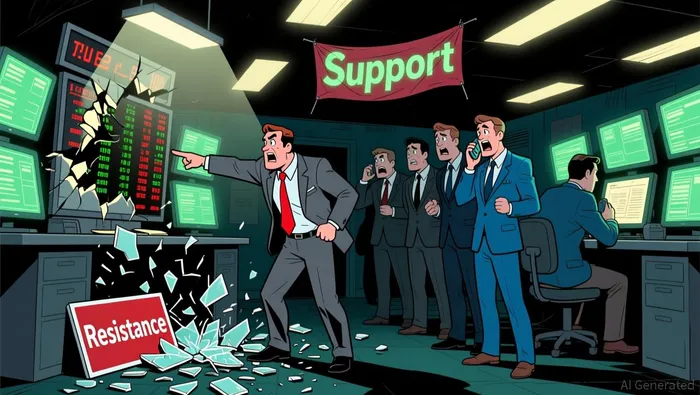
Moving Average Theory
The 50-day moving average (approximately $360–$370) is well below the 200-day MA (around $340–$350), confirming a bearish trend. The price remains below both, with the 100-day MA (~$355) acting as a dynamic resistance. The 200-day MA may serve as a critical support if the stock stabilizes, but the current trajectory suggests a continuation below $340.
MACD & KDJ Indicators
The MACD histogram has been contracting, reflecting weakening momentum, while the KDJ stochastic oscillator indicates oversold conditions (K: ~25, D: ~30). However, bearish divergence is evident: the K line is forming lower highs despite the price making lower lows, suggesting further downward pressure. A reversal in the MACD line crossing above the signal line could signal a short-term bounce, but this remains unlikely without a volume surge.
Bollinger Bands
Bollinger Bands are currently constricted, indicating low volatility. The price is near the lower band ($390.87), which may trigger a bounce or a breakdown. If the bands expand, a test of the upper band ($422.02) would require a reversal above $400.25, a level that has previously failed to hold.
Volume-Price Relationship
Volume has increased during the recent declines, validating the bearish trend. However, if volume begins to wane while the price continues to fall, it may signal exhausted sellers and a potential near-term bottom. Conversely, a surge in volume above $400.25 could confirm a short-covering rally.
RSI
The RSI is in oversold territory (~28), but the reading is misleading due to the extended downtrend. A divergence exists between RSI and price action: RSI is forming higher lows while the price makes lower lows, suggesting a potential reversal. However, RSI alone is insufficient to confirm a bottom without accompanying volume confirmation.
Fibonacci Retracement
Key Fibonacci levels from the $474.89 high to $315.00 low are critical. The 38.2% ($390.87) and 50% ($375.26) levels are immediate focal points. A rebound above $400.25 may target the 61.8% level ($357.33), but a breakdown below $375.26 could extend the decline toward $343.00 (78.6% level).
The technical landscape for CVNACVNA-- is dominated by bearish signals, with confluence between Fibonacci support, moving averages, and candlestick patterns reinforcing the downtrend. However, divergences in RSI and KDJ suggest a potential short-term bounce from $390.87. Traders should monitor volume behavior and whether the price can close above $400.25 to validate a reversal. A breakdown below $375.26 would likely trigger further declines toward $357.33, while a sustained close above $422.02 could reinvigorate bullish sentiment. The key risks include a continuation of the downtrend if volume remains strong and the absence of a clear catalyst for reversal.

If I have seen further, it is by standing on the shoulders of giants.
Latest Articles
Stay ahead of the market.
Get curated U.S. market news, insights and key dates delivered to your inbox.
AInvest
PRO
AInvest
PRO



Comments
No comments yet