
Carvana's Crossroads: Can Its Digital Disruption Outpace Execution Risks?
The used-car marketplace has long been a bastion of brick-and-mortar dealerships, but CarvanaCVNA-- (NYSE: CVNA) sought to upend the status quo with its bold, digital-first model. Yet today, the company stands at a pivotal juncture. Recent analyst downgrades, operational headwinds, and rising competition have cast doubt on its ability to sustain its premium valuation. Is Carvana's stock a contrarian buy at these levels, or does its rapid growth mask vulnerabilities that could unravel its narrative? The answer lies in dissecting its revised price targets, valuation multiples, and execution risks.
The Catalyst: Downgrades and a Fractured Consensus
In late June 2025, Wall Street Zen downgraded Carvana to “Hold” from “Buy,” citing concerns over its valuation and execution risks—a stark contrast to earlier optimism. This followed a Q2 earnings report that, while profitable, failed to meet the sky-high expectations set by its own rapid growth. Analysts now project a 3.5% downside from current prices, with the average price target falling to $326.43 (vs. a recent close of $338.26).
The downgrade was amplified by the “jogging neighbor” ad controversy, which backfired spectacularly. The campaign, meant to highlight Carvana's home-delivery model, instead drew criticism for trivializing the risks of distracted driving. This misstep not only hurt brand reputation but also raised questions about the company's judgment in leveraging its marketing budget—a critical cost center in a capital-intensive business.
Valuation in Context: Overhyped or Overvalued?
Carvana's premium valuation hinges on its ability to scale to 3 million annual sales, requiring production of 180 units/week by 2030. Yet its metrics lag far behind peers like Group 1 AutomotiveGPI-- (GPI) and Lithia MotorsLAD-- (LAD). As of mid-2025:
- P/E Ratio: Carvana's 118.88 vs. 12.9 for Group 1 and 36.8 for LithiaLAD--.
- P/S Ratio: Carvana's 0.74 vs. 0.24 for Lithia and 0.28 for Group 1.
These multiples highlight a stark disconnect. While Carvana's used-car e-commerce platform is undeniably innovative, its $72.5 billion market cap assumes flawless execution in a market where competitors are adapting swiftly. Traditional dealers like GPI and LADLAD--, with stronger balance sheets and lower leverage, now pose a credible threat.
The Execution Gauntlet
Carvana's path to dominance is fraught with risks:
- Debt Overhang: With a debt-to-equity ratio of 2.97, the company relies on cheap capital to fuel growth—a precarious position in a rising-rate environment.
- Insider Skepticism: Executives sold $403.67 million in shares in the last quarter, signaling potential overvaluation.
- Operational Scalability: Achieving 3 million sales would require a 50% annual growth rate for a decade—a feat few companies pull off without margin erosion.
The Q2 earnings miss underscored these challenges. While revenue rose 38% year-over-year to $4.23 billion, margins compressed as marketing costs surged. Competitors are now replicating Carvana's online tools, eroding its moat.
The Contrarian Case—and Why It's Risky
Bulls argue that Carvana's 360-degree imaging and home delivery remain unmatched, and its 19% CAGR through 2032 (per BofA) justifies optimism. At a 3.6 beta, the stock could thrive in a risk-on environment.
But the risks are existential:
- Valuation Squeeze: A 10% drop in growth assumptions could collapse the P/E multiple.
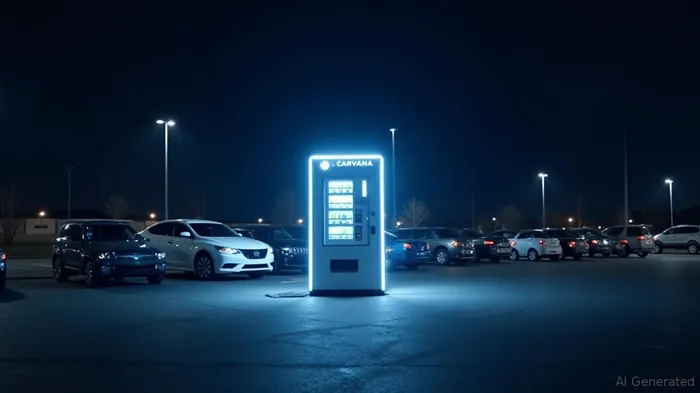
- Regulatory Risks: State-level pushback on its “vending machines” could limit expansion.
Investment Implications
For now, the $326.43 consensus price target suggests near-term downside, particularly if Q3 earnings disappoint. The $400 high target (RBC Capital) feels overly optimistic unless margins stabilize and debt declines.
Takeaway: Carvana is a “story stock” trading on peak expectations. Investors seeking contrarian opportunities should wait for a pullback to $275–$300, where its P/E aligns closer to peers. For most, the risks—overvaluation, execution hurdles, and rising competition—outweigh the rewards.
In the used-car wars, Carvana's digital edge is undeniable. But without margin discipline, debt reduction, and sustained top-line acceleration, its valuation may remain a mirage.
Final Call: Hold for now. Reassess at $275 or below.

Stay ahead of the market.
Get curated U.S. market news, insights and key dates delivered to your inbox.




Comments
No comments yet