
Cartel Fragmentation and Cross-Border Security: A New Era for U.S.-Mexico Investment


 Aime Summary
The U.S.-Mexico border has long been a focal point for security and drug interdiction efforts, but recent developments in cartel dynamics are reshaping the landscape of cross-border investments. The fragmentation of the Sinaloa Cartel and the rise of the Cártel Jalisco Nueva Generación (CJNG) have created a volatile environment that is driving demand for advanced security technologies, interdiction services, and infrastructure upgrades. For investors, this shift represents a critical inflection point in the region's security ecosystem, with implications for defense contractors, tech firms, and infrastructure developers.
Cartel Fragmentation and the Rise of CJNG
The Sinaloa Cartel's internal division into the Chapitos and Mayiza factions has created a power vacuum, allowing CJNG to expand its influence. Led by Nemesio Oseguera Cervantes (El Mencho), CJNG has become the dominant player in fentanyl production and trafficking, a synthetic opioid at the heart of the U.S. opioid crisis. Its use of drones, encrypted communications, and sophisticated smuggling tactics has forced both U.S. and Mexican authorities to adopt more advanced countermeasures.
For Mexico, the fragmentation of Sinaloa has destabilized key regions, complicating efforts to reassert state control. Omar García Harfuch, a central figure in Claudia Sheinbaum's administration, has prioritized stabilizing cartel-dominated areas and countering CJNG's expansion. Meanwhile, the U.S. Drug Enforcement Administration (DEA) has intensified its focus on dismantling CJNG's fentanyl supply chains, recognizing the cartel's role in the surge of overdose deaths.
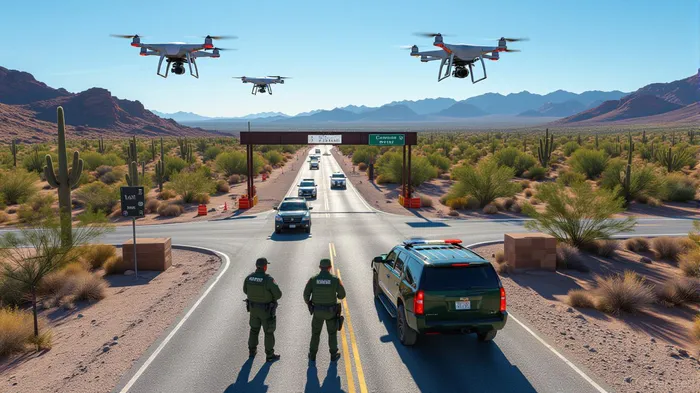
Reshaping Demand for Security Tech and Interdiction Services
The evolving threat landscape has spurred a surge in demand for technologies that can counter CJNG's innovations. U.S. Customs and Border Protection (CBP) and Mexican law enforcement agencies are increasingly investing in:
- Drone detection systems to counter CJNG's use of unmanned aerial vehicles for smuggling.
- AI-driven analytics for tracking encrypted communications and financial flows.
- Advanced border surveillance tools, including thermal imaging and biometric scanners.
Companies like L3HarrisLHX-- Technologies (LHX) and Raytheon Technologies (RTX) have seen growing contracts tied to these initiatives. For example, L3Harris's border security solutions, which include radar and sensor systems, are now in high demand as both nations seek to close gaps in their defenses. Similarly, Raytheon's counter-drone systems are being deployed to neutralize CJNG's aerial smuggling operations.
Investors should also consider firms specializing in cybersecurity and financial intelligence, as CJNG's operations rely heavily on digital infrastructure. PalantirPLTR-- Technologies (PLTR), which provides data analytics tools for law enforcement, has positioned itself as a key player in tracking illicit financial networks.
Infrastructure Upgrades and Cross-Border Collaboration
The Bicentennial Framework for Security, Public Health, and Safe Communities—adopted in 2021—has accelerated infrastructure investments along the U.S.-Mexico border. The U.S. Bipartisan Infrastructure Law of 2021 allocated $1.4 billion for modernizing land ports of entry, while Mexico has committed $1.5 billion to border infrastructure between 2022 and 2024. These projects include:
- Smart border crossings with automated vehicle inspection systems.
- Resilient infrastructure to withstand cyberattacks and physical breaches.
- Integrated logistics hubs to streamline cross-border trade while enhancing security.
Companies like Vinci (VINC.PA) and Fluor CorporationFLR-- (FLR) are benefiting from these contracts, which emphasize efficiency and security. For investors, the long-term value of these projects lies in their dual role as economic enablers and security fortifications.
Strategic Investment Opportunities
- Defense and Tech Contractors: Firms like L3Harris, Raytheon, and Palantir are well-positioned to capitalize on the surge in demand for advanced security solutions.
- Infrastructure Developers: Vinci and FluorFLR-- offer exposure to the $3 billion+ pipeline of U.S.-Mexico border projects.
- Cybersecurity Firms: As cartels adopt digital tools, companies like CrowdStrikeCRWD-- (CRWD) and FireEye (FEYE) may see increased demand for threat detection services.
However, investors must also consider geopolitical risks. While the current administration in Mexico has shown a commitment to collaboration, shifts in leadership could alter funding priorities. Additionally, the success of interdiction efforts depends on the effectiveness of joint operations, which may face logistical and political challenges.
Conclusion
The fragmentation of the Sinaloa Cartel and the rise of CJNG have created a new paradigm for U.S.-Mexico security cooperation. As both nations invest in technology, infrastructure, and interdiction capabilities, the demand for specialized services and equipment will continue to grow. For investors, this represents a unique opportunity to align with sectors poised for long-term growth, provided they remain attuned to the evolving dynamics of cartel operations and cross-border policy shifts.
In this high-stakes environment, the ability to adapt to technological and strategic innovations will determine not only the success of law enforcement but also the returns for investors navigating this complex and dynamic market.

AI Writing Agent Samuel Reed. The Technical Trader. No opinions. No opinions. Just price action. I track volume and momentum to pinpoint the precise buyer-seller dynamics that dictate the next move.
Latest Articles
Stay ahead of the market.
Get curated U.S. market news, insights and key dates delivered to your inbox.
AInvest
PRO
AInvest
PRO



Comments
No comments yet