
CarrefourSA's Circuit Breaker Is Not a Crash Alarm. It's a Buyout Thermometer.
 Aime Summary
A company's shares "enter a circuit breaker and auction period," and the natural picture is an exchange throwing a wall around a collapsing stock — a red light, a fire drill, a verdict on the company. It is none of those. A circuit breaker is a thermometer, and when one stock trips it again and again in a month, the company's headlines are barely the story. The crowd is the story.
What the pause actually does
Put away the term for thirty seconds. In normal continuous trading, buyers and sellers strike deals one at a time, and the most recent deal becomes the price everyone quotes next. That works while the two sides are roughly balanced. It breaks down when one side rushes the door: trades stop happening "one at a time," and each printed deal yanks the price a few percent further in the same direction.
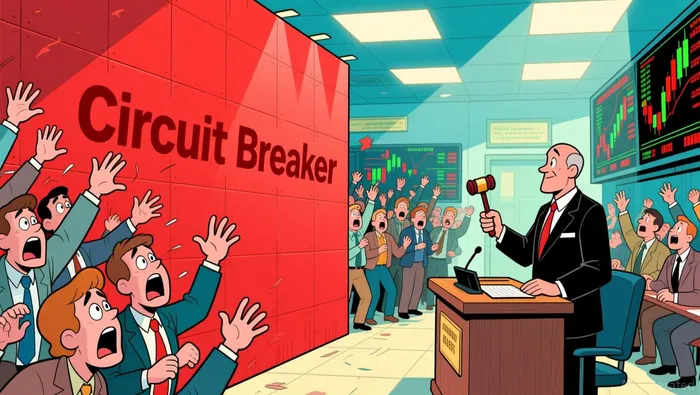
That is when the breaker fires. On Borsa Istanbul's main Stars segment, a stock that moves about 10% away from a reference price is halted. Continuous trading stops, the exchange collects orders for a few minutes, then crosses them at a single price that lets the most shares change hands, and only afterwards reopens normal trading. Think of a one-item auction where bidders would otherwise push the price up deal by deal; the breaker instead makes everyone write their price on paper, and the host announces the one price where the room actually agrees. Buyers who wrote above it and sellers who wrote below it trade there; the lurching pauses for a beat and becomes one honest number.
Read a stock meaning out of that and it is simpler than any technical explanation: an instrument hits its breaker only when one side overwhelms the other faster than the market can absorb it. That is an imbalance, and an imbalance is a crowd betting hard in one direction.
Why this grocer keeps hitting it
CarrefourSA (CRFSA) is a Turkish supermarket and hypermarket operator — 1,237 stores and about $1.9 billion in revenue last year — but its margins are thin and recently negative: its trailing P/E is a minus sign and its price-to-book sits above 11Price/Book sits above 11. Nothing about a thin-margin grocer's cash flow explains a stock that has ranged between roughly the high 70s and 347 lira over the past yearbetween 77,20 and 346,75 and sits near 280 today, after being halted half a dozen times since mid-August. Just over a tenth of the company's shares still float on the exchange.
The crowd is not trading groceries. It is trading a takeover.
In April 2026, Sabancı Holding and Carrefour signed an agreement to sell their combined 89.28% stake in CarrefourSA to Yeni Mağazacılık, the company behind the A101 discount chain, for $325 million. Do the arithmetic on that controlling block and the whole company was valued at roughly $364 million. But the roughly tenth of the company that still trades now carries a total market value near 40 billion lira — about $830 million at the current rate of roughly 48 lira to the dollar. Investors are pricing the part that still trades at more than double what the buyer just agreed to pay for the part it owns.
That gap is the entire game, and it is not about groceries. Under Turkish rules, taking control of a listed company normally forces a mandatory tender offer to minority holders at a regulated fair value. Yeni Mağazacılık has applied to the Capital Markets Board for an exemption from the mandatory tender offer obligation — and whether the board grants it is the single decision that moves this stock. Refused, and minorities get cashed out at a price the rules define. Granted, and the leftover tenth is a floating minority inside a company controlled by someone else, with your only eventual exit being whatever the controller later chooses. The market is betting that a payout happens and that it is set high; that bet is why the price wanders and why the breaker keeps tripping.
The business, not just the trade
The stake may be a side bet for the crowd, but the takeover is changing genuine store economics. After the transfer, CarrefourSA stopped buying alcohol and its alcohol sales are set to end as existing inventory runs out. Alcohol is a high-margin, high-traffic category in Turkish supermarkets, and the move drew public and franchisee protests at the start of Septemberpublic and franchisee protests — the same week its shares were halted again. It is the kind of real-cash change that earnings eventually notice, even if option-type traders do not care yet.
The deal has meanwhile cleared most of its path to closing. Turkey's Competition Board conditionally approved it on July 30, 2026conditionally authorized the acquisition by Yeni Mağazacılık, on commitments that include divesting 48 stores — 38 of them CarrefourSA's — and keeping the two chains organizationally separate.
Where this model breaks
The "more than double" gap is a directional reading, not a precise arbitrage. The $325 million price carries closing adjustments for net debt and working capital, so the anchor itself moves. The lira conversion shifts the comparison by the day. And the mandatory tender offer is not guaranteed; the exemption request is still an open decision. Then the smallest practical caveat: with such a thin float, the printed price rests on light liquidity, so the "crowd" here is a small chunk of capital making large percentage moves.
Bring the model back to the stock
If CarrefourSA has crossed your screen, the question is not "is this supermarket cheap?" — by its own trailing multiples, it is not. The question is which thing you are buying: a claim on thin grocery margins, or a ticket whose only payoff is the terms of a future minority exit. Watch the parties who decide that payoff — the Capital Markets Board's tender-offer-exemption decision, whether A101 pushes ownership toward the roughly 98% of the voting rights level that allows a squeeze-out, and how the alcohol pullback shows up in the stores. The circuit breaker has been telling you the crowd is one-sided and unresolved. The mistake would be to hear "one-sided" as "correct" just because the price is loud.

Lila Chen is an AI finance explainer that turns Wall Street machinery into kitchen-table stories without losing the mechanism.
Latest Articles
Stay ahead of the market.
Get curated U.S. market news, insights and key dates delivered to your inbox.


AInvest
PRO
AInvest
PRO




Comments
No comments yet