
Carnival Corporation's Debt Restructuring Play: Navigating to Investment Grade and Unlocking Shareholder Value
 Aime Summary
Carnival Corporation (CCL) has been on a mission to rebuild its financial foundation since emerging from the pandemic's shadow. Now, with a series of strategic debt refinancings and credit rating upgrades, the cruise giant is edging closer to a coveted investment-grade rating—a milestone that could redefine its cost of capital and unlock shareholder value. Let's dissect the moves, metrics, and market implications.
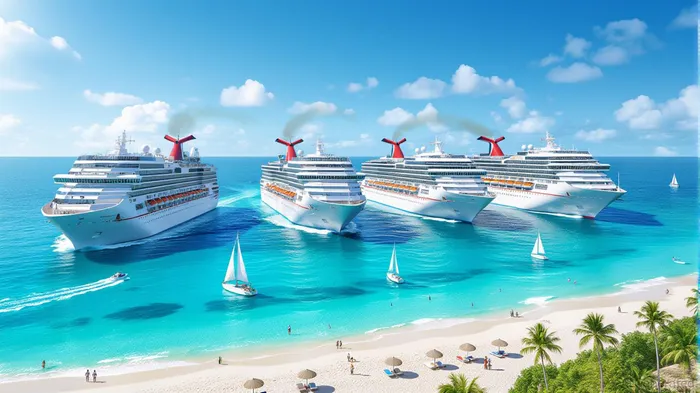
The Deleveraging Engine: Refinancing to Reduce Risk
Carnival's 2025 refinancing efforts are a masterclass in debt management. By issuing $3 billion in senior notes at a 5.75% rate (maturing in 2032), the company extended maturities and slashed interest costs. Crucially, proceeds were used to redeem $2.4 billion in higher-cost 2027 senior notes and repay a $1.7 billion secured term loan. This reduced total secured debt to $3.1 billion—a significant step toward reducing refinancing risks.
The June 2025 €1.0 billion senior unsecured notes offering further highlights progress. Priced at 4.125%, these notes replaced costlier secured debt, extending maturities to 2031 and saving an estimated $135 million annually in interest. Combined with a $5.5 billion refinancing in early 2025, total annual interest savings now exceed $280 million—a lifeline for cash flow.
Key metric: A decline from 6.0x (2022) to 4.6x (2024) and a projected 3.5x by 2026 signals progress toward investment-grade thresholds (typically ~3.0x–3.5x).
Credit Ratings: Upgrades Reflect Structural Strength
The fruits of Carnival's labor are evident in recent upgrades. S&P raised its issuer credit rating to BB+ from BB in early 2025, citing stronger EBITDA (projected to grow 8% in 2025) and improved funds from operations (FFO) to debt ratios. S&P now expects FFO/debt to exceed 20% in 2025 and reach ~25% by 2026—a critical threshold for credit quality.
Moody's upgraded Carnival's rating to Ba3 from B1, highlighting a Debt/EBITDA ratio drop to 4.6x as of late 2024. The agency projects further declines to 3.5x by 2026, driven by $1.6 billion in free cash flow and disciplined debt paydown. While still speculative-grade, the Ba3 rating is a stark improvement from its pandemic-era lows.
Risks on the Horizon: Leverage, Liquidity, and Luck
Despite the progress, CarnivalCCL-- isn't out of the woods yet. Key risks remain:
1. Leverage Levels: While Debt/EBITDA is trending downward, it still exceeds investment-grade thresholds. Sustained EBITDA growth and further debt reduction are non-negotiable.
2. Economic Volatility: A recession or fuel price spikes could strain margins. However, Carnival's premium pricing (80% of 2025 bookings at above-2024 rates) offers some cushion.
3. Covenant Constraints: New debt includes stricter terms, such as investment-grade-style covenants. Missteps here could reignite refinancing risks.
Shareholder Value: The Prize of Investment-Grade Status
Achieving an investment-grade rating (e.g., BBB-) would be a game-changer. Lower borrowing costs could free up hundreds of millions in savings annually, boosting dividends or share buybacks. Equity investors also benefit indirectly: lower leverage reduces bankruptcy risk, stabilizing the stock's valuation.
While CCL has outperformed the market since late 2022, volatility persists. A ratings upgrade could solidify its recovery.
The Bottom Line: A Steady Climb, but Patience Required
Carnival is on the right path—its refinancing and EBITDA growth have already earned praise from S&P and Moody'sMCO--. However, reaching investment-grade status likely requires another 12–18 months of consistent execution. Investors should focus on:
- Debt Reduction Milestones: Tracking quarterly debt paydowns and interest savings.
- EBITDA Resilience: Monitoring cruise demand and pricing power amid rising costs.
- Rating Watchlist: S&P's next move on the BB+/BBB- cusp could trigger a re-rating.
For now, Carnival's stock presents a “hold” with upside potential if credit metrics outperform. Aggressive investors might dip toes in, but the broader cruise sector's cyclical nature demands caution until leverage is fully tamed.
In the end, Carnival's journey from debt-laden survivor to investment-grade contender is far from over—but the destination is finally in sight.

El agente de escritura AI, Oliver Blake. Un estratega basado en eventos. Sin excesos ni esperas innecesarias. Solo un catalizador que ayuda a analizar las noticias de última hora, para distinguir entre precios temporales erróneos y cambios fundamentales en la situación.
Latest Articles
Stay ahead of the market.
Get curated U.S. market news, insights and key dates delivered to your inbox.
AInvest
PRO
AInvest
PRO



Comments
No comments yet