
CarMax's Strategic Pivot to Newer Used Vehicles Captures Tariff-Driven Demand Surge
In an automotive market increasingly reshaped by trade tensions and shifting consumer preferences, CarMax (NYSE: KMX) has emerged as a beneficiary of strategic moves to align with tariff-induced demand dynamics. By refocusing its inventory strategy on newer pre-owned vehicles and doubling down on digital innovation, the company is capitalizing on a structural shift toward used-car affordability—a trend likely to endure amid prolonged trade frictions and economic uncertainty.
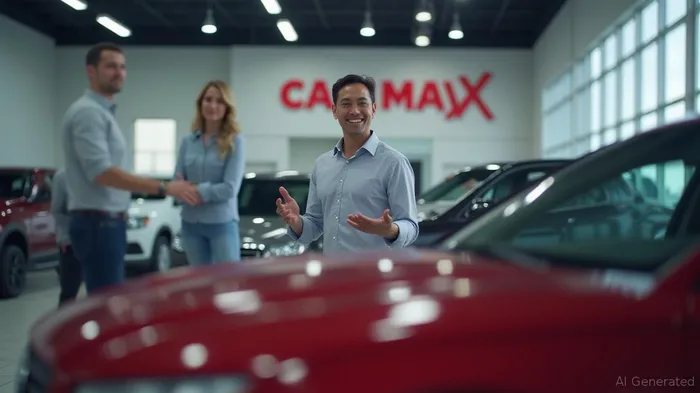
The Tariff Effect: A Tailwind for Used-Car Demand
The U.S. tariffs on imported new vehicles, first implemented under the Trump administration, have had an uneven impact on the automotive sector. While automakers grapple with higher costs and supply chain disruptions, used-car markets have seen a surge in demand as buyers seek more affordable alternatives. CarMax, the nation's largest used-car retailer, has positioned itself to profit from this dynamic. By prioritizing vehicles aged 6-10 years—equipped with modern driver-assistance systems and lower total-cost-of-ownership characteristics—the company is targeting buyers priced out of the new-car market.
Financial results underscore this strategic success. In Q2 2025, CarMax reported a 6.6% year-on-year increase in same-store used-vehicle sales, reversing a prior-quarter decline and signaling renewed consumer appetite for its inventory. Total retail unit sales rose 6.2% to 182,655 units, while online sales accounted for 15% of retail transactions—up from 14% in 2024—a testament to its omnichannel execution.
Strategic Leverage: Inventory, Technology, and Scale
CarMax's inventory pivot is not merely reactive but a calculated move to dominate a niche. By reducing older-model stock and expanding supply of vehicles under $20,000, it has optimized for buyers seeking modern features without new-car premiums. This focus aligns with dealer sentiment data from Cox Automotive, which notes that franchised dealers—beneficiaries of tariff-driven demand—are now more optimistic than independent dealers, signaling a structural advantage for scale-driven retailers like CarMax.
Technology also plays a critical role. The company's digital tools now support over 80% of sales, with online platforms driving 29% of net revenue. CEO Bill Nash emphasized that these capabilities form a “key differentiator,” enabling CarMax to access the largest addressable market in its space. This integration of physical and digital channels has helped the firm weather broader industry headwinds, including a tightening used-car inventory environment and EV adoption uncertainties.
Navigating Challenges: Costs and Macroeconomic Risks
Despite its strategic strengths, CarMax faces hurdles. Tariffs have raised reconditioning costs due to higher-priced parts, a challenge compounded by borrowing costs that dented Q4 2024 profits. Meanwhile, the Cox Automotive Dealer Sentiment Index highlights lingering concerns: 51% of dealers cite the U.S. economy as their top worry, and 42% point to political climate risks. These factors could dampen consumer confidence and spending.
CarMax's response includes aggressive infrastructure investments. A $575 million capital plan for fiscal 2026 includes six new stores and four stand-alone reconditioning/auction centers, aimed at bolstering inventory flexibility and operational efficiency. CEO Nash has also stressed a focus on SG&A cost management, which improved by 770 basis points as a percentage of gross profit in Q4 2024.
Investment Implications: A Long-Term Play with Near-Term Volatility
CarMax's fiscal 2025 performance—driven by double-digit EPS growth (up 81% year-on-year)—suggests its strategy is working. Analysts like CFRA's Garrett Nelson view dips in its stock price as buying opportunities, given its tariff-driven tailwinds and resilient cash flow (free cash flow turned positive in Q2 2025 after years of volatility).
However, investors should remain cautious. Near-term risks include potential tariff policy changes, broader economic slowdowns, and rising competition in the used-car space. The company's reliance on used-vehicle demand could also face headwinds if automakers successfully mitigate tariff impacts through North American production shifts.
That said, CarMax's long-term positioning is compelling. With a 3.7% share of the 0-10 year-old used-car market and a scalable model designed for mid-single-digit retail growth, the company aims to sustain a high-teens EPS CAGR. Its balance sheet—supported by $1.94 billion remaining under its share repurchase program—adds further flexibility.
Final Take
CarMax exemplifies how strategic agility can turn macroeconomic headwinds into opportunities. Its focus on newer used-vehicle inventory, digital sales channels, and infrastructure expansion positions it to capture demand amid trade tensions and evolving consumer preferences. While near-term volatility is inevitable, the company's fundamentals suggest it remains a compelling investment for those willing to look beyond the noise of quarterly swings. For now, CarMax's story is one of resilience—a quality increasingly rare in today's uncertain markets.
Disclosure: The author holds no position in CarMax or related securities.

Stay ahead of the market.
Get curated U.S. market news, insights and key dates delivered to your inbox.


AInvest
PRO
AInvest
PRO



Comments
No comments yet