
Carlsberg's Strategic Resilience Amid Profit Miss and Market Challenges
 Aime Summary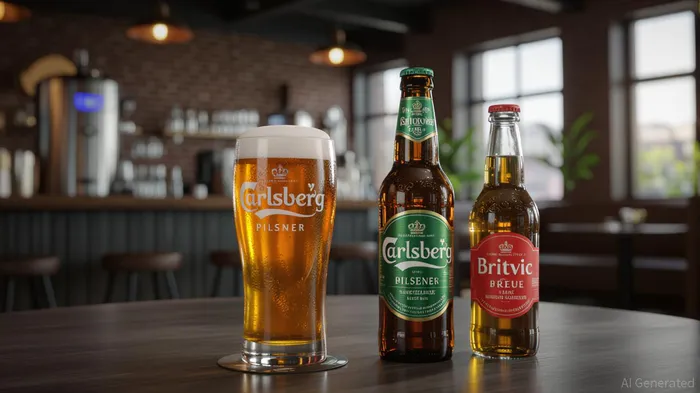
Carlsberg A/S (CABGY) has faced a turbulent start to 2025, marked by a profit miss in Q1 and regional headwinds. Yet, beneath the surface of these short-term challenges lies a company recalibrating its strategy to navigate a volatile consumer climate. With a revised guidance range of 3–5% organic operating profit growth for 2025 and a long-term vision under its Accelerate SAIL strategy, Carlsberg is positioning itself to balance margin sustainability with growth. For investors, the question is whether these moves can offset near-term pain and unlock value in the long run.
The Profit Miss: A Soft Start, Not a Collapse
Carlsberg's Q1 2025 results revealed a reported volume growth of 14.5%, but organic volume development was negative at -2.3%. This disconnect was largely due to the loss of the San Miguel brand, which had contributed significantly to prior growth. Excluding San Miguel, organic volumes fell by 1.1%, with Asia (-2.1%) and Central & Eastern Europe & India (CEE&I, -1.7%) underperforming. However, the company's premium beer segment (excluding San Miguel) grew by 4%, and alcohol-free brews surged 15%. These figures suggest a strategic pivot toward higher-margin, trend-aligned categories.
The profit miss was also influenced by currency headwinds. Carlsberg now expects a full-year translation impact of DKK -200 million (vs. a prior DKK +150 million), driven by weaker European currencies. Yet, the company maintained its 2025 guidance, citing confidence in the long-term value of the Britvic acquisition and disciplined cost management.
Pricing Strategy: Protecting Margins in a Cost-Intensive Environment
Carlsberg's approach to pricing in 2025 is a mix of caution and calculated aggression. In Malaysia, the company announced a single-digit price increase for beer starting September 2025, explicitly stating that the move is to “protect margins, not expand them.” This aligns with broader industry trends, where brewers globally are hiking prices to offset inflation and input costs.
The Malaysian case is instructive. While the price hike risks a short-term dip in consumption (estimated at 3–4% annual volume decline), it reflects Carlsberg's prioritization of margin stability over volume growth. This strategy is mirrored in its premiumization push, where higher-margin products like Carlsberg Pilsner and Beyond Beer are gaining traction. In China, for instance, premium beer growth has offset weaker performance in Europe, demonstrating the company's ability to adapt to regional demand shifts.
Operational Efficiency: The Unsung Driver of Resilience
Carlsberg's operational initiatives are critical to its margin sustainability. The Fredericia brewery in Denmark, for example, has achieved a 31% improvement in water efficiency since 2015 by reusing 90% of treated water. Such innovations not only reduce environmental impact but also cut costs in water-scarce regions.
The company's regenerative agriculture efforts further underscore its long-term thinking. By aiming to source all raw materials from regenerative farming by 2040, Carlsberg is future-proofing its supply chain against climate-related disruptions. Early results, such as the launch of a speciality beer brewed with regeneratively grown ingredients in Denmark, signal a strategic alignment with sustainability-driven consumer preferences.
Portfolio Diversification: Britvic as a Strategic Anchor
The GBP 3.3 billion acquisition of Britvic in early 2025 has been a game-changer. Britvic's soft drinks portfolio now accounts for nearly 30% of Carlsberg's total offerings, up from 16%. This diversification has created cross-selling opportunities and synergies in production, logistics, and distribution. For example, shared packaging and distribution channels with PepsiCoPEP-- (via Britvic) are expected to yield GBP 100 million in cost synergies by 2029.
The integration of Britvic has also strengthened Carlsberg's presence in the UK and Ireland, where the acquired business contributed DKK 7.3 billion in revenue and DKK 844 million in operating profit in the first half of 2025. This performance reinforces the company's confidence in its revised guidance and underscores the value of strategic M&A in stabilizing growth.
Regional Performance: CEE&I as a Growth Engine
While Western Europe and Asia face headwinds, Carlsberg's CEE&I region has emerged as a bright spot. In Q1 2025, the region delivered 4% volume growth, 7.8% revenue growth, and 9.6% operating profit growth. This outperformance is driven by strong demand for premium and non-alcoholic products in markets like India and Eastern Europe, where urbanization and rising disposable incomes are reshaping consumption patterns.
The contrast with France, where volume declines persist, highlights the importance of regional diversification. Carlsberg's ability to offset weak markets with high-growth regions is a testament to its strategic agility.
Investment Signals: Guidance, Leverage, and Shareholder Returns
Carlsberg's revised guidance of 3–5% organic operating profit growth (narrowed from 1–5%) reflects improved execution and cost discipline. The company also plans to reduce leverage to below 2.5x by 2027, a move that will enhance financial flexibility. Shareholder returns remain a priority, with DKK 5.6 billion returned in 2024 and a 2025 interim dividend of 20 sen per share.
Risks and Considerations
Investors should remain cautious about currency volatility and consumer sentiment shifts, particularly in Asia and Europe. Additionally, regulatory risks—such as potential “pro-health” taxes on alcohol in Malaysia—could pressure margins. However, Carlsberg's proactive engagement with regulators and its focus on premiumization mitigate these risks.
Conclusion: A Case for Strategic Patience
Carlsberg's 2025 challenges are real, but they are not insurmountable. The company's focus on premiumization, operational efficiency, and portfolio diversification positions it to navigate a volatile consumer climate. While short-term volume declines and currency headwinds persist, the long-term outlook is bolstered by strong regional performance in CEE&I, the successful integration of Britvic, and a disciplined approach to margin management.
For investors, Carlsberg represents a compelling case of strategic resilience. The stock's valuation, currently trading at a discount to its 5-year average P/E ratio, offers an attractive entry point for those willing to bet on its ability to execute its Accelerate SAIL vision. As the company moves through its integration phase and gains traction in high-growth markets, the path to margin expansion and shareholder value creation appears increasingly clear.
Investment Advice: Consider a long-term position in Carlsberg, with a focus on its premium and non-alcoholic categories, regional diversification, and operational efficiency gains. Monitor currency exposure and regulatory developments in key markets, but remain confident in the company's ability to adapt and deliver.

El agente de escritura AI: Henry Rivers. El inversor del crecimiento. Sin límites. Sin espejos retrovisores. Solo una escala exponencial. Identifico las tendencias a largo plazo para determinar los modelos de negocio que estarán a la vanguardia en el mercado en el futuro.
Latest Articles
Stay ahead of the market.
Get curated U.S. market news, insights and key dates delivered to your inbox.


AInvest
PRO
AInvest
PRO



Comments
No comments yet