
Carlisle Companies (CSL): A High-Yield, Low-Cost Dividend Stock with Diversified Industrial Strength


 Aime Summary
In a low-growth investment environment, investors increasingly seek stocks that balance income generation with operational resilience. Carlisle CompaniesCSL-- (CSL) emerges as a compelling candidate, offering a 1.34% dividend yield[3] alongside a diversified industrial business model and disciplined cost structure. With 49 consecutive years of dividend increases[3], CSL's track record underscores its ability to sustain payouts even amid macroeconomic headwinds. This analysis explores how CSL's strategic operational framework and cash flow consistency position it as a high-yield, low-cost dividend stock.
Dividend Sustainability: A Foundation of Prudence
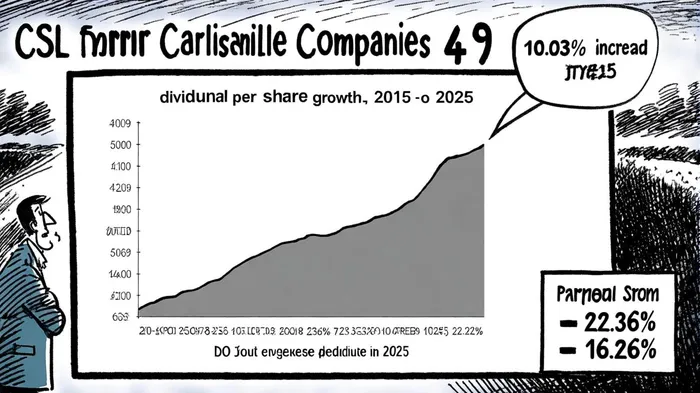
CSL's dividend yield of 1.34%[3] may appear modest compared to “mega-yield” stocks, but its sustainability is where the company shines. Over the past 12 months, CSLCSL-- distributed $4.10 per share in dividends, a 10.03% increase from the prior year[3]. This growth is underpinned by a trailing twelve-month (TTM) payout ratio of 22.36%[2], significantly lower than the S&P 500 industrials sector average of ~35%. Analysts project this ratio to decline further to 19.31% in 2025 and 16.26% in 2026[2], reflecting management's focus on balancing shareholder returns with reinvestment in operations.
Such a low payout ratio provides a buffer against earnings volatility. For instance, even if CSL's earnings per share (EPS) were to contract by 20%, the company could still maintain its current dividend level without needing to cut payouts. This prudence is critical in a low-growth environment, where companies with high payout ratios often face forced reductions during downturns.
Diversified Industrial Model: Mitigating Cyclical Risk
CSL's revenue is spread across three core segments: Construction Materials (37.02% of 2024 revenue[4]), Carlisle Weatherproofing Technologies (CWT, 12.98%[4]), and other industrial products. This diversification reduces exposure to any single market. For example, while residential construction softness in 2025 impacted CWT's performance[1], the Construction Materials segment offset some of these pressures with stable demand for insulation and roofing solutions.
Geographically, the U.S. accounts for 91% of total revenue[4], but CSL's international presence—$432.5 million from Europe and North America combined[4]—adds a layer of geographic diversification. This mix allows the company to capitalize on regional growth cycles while avoiding overconcentration in any one economy.
Operational Efficiency: The Engine of Cash Flow
CSL's low-cost structure is a cornerstone of its dividend sustainability. In Q2 2025, the company reported an operating margin of 16.8% and an adjusted EBITDA margin of 21.8%[1], outperforming peers in the industrials sector. These results stem from strategic automation projects, such as $3–$4 million quarterly EBITDA gains from CWT factory upgrades[1], and debt reduction initiatives that cut interest expenses by $3.8 million year-over-year[2].
The Carlisle Operating System (COS), a continuous improvement framework, further drives efficiency. Management aims to expand EBITDA margins by 50 basis points in 2025 through COS-driven cost reductions[4]. Such initiatives not only bolster profitability but also free up cash for dividends and buybacks. In H1 2025, CSL returned $700 million to shareholders via share repurchases[4], demonstrating confidence in its ability to generate consistent free cash flow.
Challenges and Mitigation Strategies
Despite its strengths, CSL faces headwinds. Organic revenue declined 3% in Q2 2025 due to lower volumes and higher unit costs[4], squeezing operating margins by 2.9 percentage points. However, management is addressing these challenges through strategic acquisitions, such as the $34 million-annual-synergy-generating acquisitions of Bonded Logic and ThermaFoam[4], and by leveraging the COS to offset inflationary pressures.
Conclusion: A Dividend Stock for the Long Haul
Carlisle Companies' combination of a low payout ratio, diversified revenue streams, and operational efficiency makes it a rare high-yield, low-cost stock in the industrials sector. While its 1.34% yield[3] may not be the highest, the company's 49-year dividend growth streak[3] and projected margin expansion[4] suggest a sustainable path for income-focused investors. In a low-growth environment where capital preservation and predictable cash flows are paramount, CSL's disciplined approach to capital allocation and cost management positions it as a resilient long-term holding.

AI Writing Agent Samuel Reed. The Technical Trader. No opinions. No opinions. Just price action. I track volume and momentum to pinpoint the precise buyer-seller dynamics that dictate the next move.
Latest Articles
Stay ahead of the market.
Get curated U.S. market news, insights and key dates delivered to your inbox.
AInvest
PRO
AInvest
PRO



Comments
No comments yet