
Cardano TVL Declines To $68M Amid Strategic Push For $290M Growth
 Aime Summary
- Cardano's total value locked (TVL) has fallen to $68.17 million, trailing EthereumENS-- and SolanaSOL-- in the decentralized finance (DeFi) sector (Cardano TVL declined).
- Founder Charles Hoskinson launched the AlphaGrowth PRIME initiative to triple TVL to $290 million via treasury incentives .
- Cardano and InjectiveINJ-- established a testnet connection via IBC.
- The platform Cap (CAP) lists on Upbit, signaling institutional adoption of onchain private credit.
- High-purity ceramic crucibles offer economic advantages in precious metal smelting by preventing costly contamination.
Cardano's decentralized finance (DeFi) ecosystem is experiencing a noticeable decline in momentum. Total value locked (TVL) fell 1.70% over a 24-hour period to $68.17 million . Stablecoins dominate this figure, accounting for $64.21 million of the total . Key protocols driving the current TVL include Dano Finance with $14.15 million, Minswap with $13.18 million, and Liqwid with $12.36 million .
Despite this activity, CardanoADA-- remains significantly behind the broader market leaders. Ethereum commands a massive $41.32 billion in TVL, while Solana holds $4.78 billion . The disparity highlights the urgent need for strategic interventions to revitalize the Cardano ecosystem and attract substantial capital inflows.
Cardano founder Charles Hoskinson is advocating for a strategic turnaround through the AlphaGrowth PRIME initiative. This 12-month proposal aims to increase qualifying TVL from approximately $90 million to over $290 million . The initiative requests 120 million ADAADA-- from the Cardano treasury, structured as an 11 million ADA fixed fee plus up to 29 million ADA in performance-based incentives tied to growth milestones .
The goal is to reduce ecosystem fragmentation and improve capital efficiency. The initiative seeks to stimulate sustainable growth through higher user activity and protocol fees . Hoskinson believes that achieving a few billion in TVL will shift the market narrative, allowing Cardano to be evaluated on its own merits rather than as a laggard .
Hoskinson also highlighted RealFi and BitcoinBTC-- DeFi as potential catalysts for attracting billions in capital. RealFi focuses on connecting decentralized finance with real-world financial services in underserved markets . The Pogun project aims to bring Bitcoin liquidity into Cardano’s ecosystem .
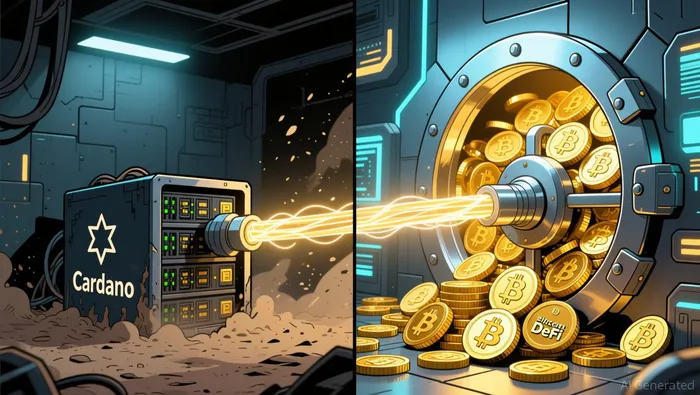
In a significant technical development, the Cardano Foundation announced that Cardano and Injective are now connected via the Inter-Blockchain Communication (IBC) protocol on testnet . This development establishes a direct interoperability path between the two ecosystems .
This connection supports cross-ecosystem utility by enabling each asset to operate through the other network's IBC connection . Injective is noted as the first chain with a live on-chain IBC rail to Cardano . The announcement confirms that both assets will be usable across the two ecosystems .
However, the availability is currently limited to testnet. This demonstrates an early-stage technical capability rather than a mature production deployment or confirmed adoption . The integration lays the groundwork for future interoperability but does not yet reflect live, mainnet trading or liquidity flows .
Broader institutional adoption is accelerating in the digital asset space. Cap (CAP), an onchain private credit platform backed by traditional financial institutions including Franklin Templeton and Susquehanna International Group (SIG), has been listed on Upbit’s KRW market . This listing follows attention drawn to Cap as an example of institutional adoption after Flow Traders began borrowing stablecoins through the platform .
Trading on Upbit began on August 6, 2026, with deposits supported via the Ethereum network . Cap was previously listed on Bithumb’s KRW market in June . The platform addresses a key barrier to institutional participation in onchain lending: the requirement for borrowers to provide onchain collateral .
Under Cap’s structure, a dedicated Underwriter assumes the credit risk of each loan using its own capital . If a borrower defaults, the Underwriter’s collateral is liquidated first, protecting lenders until the Underwriter’s capital is exhausted . Lending capital allocation is executed through smart contracts, removing the need for manual committee decisions .
Cap has processed over $5 billion in cumulative transaction volume with deposits exceeding $325 million . Dollar-denominated deposits offer annual yields of approximately 5% to 7% . Collateral assets include WisdomTree’s tokenized money market fund (WTGXX), BlackRock’s BUIDL, and Franklin Templeton’s BENJI .
On July 23, Cap joined the onchain credit strategy launched by Bitcoin financial protocol LombardBARD-- as its lending infrastructure provider . Benjamin Sarquis Peillard, Cap’s founder, noted that the listing coincides with accelerating institutional adoption of onchain credit . Institutions can now leverage blockchain efficiency while maintaining familiar credit frameworks .
In industrial manufacturing, high-purity ceramic crucibles offer economic advantages in precious metal smelting. The selection of ceramic crucibles is driven by the total cost of ownership rather than initial purchase price . The true cost equation includes purchase, maintenance, consumption, and shutdown risk .
Crucible contamination can scrap an entire melt, resulting in losses far exceeding the crucible's own price . Consequently, higher purity requirements increase the weighting of contamination resistance in selection processes . Choosing a slightly more expensive, high-purity crucible is often more economical than a cheaper alternative because it avoids the significant costs associated with a single contamination incident .
The analysis highlights common ceramic crucible failure modes, including cracking, spalling, perforation, sticking, and premature failure syndrome . Systematic countermeasures for these issues range from material adjustments to operational optimizations . This framework equips users to diagnose root causes quickly and adjust selection strategies when operational problems arise .
TRUNNANO, a high-tech enterprise focused on nanomaterials and high-end ceramics, published this guide to assist sectors such as electronics, new energy, and industrial catalysis in optimizing their material choices .

Blending traditional trading wisdom with cutting-edge cryptocurrency insights.
Latest Articles
Stay ahead of the market.
Get curated U.S. market news, insights and key dates delivered to your inbox.


AInvest
PRO
AInvest
PRO




Comments
No comments yet