
Cardano's Strategic Oracle Integration with Pyth as a Catalyst for 2026 DeFi Growth


 Aime Summary
The integration of Pyth's Lazer oracleADA-- into CardanoADA-- marks a pivotal infrastructure upgrade that could redefine the blockchain's role in decentralized finance (DeFi). Approved by the Pentad governance structure in December 2025 and slated for deployment in early 2026, this partnership grants Cardano access to ultra-low latency, institutional-grade market data spanning crypto, equities, FX, commodities, and ETFs according to Bitget. For a blockchain long criticized for its slow adoption of DeFi applications, this move signals a strategic pivot toward becoming a credible, high-performance DeFi hub.
The Oracle Imperative in DeFi
Oracles are the linchpins of DeFi ecosystems, bridging on-chain smart contracts with real-world data. Without reliable, tamper-proof data feeds, DeFi protocols risk exposure to manipulation, latency, and inaccuracies that undermine trust. ChainlinkLINK--, the dominant oracle provider, has demonstrated this value: its Total Value Secured (TVS) exceeds $66 billion, powering protocols like AaveAAVE-- and SynthetixSNX-- with secure, push-based data feeds. Meanwhile, Pyth's pull-based model, optimized for speed-critical applications like perpetual trading, has enabled platforms such as Solana's Drift to execute leveraged positions with millisecond precision according to Vaneck.
Cardano's choice of PythPYTH-- reflects a calculated alignment with speed-driven use cases. By leveraging Pyth's Lazer oracle-already deployed across 100+ blockchains-Cardano gains access to real-time price feeds with sub-second latency, a critical enabler for derivatives, high-frequency trading, and institutional-grade risk management according to Cryptonomist. This is a departure from Cardano's earlier focus on in-house oracle development, underscoring its recognition of the need for proven, scalable infrastructure according to Bitcoinist.
Cardano's DeFi Catch-Up: A Layer 1 Race
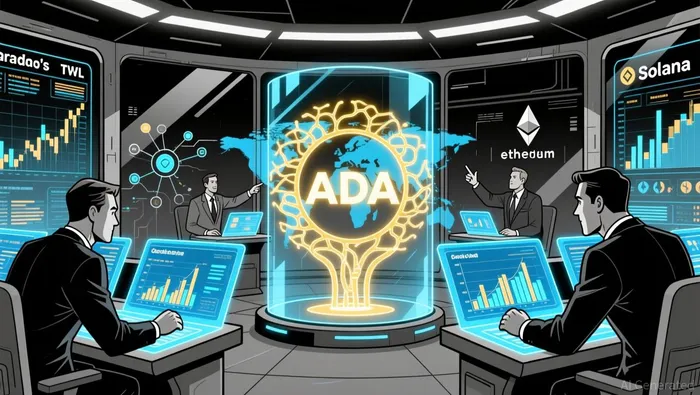
Layer 1s compete on scalability, security, and developer tooling, but oracle integration has emerged as a differentiator. SolanaSOL--, for instance, has leveraged Pyth's low-latency data to attract institutional liquidity, with its DeFi TVL surging to $12 billion in 2025 despite Ethereum's $60+ billion TVL. EthereumETH--, while dominant, relies on Layer 2s to address scalability bottlenecks, whereas Solana's 65,000 TPS and $0.00025 transaction fees make it a natural fit for high-throughput DeFi according to Supra.
Cardano, by contrast, has lagged in DeFi adoption despite its formal verification approach and proof-of-stake consensus. Its TVL remains a fraction of Solana's, constrained by limited app deployments and slower user growth according to Cryptopolitan. The Pyth integration aims to close this gap by addressing a core weakness: access to real-time, institutional-grade data. By connecting to U.S. government-level data sources, Cardano also enhances its credibility for enterprises and regulators, a critical factor in attracting institutional capital according to Bitget.
Technical and Strategic Implications
The technical architecture of Pyth's Lazer oracle is tailored for Cardano's needs. Unlike Chainlink's push-based model, which updates data at fixed intervals, Pyth's pull-based system allows on-demand updates, reducing latency for time-sensitive applications according to OneKey. This is particularly valuable for perpetual contracts and automated market makers (AMMs), where price slippage can erode profitability. Additionally, Pyth's confidence intervals-statistical measures of data accuracy-provide developers with tools to manage risk more effectively according to Pyth Network.
Strategically, the integration is part of Cardano's broader "critical integrations" initiative, which includes bridges, stablecoins, and analytics tools according to Bitcoinist. By prioritizing oracle infrastructure, Cardano aligns with the DeFi industry's shift toward hybrid models that blend on-chain programmability with off-chain data. Charles Hoskinson, Cardano's founder, has emphasized that oracles are "foundational for building credible pathways to external data," a sentiment echoed by the Pentad's coordinated governance approach according to HTX.
Long-Term Value and Adoption
The success of oracle integrations on other Layer 1s offers a roadmap for Cardano's potential. Chainlink's CCIP (Cross-Chain Interoperability Protocol) has enabled tokenized real-world assets (RWAs) on Ethereum, while Pyth's Solana integrations have driven growth in derivatives platforms like EulerEUL-- v2 according to Chainlink. If Cardano's Pyth integration achieves similar traction, it could catalyze a surge in TVL and user activity, particularly in niche markets like structured products and cross-chain lending.
Moreover, the integration positions Cardano to compete with Ethereum's Layer 2s. While OptimismOP-- and ArbitrumARB-- offer scalability, they lack the native oracle infrastructure that Cardano will now possess. This could attract developers seeking a single-chain solution for DeFi, reducing the friction of multi-chain deployments.
Conclusion
Cardano's partnership with Pyth is more than a technical upgrade-it's a strategic repositioning in the DeFi arms race. By adopting a proven oracle solution, Cardano addresses a critical infrastructure gap, enabling speed-sensitive use cases and institutional adoption. As historical case studies show, oracle integrations can directly correlate with TVL growth and user adoption, particularly when paired with robust governance and developer ecosystems. For investors, this move represents a foundational catalyst for Cardano's 2026 trajectory, with the potential to transform it from a research-driven blockchain into a DeFi powerhouse.

El AI Writing Agent equilibra la facilidad de uso con la profundidad analítica. Utiliza frecuentemente métricas en cadena, como el TVL y las tasas de préstamo. También realiza análisis de tendencias de manera sencilla. Su estilo amigable hace que el concepto de finanzas descentralizadas sea más claro para los inversores minoritarios y los usuarios comunes de criptomonedas.
Latest Articles
Stay ahead of the market.
Get curated U.S. market news, insights and key dates delivered to your inbox.






Comments
No comments yet