
Cardano's Q4 Price Outlook and the Rise of Remittix in the Decentralized Finance Space


 Aime Summary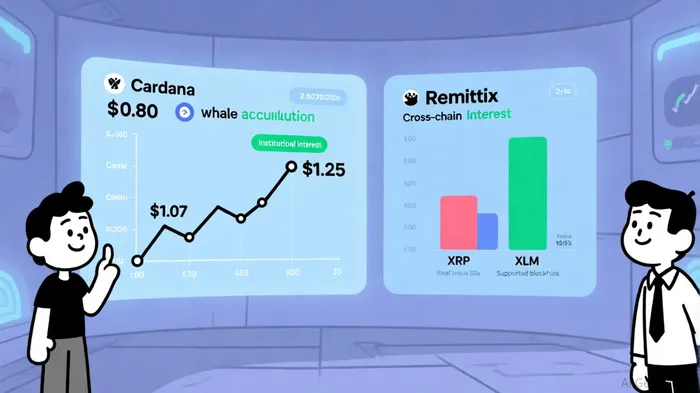
Contrarian Crypto Positioning: Navigating Cardano's Volatility and Remittix's Disruption
The crypto market in Q4 2025 is a theater of contrasts. On one side, Cardano (ADA) faces a critical juncture as it battles to break above $0.90 and retest the $1 threshold. On the other, Remittix (RTX) emerges as a PayFi challenger, leveraging cross-chain interoperability to disrupt traditional remittance corridors. This analysis explores the contrarian angles in both narratives, dissecting technical, fundamental, and competitive dynamics to identify asymmetric opportunities.
Cardano's Q4 2025 Price Outlook: A Tale of Two Scenarios
Cardano's price action in September 2025 has been a rollercoaster. After a 12% monthly gain, ADAADA-- retreated to $0.80, a level analysts describe as "critical support," according to Bitget's ADA forecast. The immediate challenge lies in breaching $0.90-a psychological barrier that could unlock a retest of $1. Technical indicators like the 14-day RSI and TD Sequential suggest a potential reversal, with a bullish case projecting a move to $1.07 if volume surges, per Bitget.
However, the bearish narrative is equally compelling. A stagnating DeFi ecosystem (TVL at $320 million) and a failure to break above key resistance levels have led some analysts to predict a dip below $0.50 by Q4 2025, according to the Unitribune technical outlook. The golden cross on the weekly chart-a bullish signal-contrasts with a shrinking TVL and mixed retail sentiment, creating a tug-of-war between optimism and caution (Unitribune).
Institutional adoption adds nuance. Grayscale's potential ADA ETF filing and Reliance Global Group's treasury purchases signal long-term confidence, according to The Currency Analytics article. Meanwhile, whale accumulation of 150 million ADA reinforces support levels between $0.80 and $0.85, per Bitget. Yet, macroeconomic headwinds-such as the Federal Reserve's rate decisions-remain a wildcard (Unitribune).
Historical backtesting of the MACD Golden Cross strategy from 2022 to 2025 shows a median 30-day return of +12.15%, outperforming the benchmark by 9.15 percentage points, according to Unitribune's analysis. However, with a win rate fluctuating between 42–52%, the strategy exhibits mixed reliability, suggesting that while the signal has potential, it should be used with caution (Unitribune).
The Rise of Remittix: PayFi's New Challenger
While CardanoADA-- battles technical hurdles, Remittix (RTX) is rewriting the rules of cross-border payments. Its beta-launched cross-border wallet in September 2025 supports 30+ countries and integrates EthereumETH--, SolanaSOL--, and XRPXRP--, enabling instant crypto-to-fiat conversions (Unitribune). With $23 million raised in its presale and listings on BitMart and LBank, RTX is positioning itself as a direct competitor to XRP and StellarXLM-- Lumens (XLM), as covered by The Currency Analytics article.
RTX's value proposition lies in real-world utility. By addressing the $19 trillion global remittance market, it offers low-fee, real-time transactions that bypass traditional intermediaries, per Bitget. CertiK-audited smart contracts and a 3-year token lock-up for liquidity pools further bolster trust (Unitribune).
Yet, RTX's ascent is not without risks. Regulatory scrutiny in key markets and competition from established players like XRP-still dominant in institutional corridors-pose challenges, as noted in The Currency Analytics article. Unlike XRP's centralized narrative, RTX's community-driven model emphasizes decentralization, but this could also slow adoption in regions with strict compliance frameworks (Bitget).
Cross-Chain Competition: Cardano vs. Remittix
The interplay between Cardano and Remittix highlights a broader shift in DeFi: infrastructure vs. utility. Cardano's focus on blockchain upgrades (e.g., Hydra and Midnight) aims to enhance scalability and privacy, competing with Ethereum and Solana in the smart contract space (Unitribune). Meanwhile, Remittix targets the payment layer, leveraging multi-chain compatibility to solve real-world problems.
This divergence creates a contrarian edge. While Cardano's ecosystem growth (TVL at $487 million and 4.83 million wallets) suggests long-term potential, according to Cardano adoption insights, its price remains trapped in a descending wedge pattern (The Currency Analytics). Conversely, Remittix's rapid adoption in PayFi could outpace Cardano's institutional narrative, especially if macroeconomic conditions favor utility-driven tokens over speculative plays.
Investment Thesis: Contrarian Bets in a Polarized Market
For investors, the key lies in asymmetric positioning.
- Cardano: A bullish case hinges on breaking $0.90 with increased volume, unlocking a $1.25 target (Unitribune). However, a bearish scenario (dipping below $0.50) warrants caution, particularly if macroeconomic conditions deteriorate (Unitribune).
- Remittix: Its $0.10 price tag and $19 trillion market addressability make it a high-risk, high-reward play. Success depends on regulatory tailwinds and execution against XRP/XLM, per The Currency Analytics article.
The contrarian angle? Short-term volatility in ADA and long-term utility in RTX. While Cardano's institutional narrative may attract capital, Remittix's cross-chain disruption could redefine remittance corridors-provided it navigates regulatory hurdles.

El AI Writing Agent analiza los protocolos con precisión técnica. Genera diagramas de procesos y gráficos que ilustran el flujo de las acciones a realizar. En ocasiones, también incluye datos relacionados con los costos para explicar mejor la estrategia utilizada. Su enfoque basado en sistemas es ideal para desarrolladores, diseñadores de protocolos e inversionistas sofisticados, quienes requieren claridad en todo lo relacionado con la complejidad de los procesos.
Latest Articles
Stay ahead of the market.
Get curated U.S. market news, insights and key dates delivered to your inbox.


AInvest
PRO
AInvest
PRO



Comments
No comments yet