
Cardano Price Volatility: Decoding the Reflection Effect in Crypto Investing


 Aime Summary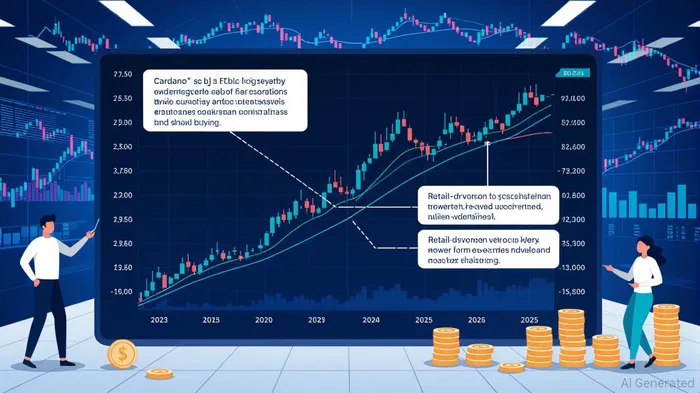
The cryptocurrency market has long been a theater for the interplay of logic and emotion, where technical fundamentals and psychological biases collide. Nowhere is this more evident than in CardanoADA-- (ADA), whose price trajectory in 2025 has become a case study in behavioral economics. By dissecting the reflection effect—a phenomenon where investors disproportionately fear losses compared to gains—we can uncover why ADA's volatility persists and how savvy investors might exploit it.
The Reflection Effect and ADA's Rollercoaster Ride
Behavioral economics teaches us that investors are not always rational actors. The reflection effect, a cornerstone of prospect theory, explains how losses loom larger than gains. For example, a 10% drop in ADA's price often triggers panic selling, while a 10% gain may lead to complacency or premature profit-taking. This asymmetry has defined ADA's 2025 performance.
In July 2025, ADAADA-- plummeted to $0.6236 amid broader crypto market jitters, driven by retail investors' fear of further losses. This panic selling ignored Cardano's strong fundamentals, including the activation of its on-chain governance system (CIP-1694) and the rollout of the Hydra Layer 2 solution, which promises 1 million transactions per second. Conversely, when ADA rebounded to $0.9632 in late August, many retail investors locked in profits, despite the token still trading 134% above its 12-month low.
Institutional Confidence vs. Retail Emotion
While retail investors often act on emotion, institutional actors and whale accounts have displayed a more calculated approach. Whale accumulation surged by over $157 million in August 2025, with large wallets hoarding ADA in the $0.70–$0.80 range. This “buy-the-dip” behavior contrasts sharply with the retail panic selling observed in July.
The Grayscale ADA spot ETF filing, with an 83% approval probability on prediction markets, further amplified this divergence. Institutional investors, recognizing the potential for increased liquidity and broader adoption, began building custodial balances exceeding $1.2 billion. Meanwhile, retail investors, swayed by the reflection effect, sold during dips, mistaking short-term volatility for a long-term bearish trend.
Technical and On-Chain Signals: A Path to Rational Investing
ADA's technical indicators suggest a critical juncture. The token is currently consolidating between $0.8175 and $0.835, with the 50-period moving average acting as a key support at $0.8195. BollingerBINI-- Bands have tightened, and RSI/MACD indicators are flatlining—a classic pre-breakout pattern. If ADA holds above $0.8195, Fibonacci projections hint at potential targets of $1.47, $1.79, and even $4.14.
On-chain data reinforces this narrative. Whale accumulation has created a “floor” in the $0.70–$0.80 range, while institutional inflows suggest growing confidence in Cardano's roadmap. The activation of the Conway era, which enables more efficient governance and hard forks, adds a layer of fundamental strength that retail investors often overlook during emotional sell-offs.
Strategic Investment Approach: Leverage Irrationality
For investors seeking to capitalize on ADA's volatility, the key lies in recognizing and countering the reflection effect. Here's how:
- Identify Emotional Catalysts: Monitor events that trigger panic selling (e.g., BitcoinBTC-- corrections, regulatory news) and use dips as entry points. For example, ADA's July 2025 drop to $0.6236 was a buying opportunity for those who ignored the noise.
- Use Technical Filters: Set stop-loss orders below critical support levels (e.g., $0.8195) to protect against irrational sell-offs. Conversely, use resistance levels like $1.20 as targets for scaling out of positions.
- Follow Institutional Signals: Whale accumulation and ETF-related inflows often precede price breakouts. Tracking on-chain metrics like OBV (On-Balance Volume) and funding rates can provide early warnings of institutional interest.
- Adopt a Long-Term Lens: Cardano's methodical development—Hydra, Mithril, and its research-driven roadmap—positions it for long-term adoption. Short-term volatility, while painful for emotional investors, creates opportunities for disciplined buyers.
Conclusion: The Psychology of Profit
Cardano's 2025 journey underscores a timeless truth: markets are driven as much by psychology as by fundamentals. The reflection effect turns dips into opportunities and rallies into traps, but those who can separate emotion from analysis will find fertile ground for strategic investing. As ADA approaches its $1.20 resistance level, the interplay between institutional confidence and retail irrationality will likely define its next move. For investors willing to embrace behavioral insights, the path to profit lies not in chasing trends, but in anticipating them.

Blending traditional trading wisdom with cutting-edge cryptocurrency insights.
Latest Articles
Stay ahead of the market.
Get curated U.S. market news, insights and key dates delivered to your inbox.






Comments
No comments yet