
Cardano News Today: Malicious Attack or Misguided Experiment? Cardano's AI-Driven Chain Split Under FBI Scrutiny


 Aime Summary
The Federal Bureau of Investigation is investigating a temporary chain split on the CardanoADA-- blockchain, an incident attributed to a malformed transaction generated via artificial intelligence tools. The disruption, which occurred on November 21, caused a brief fork in the network as older and newer node versions validated transaction data inconsistently, prompting an emergency patch and network-wide upgrade according to reports. Cardano co-founder Charles Hoskinson described the event as a targeted attack by a disgruntled stake-pool operator, while a pseudonymous individual known as "Homer J" claimed responsibility, asserting the action was a "failed personal challenge" with no malicious intent.
The chain split emerged when a wallet linked to a former Cardano testnet participant submitted a transaction with an oversized hash that bypassed initial validation checks. This exploited a long-standing bug in an underlying software library, causing some block producers to follow a "poisoned" chain while others adhered to the normal ledger. The Cardano ecosystem governance body, Intersect, noted the flaw had been masked by older ledger versions but resurfaced in recent node releases combined with specialized submission methods. 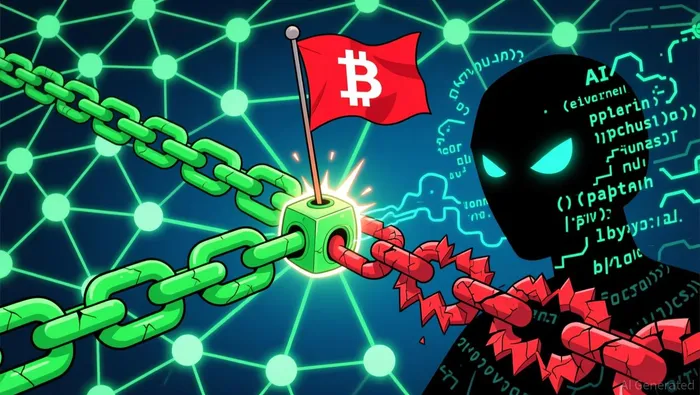 Exchanges and wallet providers paused deposits and withdrawals during the incident, though no user funds were lost, and most retail wallets remained unaffected due to their reliance on components that ignored the malformed transaction according to analysis.
Hoskinson warned the disruption had broader implications, affecting block producers' rewards and decentralized finance (DeFi) protocols' state consistency. He emphasized that restoring full network uniformity could take weeks, while the attacker expressed remorse, stating he acted alone and only realized the extent of the disruption when block explorers froze. Meanwhile, SolanaSOL-- co-founder Anatoly Yakovenko praised Cardano's consensus design for maintaining network continuity without proof-of-work, calling the response to the crisis a validation of its resilience under stress according to industry reports.
The incident has reignited scrutiny over Cardano's security protocols, particularly as AI tools become more accessible for both legitimate and malicious uses. ADA's price fell over 6% following the disruption, outpacing losses among major cryptocurrencies as traders reacted to the perceived vulnerability in decentralized proof-of-stake networks. Intersect's post-mortem report highlighted the need for improved validation logic to prevent similar exploits, while Hoskinson hinted at potential legal action against the attacker.
Cardano's swift recovery, however, underscored its technical capabilities. Developers deployed patched node software, instructing operators to upgrade and consolidate the two chains into a single canonical history. The network's ability to avoid prolonged downtime drew unexpected praise from industry rivals, with Yakovenko noting the rarity of such outcomes in decentralized systems according to industry analysis.
As the FBI's investigation unfolds, the incident serves as a cautionary tale for blockchain networks grappling with the dual-edged potential of AI. While the technology can enhance automation and efficiency, its misuse-whether intentional or accidental-poses risks to even the most established protocols. For Cardano, the challenge now lies in reinforcing its defenses while maintaining the trust of stakeholders who view it as a competitor to EthereumETH-- and Solana in the enterprise blockchain space.
Cardano (ADA) News: Network Splits in Two as Attacker ... https://www.coindesk.com/markets/2025/11/23/cardano-temporarily-splits-into-two-chains-after-attacker-uses-ai-generated-script-to-exploit-a-known-bug
Cardano Swiftly Recovers From AI-Caused Chain Split https://finance.yahoo.com/news/cardano-swiftly-recovers-ai-caused-133818401.html

Stay ahead of the market.
Get curated U.S. market news, insights and key dates delivered to your inbox.


AInvest
PRO
AInvest
PRO



Comments
No comments yet