
Cardano News Today: FBI Probes Cardano Chain Split, Unveiling Legal Risks for Blockchain Developers


 Aime Summary
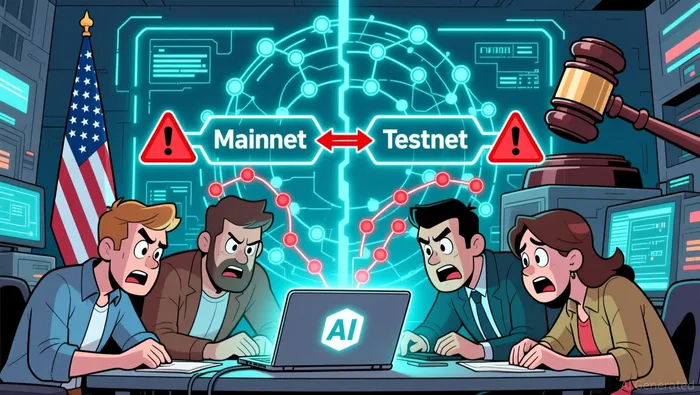
The U.S. Federal Bureau of Investigation has launched an investigation into the November 21 chain split incident on the CardanoADA-- blockchain, marking one of the most significant security probes in cryptocurrency history. The incident, triggered by a malformed delegation transaction exploiting a three-year-old software bug, temporarily fragmented the $14 billion network into two competing chains, prompting emergency interventions and raising legal questions about developer accountability according to reports.
The chain split occurred at approximately 08:00 UTC when a transaction bypassed validation checks on newer node versions, creating incompatible ledger states. The anomaly mirrored a testnet issue reported just one day earlier, suggesting premeditated testing before deployment on the mainnet. Input Output Global (IOG), Cardano's development firm, deployed emergency patches within three hours, allowing the network to converge naturally by November 22. Despite the swift resolution, the incident disrupted exchanges, with CoinbaseCOIN-- pausing ADAADA-- operations for 14 hours and other platforms implementing shorter halts to assess ledger integrity according to reports.
A developer identified on X as "Homer J" publicly apologized for the incident, admitting they relied on AI-generated code to execute the transaction without adequate testnet validation. "It started off as a 'let's see if I can reproduce the bad transaction' personal challenge," they wrote, adding they felt "ashamed of my carelessness" according to statements. However, Cardano founder Charles Hoskinson labeled the act a "premeditated attack", asserting the FBI was already investigating and that such actions could constitute a felony under U.S. law.
The FBI's involvement has intensified scrutiny of blockchain protocol testing practices. An IOG employee, identified as Plutus language developer "effectively," resigned following Hoskinson's comments, citing fears that future development errors could attract legal consequences. "I didn't realize there was a risk of getting raided by the authorities," they stated on X, highlighting tensions between innovation and regulatory compliance in decentralized systems.
 Market reactions were mixed. ADA's price dropped as much as 16% immediately after the incident before rebounding to around $0.41. Derivatives data revealed $7.5 million in long-position liquidation risks near $0.38, underscoring investor anxiety. While Intersect, a Cardano ecosystem organization, confirmed no user funds were lost, the incident exposed vulnerabilities in consensus mechanisms and raised concerns about orphaned transactions and double-spending risks according to analysis.
The FBI's probe focuses on whether proper protocols were followed during the test, the extent of network damage, and potential criminal liability for the developer. Hoskinson emphasized the gravity of the situation, stating, "These things impact the lives, money, and commerce of millions of people," and noting that similar incidents could face felony charges in multiple jurisdictions according to statements.
The incident underscores broader challenges in balancing rigorous security testing with operational stability in blockchain networks. While developers argue such experiments are necessary to identify vulnerabilities, the Cardano split highlights the need for standardized safeguards. Regulatory clarity on developer responsibilities-and the legal boundaries of protocol testing-may emerge as critical issues for the cryptocurrency industry in 2026.

Stay ahead of the market.
Get curated U.S. market news, insights and key dates delivered to your inbox.
AInvest
PRO
AInvest
PRO



Comments
No comments yet