
Cardano News Today: Cardano's DeFi Dilemma: User Apathy vs. Governance Gaps


 Aime Summary
Cardano (ADA), a blockchain platform once hailed as a potential rival to EthereumETH--, finds itself at a crossroads as founder Charles Hoskinson confronts criticism over its lagging decentralized finance (DeFi) ecosystem. With a total value locked (TVL) of just $262 million—ranking 24th globally—Hoskinson has publicly shifted blame from technical shortcomings to user behavior, arguing that ADAADA-- holders are failing to adopt native DeFi platforms (Cardano founder blames users). The network's TVL pales in comparison to SolanaSOL-- ($11.17 billion) and Ethereum ($84.22 billion), despite Cardano's 1.3 million stakers collectively holding $15 billion in ADA, Hoskinson responded in a Yahoo Finance interview.
Hoskinson emphasized that the issue lies in a "chicken-and-egg" loop: low DeFi engagement deters partnerships and liquidity, while limited external integrations hinder on-chain adoption, a point he made in his Yahoo Finance interview. He dismissed the notion that introducing major stablecoins like USDTUSDT-- or USDCUSDC-- would automatically boost growth, noting that CardanoADA-- already has asset-backed stablecoins (USDM, USDA) with strong pegs, as covered in a BeInCrypto report. Instead, he highlighted structural coordination and accountability gaps within the ecosystem, stating, "It's not a technology problem. It's a problem of governance and coordination."
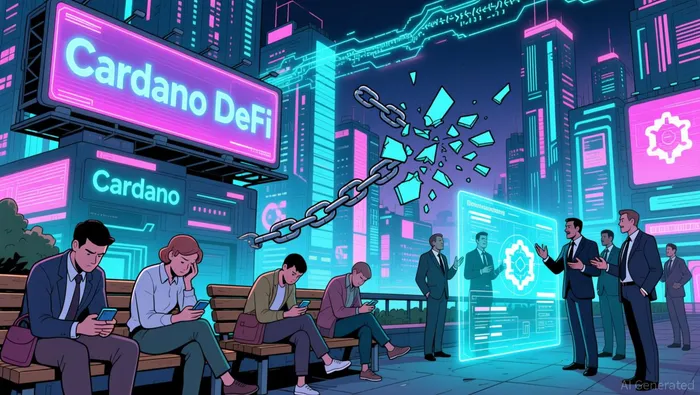
The founder's comments have sparked debate. Some users argue that ADA holders lack incentives such as competitive yields, intuitive interfaces, or robust security to engage with DeFi protocols, a view reported by TheCryptoBasic. Others counter that Cardano's governance strength—evidenced by its 1.3 million active stakers—demonstrates a healthy ecosystem, according to a Bitcoinist article. Hoskinson acknowledged this duality, noting that staking participation does not translate to liquidity provision and that bridging this gap could push TVL to $5–$10 billion.
To address the challenges, Cardano is pursuing a multi-year roadmap centered on BitcoinBTC-- interoperability and real-world finance integration. Projects like Midnight (a privacy-focused sidechain) and RealFi (a microfinance platform targeting Africa) aim to unlock liquidity by enabling ADA and BTC to be lent, converted into stablecoins, and used in lending products, Hoskinson told Yahoo Finance. Hoskinson also cited Leios, a protocol-level innovation, as evidence of Cardano's technical evolution, a point also noted by BeInCrypto.
The urgency for action is underscored by declining on-chain activity. ADA's daily active addresses dropped from over 32,000 in mid-October to 24,000 in early November, according to Bitcoinist, while the token's price fell below $0.57 amid broader crypto market declines. Hoskinson defended his earlier remarks, clarifying that he never "blamed the community" but sought to highlight a participation imbalance. "There's not a single person in the Cardano ecosystem I'm blaming," he insisted.
Market analysts remain skeptical. With ADA trading at $0.5417—a 6.2% drop in 24 hours—and the broader crypto market down 4%, the pressure is on for Cardano to deliver tangible results. Hoskinson's roadmap hinges on mobilizing passive ADA holders through targeted marketing and accountability measures, but the path to a DeFi revival remains fraught with challenges, as reporting from BeInCrypto has suggested.

Stay ahead of the market.
Get curated U.S. market news, insights and key dates delivered to your inbox.


AInvest
PRO
AInvest
PRO



Comments
No comments yet