
Cardano News Today: Cardano's Chain Split Exposes Governance and AI Risks


 Aime Summary
Cardano's blockchain network faced a critical security incident on November 21, 2025, when a chain split disrupted operations and raised questions about the protocol's resilience. The incident, triggered by a malformed transaction exploiting a bug dating back to 2022, exposed vulnerabilities in the network's governance and technical safeguards. According to reports, while no funds were lost, the event has intensified scrutiny over the project's ability to withstand both accidental and intentional disruptions.
The chain split occurred after a staking pool operator, identified as "Homer J," executed an AI-generated transaction designed to test the network's limits. The transaction, which bypassed standard validation checks, created two competing chains-one including the invalid block and another excluding it. Miners began producing blocks on both chains, temporarily fragmenting the network until an urgent software update (version 10.5.3) was deployed to reconcile the split according to technical analysis. Charles Hoskinson, Cardano's founder, condemned the incident as a "premeditated attack", emphasizing the potential for double-spending and DeFi disruptions.
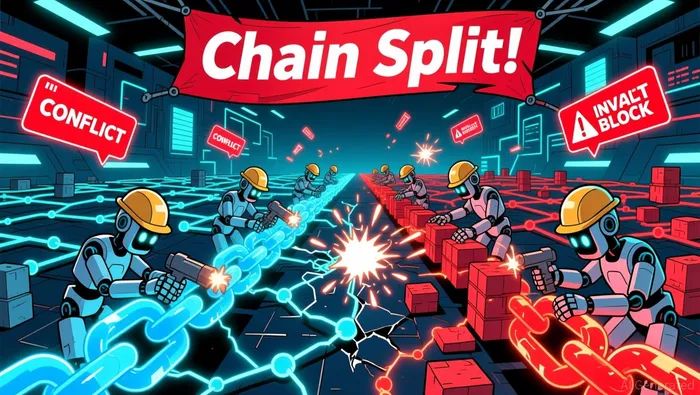
The incident underscores the risks of human error and untested code in blockchain systems. Homer J admitted to using AI-generated code without prior testing, stating his actions were a "personal challenge" that inadvertently endangered the network. As concerns grow in the crypto industry about the growing use of AI in attack vectors, this aligns with broader industry patterns.
Cardano's rapid recovery, with engineers resolving the issue within hours, has been praised as a testament to the network's technical capabilities. However, critics argue the incident reveals deeper governance flaws. The 2022 bug's prolonged existence in the codebase and the lack of rigorous testing for patches have fueled skepticism about the project's formal, research-driven approach. Community members questioned the protocol's fragility, noting that "if you can break it so easily, what else is under the rug?"
The price of ADAADA--, Cardano's native token, remained relatively stable at around $0.40 during the crisis, but the reputational damage could have long-term implications. The project has since announced plans to implement the Ouroboros Phalanx upgrade, aimed at enhancing consensus security and preventing future chain drifts. Yet, rebuilding trust will require more than technical fixes-transparency in patch approval processes and stricter operator accountability are now under the microscope.
As blockchain networks grow in complexity, the CardanoADA-- incident serves as a cautionary tale about the interplay between innovation, governance, and human error. With AI's role in both development and exploitation expanding, the industry's ability to adapt to emerging threats will determine its long-term viability.

Stay ahead of the market.
Get curated U.S. market news, insights and key dates delivered to your inbox.


AInvest
PRO
AInvest
PRO



Comments
No comments yet