
Cardano News Today: Blockchain Clash: Prosecute Chain Split Culprits or Protect Open-Source Innovation?


 Aime Summary
Solana Co-Founder Anatoly Yakovenko has publicly praised Cardano's network design following its swift recovery from a recent chain split, calling the blockchain's resilience "pretty cool" and highlighting the challenges of building a Nakamoto-style consensus mechanism without proof-of-work according to Yakovenko. The incident, which occurred on November 21, 2025, saw Cardano's blockchain temporarily fork after a malicious transaction exploited a known deserialization bug, prompting emergency node upgrades to restore convergence as reported. Despite the disruption, Yakovenko commended the protocol for functioning as designed, emphasizing that achieving Bitcoin-level security without energy-intensive proof-of-work is a rare feat in the proof-of-stake (PoS) space according to analysis.
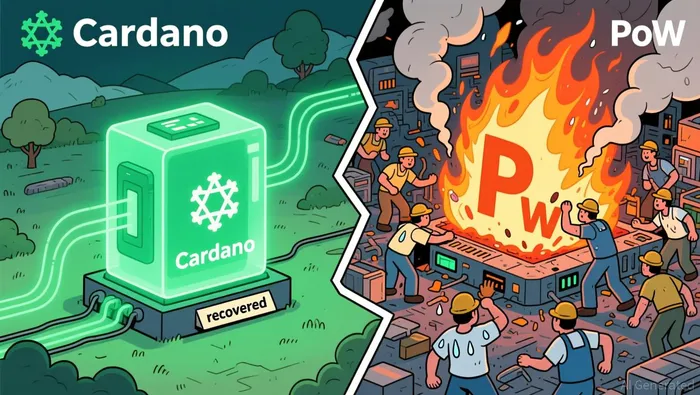 Cardano's recovery was facilitated by its Ouroboros consensus model, which prioritizes energy efficiency while enabling the "honest chain" to prevail in the event of a split according to experts. The network avoided a full rollback or hard fork, maintaining transaction throughput and preventing fund losses, according to founder Charles Hoskinson as noted in reports. Within hours, developers and stake pool operators deployed patches, resolving the fork and demonstrating the effectiveness of a decade-long focus on formal methods and high-assurance engineering according to technical analysis. Yakovenko, who likened the achievement to "a decade of formal methods paying off when it was needed the most," noted that most PoS networks would struggle to recover from such an incident without external intervention as reported.
The chain split, however, sparked a public debate between Hoskinson and Yakovenko over whether the incident should be treated as a criminal matter. Hoskinson argued that the attack-orchestrated by a disgruntled stake pool operator (SPO) who exploited testnet vulnerabilities-warranted legal action, stating it caused "catastrophic harm" to the ecosystem according to reports. Yakovenko countered that prosecuting the actor could create a "chilling effect" on open-source development, warning that overreach by regulators might deter innovation in permissionless networks as stated. Hoskinson, meanwhile, emphasized that premeditated attacks on public infrastructure should be treated as federal crimes, drawing parallels to risks faced by regulated financial systems built on blockchains like SolanaSOL-- according to analysis.
Cardano's handling of the incident has bolstered its reputation as a resilient PoS network. Analysts noted that the fork underscored the platform's ability to self-correct without halting operations, a rarity in the crypto space according to analysts. The network's upcoming Leios upgrade, scheduled for 2026, aims to automate such recovery processes, further solidifying its security framework according to development reports. Hoskinson also announced plans for the Midnight sidechain's NIGHT token, set to launch in December 2025, as part of broader efforts to expand Cardano's ecosystem as reported.
While Yakovenko's praise signals growing cross-chain respect among blockchain leaders, the incident highlights ongoing challenges in securing PoS systems against targeted exploits. The debate over legal accountability also raises broader questions about how to balance protocol resilience with regulatory oversight in decentralized networks according to industry analysis. For now, Cardano's swift recovery has reinforced confidence in its design, with observers suggesting its approach could serve as a benchmark for future PoS development as noted in industry reports.

Stay ahead of the market.
Get curated U.S. market news, insights and key dates delivered to your inbox.






Comments
No comments yet