
Cardano News Today: AI-Triggered Chain Split Proves Cardano's Resilience and Agile Governance


 Aime Summary
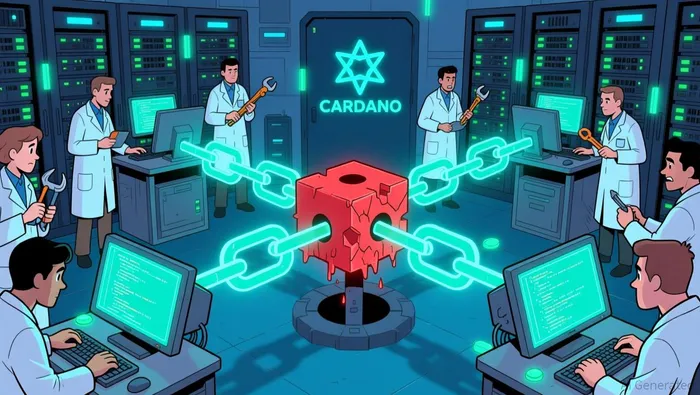
Cardano's blockchain network has demonstrated resilience in the face of a recent crisis, surviving a chain split incident without experiencing downtime. The disruption, triggered by a malformed transaction generated by AI tools, briefly impacted network consensus but was swiftly resolved. Pool operators updated node software within a day, restoring synchronization and merging the chains. This event, while exposing an edge-case vulnerability, ultimately underscored the robustness of Cardano's Ouroboros protocol and the agility of its community-driven governance model according to the report.
The incident occurred during testing by a developer known as Homer J, who exploited a bug allowing oversized hashes to bypass transaction validation. While many wallets and decentralized applications (dApps) became temporarily inaccessible, block production continued uninterrupted. CardanoADA-- founder Charles Hoskinson confirmed the technical fix was implemented promptly and hinted at potential regulatory action regarding the exploit. The incident highlighted the protocol's ability to maintain stability despite unforeseen challenges, a trait praised by industry peers. SolanaSOL-- co-founder Anatoly Yakovenko noted that Cardano's Ouroboros protocol functioned as designed, emphasizing the difficulty of building Nakamoto-style consensus without proof of work according to analysis.
Market sentiment remains cautiously optimistic. On-chain data reveals large holders are accumulating ADAADA-- at levels considered strong technical support zones, with positive delta metrics indicating whale activity. This trend contrasts with retail participation, suggesting experienced investors view current price levels as undervalued. Meanwhile, Cardano's stablecoin ecosystem has grown significantly, with its stablecoin market capitalization reaching $42 million in 2025, up from nearly zero in 2021. However, this remains modest compared to the $308 billion global stablecoin market, signaling untapped potential according to market data.
In response to the crisis, the Cardano Foundation has proposed a 2026 budget of 70 million ADA (approximately $70 million) to strengthen the ecosystem. Key initiatives include expanding stablecoin integration, advancing the Midnight sidechain, and enhancing BitcoinBTC-- DeFi capabilities. The budget also allocates funds for liquidity support and advanced payment systems, aligning with broader strategies to position Cardano as a hub for cross-chain innovation. The community vote on the Critical Integrations Budget represents a pivotal test of the network's decentralized governance framework, which prioritizes stakeholder input in decision-making according to community reports.
Market analysts have noted a pattern of whale accumulation coinciding with key technical levels. For ADA, these accumulation phases have historically followed specific RSI oversold conditions and have led to subsequent price rebounds. Some traders are now monitoring for a potential RSI oversold signal as a possible catalyst for further ADA appreciation.
Institutional interest in Cardano persists, with blockchain analytics indicating steady accumulation by major holders. The network's ability to recover swiftly from the chain split has reinforced confidence in its infrastructure, particularly as it navigates evolving regulatory and technological landscapes. With plans to integrate Bitcoin DeFi and expand its sidechain capabilities, Cardano aims to solidify its role in the next phase of blockchain adoption while addressing vulnerabilities exposed by recent events.

Stay ahead of the market.
Get curated U.S. market news, insights and key dates delivered to your inbox.


AInvest
PRO
AInvest
PRO



Comments
No comments yet