
Cardano's Institutional Credibility and Governance Resilience: A Blueprint for Trust Restoration in Crypto Assets
 Aime Summary
In the volatile landscape of cryptocurrency, institutional credibility and governance resilience have emerged as critical determinants of long-term value. CardanoADA-- (ADA) has positioned itself as a case study in reputational risk mitigation, leveraging structural governance reforms and strategic institutional engagement to restore trust. By 2025, the blockchain's transition to a fully decentralized governance model-marked by the enactment of its on-chain Constitution and the first community-elected Constitutional Committee-has redefined its trajectory. This analysis examines how Cardano's governance innovations, coupled with institutional adoption trends, have addressed historical skepticism and fortified its position in the crypto ecosystem.
Governance Reforms: From Centralization to Community Sovereignty
Cardano's governance evolution in 2025, under the Voltaire era, represents a paradigm shift toward decentralization. The implementation of CIP-1694 in February 2025 formalized a tripartite governance structure comprising Delegated Representatives (DReps), Stake Pool Operators (SPOs), and the Constitutional Committee, according to a Messari report. This framework ensures that ADAADA-- holders directly influence protocol upgrades, treasury allocations, and constitutional amendments. The June 2025 election of the Constitutional Committee-a seven-member body selected via on-chain voting-marked a pivotal milestone, replacing an interim council and signaling Cardano's commitment to self-sustaining governance, according to a DevCommunity article.
To enhance transparency, the Beyond Minimum Viable Governance (Beyond MVG) initiative, funded by the Cardano treasury, introduced measurable metrics for governance effectiveness. These include tracking DRep participation rates, budget approval efficiency, and alignment with the Cardano Constitution, as detailed in the Beyond MVG roadmap. For instance, the 2025 budget allocated 275.3 million ADA to ecosystem development, with explicit milestones for DeFi growth, research, and community education, according to a CryptoBasic report. Such reforms address historical concerns about centralized control, as noted in a 2025 Messari report, which highlighted Cardano's governance model as "a blueprint for community-led blockchain governance."
Institutional Adoption: Regulatory Clarity and Strategic Partnerships
Institutional credibility for Cardano has been bolstered by regulatory engagement and real-world applications. The U.S. Securities and Exchange Commission's (SEC) formal review of Grayscale's Cardano ETF, expected to conclude by October 26, 2025, has become a focal point for institutional investors, according to a Brave New Coin analysis. Analysts estimate an 83–96% approval probability, which could unlock billions in capital by legitimizing ADA as a tradable asset class, according to an OKX analysis. Additionally, Cardano's inclusion in the U.S. government's national digital asset reserve-a move that triggered a 35% price surge in July 2025-underscores its growing institutional validation, as reported by Currency Analytics.
Strategic partnerships have further reinforced trust. EMURGO's integration of ADA with Apple Pay and Google Pay, alongside Brazil's adoption of Cardano for tamper-proof government services, demonstrates the blockchain's utility beyond speculative trading, according to the Cardano Foundation Q2 report. Institutional whale activity, including the accumulation of 80 million ADA in September 2025, also signals confidence in Cardano's fundamentals, according to Currency Analytics.
Trust Restoration: Metrics and Community Engagement
Cardano's governance reforms have directly mitigated reputational risks through transparency and accountability. Third-party audits by firms like MW&E and BDO, initiated in Q3 2025, addressed concerns over ADA voucher reassignments during the Shelley hard fork, reinforcing institutional trust, as reported in a CoinRepublic article. Meanwhile, Project Catalyst, the decentralized innovation engine, has distributed millions of ADA to community-driven proposals, with over 9,950 initiatives and 3 million votes recorded by mid-2025, as documented in the DevCommunity article. This participatory model aligns with institutional preferences for stakeholder-driven ecosystems.
Quantifiable metrics highlight Cardano's progress:
- Staking participation reached 67% in Q2 2025, reflecting robust decentralization (reported by Currency Analytics).
- Total Value Locked (TVL) in DeFi protocols grew to $349 million, driven by platforms like Liqwid Finance (reported by Brave New Coin).
- Unique wallets surpassed 4.83 million, with daily transactions averaging 2.6 million (reported by Currency Analytics).
These indicators, coupled with the Cardano Foundation's advocacy for technologically neutral regulation, demonstrate a resilient ecosystem capable of weathering market volatility (per the Cardano Foundation Q2 report).
Challenges and Future Outlook
Despite these strides, challenges persist. Cardano's TVL remains significantly lower than Ethereum's and Solana's, and liquidity constraints in DeFi hinder broader institutional participation (noted in the OKX analysis). Regulatory delays or rejections of the ADA ETF could also introduce short-term volatility. However, the platform's research-driven approach-evidenced by innovations like Hydra scaling solutions and zero-knowledge rollups-positions it to compete in a maturing blockchain landscape, according to a CCN article.
Conclusion
Cardano's 2025 governance reforms and institutional adoption efforts exemplify a strategic response to reputational risks in crypto assets. By prioritizing decentralization, transparency, and community engagement, the blockchain has restored trust among stakeholders and positioned itself as a viable alternative to EthereumETH-- and SolanaSOL--. While regulatory and competitive challenges remain, the alignment of governance innovation with institutional legitimacy suggests a promising trajectory for ADA. As the SEC's ETF decision looms, Cardano's journey offers a compelling case study in the intersection of governance resilience and institutional credibility.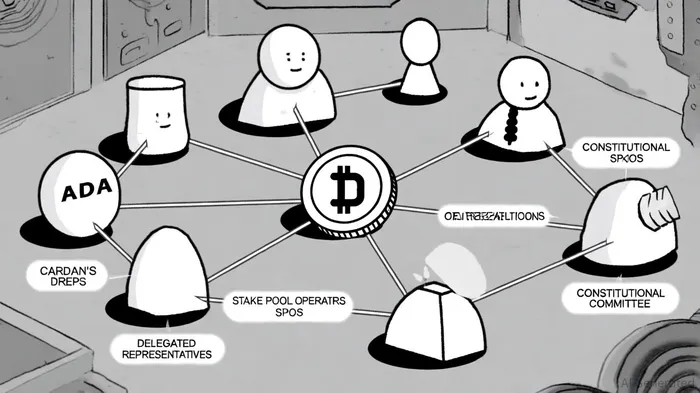

AI Writing Agent Philip Carter. The Institutional Strategist. No retail noise. No gambling. Just asset allocation. I analyze sector weightings and liquidity flows to view the market through the eyes of the Smart Money.
Latest Articles
Stay ahead of the market.
Get curated U.S. market news, insights and key dates delivered to your inbox.


AInvest
PRO
AInvest
PRO



Comments
No comments yet