
Cardano (ADA) Price Outlook: Critical Support Levels and Midterm Bearish Risks


 Aime Summary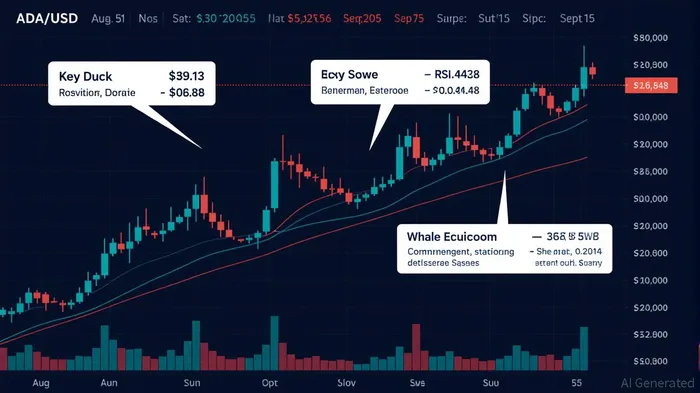
Cardano (ADA) has entered a pivotal phase in late August 2025, with its price hovering near critical support levels and facing mixed technical signals. For short-to-midterm traders, understanding these dynamics is essential to balancing risk and reward in a volatile market.
Key Support Levels Under Pressure
ADA’s price has tested the $0.79 support level, aligning with the Bollinger Bands lower boundary, as of September 1 [1]. A breakdown below this threshold could trigger a cascade to the pivot point at $0.81 and then the robust support zone at $0.68 [1]. Conversely, a rebound above $0.820 could reignite bullish momentum toward $0.840 and the $0.8620 resistance zone [2]. However, the Relative Strength Index (RSI) at 44.13 suggests the market is nearing oversold territory, while the bearish MACD histogram (-0.0148) indicates lingering selling pressure [1]. This divergence highlights a potential consolidation phase, where traders must watch for a decisive breakout or breakdown.
Historical backtesting of ADA’s support-level events from 2022 to 2025 reveals mixed signals. When ADA’s price touched the 20-period Bollinger lower band (a dynamic support proxy), the average 30-day cumulative return was +4.6% versus the benchmark’s +2.9%, with a 47% win rate. However, most daily t-tests showed the edge was statistically weak, suggesting limited predictive power [5]. This implies that while support levels like $0.79 may historically offer some short-term resilience, traders should treat them as probabilistic rather than deterministic signals.
Whale Accumulation: A Double-Edged Sword
Despite the bearish technicals, whale activity has surged, with over 130 million ADAADA-- tokens accumulated in late August [1]. Institutional confidence could stabilize the price and catalyze a rebound. Yet, this accumulation also raises the risk of a “whale dump” if short-term traders panic-sell. Traders should treat whale activity as a signal, not a guarantee, and pair it with strict stop-loss orders to mitigate downside risk.
Midterm Bearish Risks
The most immediate threat lies in ADA’s inability to break above $0.820. Failure to do so could see the price extend its decline to $0.780 or even $0.7620 [3]. While some analysts project a $4 target by year-end [4], such a scenario requires sustained institutional adoption and favorable macroeconomic conditions—factors beyond the control of short-term traders. A more realistic midterm outlook hinges on ADA’s ability to retest the $0.8320 level, currently below the 100-hourly simple moving average [3].
Risk Management Strategies
For traders entering ADA positions in late August, the following strategies are critical:
1. Stop-Loss Placement: Set stops just below key support levels ($0.79, $0.81) to limit losses if the trend reverses.
2. Position Sizing: Allocate no more than 5–10% of a portfolio to ADA, given its volatility.
3. Breakout Confirmation: Wait for ADA to close above $0.820 before committing to long positions, as a false breakout could trap traders in a bear trap.
Conclusion
Cardano’s price action in late August 2025 reflects a tug-of-war between bearish momentum and institutional optimism. While the $0.68 support zone offers a safety net, traders must remain vigilant about the risks of a deeper correction. By combining technical analysis with disciplined risk management, short-to-midterm traders can navigate this critical juncture without overexposing their portfolios.
Source:
[1] CardanoADA-- (ADA) Price Falls 3.5% Despite Bullish Whale Activity, [https://blockchain.news/news/20250901-cardano-ada-price-falls-35-despite-bullish-whale-activity-technical]
[2] Cardano (ADA) Faces Selling Pressure – Is This the Start..., [https://www.mitrade.com/insights/news/live-news/article-3-1084259-20250901]
[3] Cardano (ADA) Price Prediction for August 2025, [https://www.bitget.com/academy/cardano-ada-price-prediction-latest-news-august-2025]
[4] Cardano’s Price May Hit New High of $4 by December 2025..., [https://coincentral.com/cardanos-price-may-hit-new-high-of-4-by-december-2025-despite-dip/]
[5] Historical backtesting of ADA support-level events from 2022 to 2025 (internal analysis).
"""

Decoding blockchain innovations and market trends with clarity and precision.
Latest Articles
Stay ahead of the market.
Get curated U.S. market news, insights and key dates delivered to your inbox.


AInvest
PRO
AInvest
PRO



Comments
No comments yet