
Cardano (ADA) and the ETF Regulatory Hurdle: Is Institutional Adoption Enough to Drive a 2025 Bull Run?


 Aime Summary
The crypto market in 2025 is at a crossroads, with regulatory uncertainty and institutional demand shaping the trajectory of major assets like CardanoADA-- (ADA). As the U.S. Securities and Exchange Commission (SEC) delays its decision on the Grayscale Cardano ETF until October 26, 2025, investors are left to weigh the interplay between regulatory inertia, institutional interest, and Cardano's technological advancements. This article evaluates whether these factors can catalyze a bull run for ADAADA-- in the near term and solidify its long-term value proposition in a maturing crypto ecosystem.

Regulatory Delays: A Double-Edged Sword
The SEC's extended review of the Grayscale Cardano ETF—pushed back from August 27 to October 26—reflects broader regulatory caution. While the agency cites concerns over investor protections, market structure, and custody solutions, this delay has introduced volatility into ADA's price action. The token has tested critical support levels, such as $0.82, with limited buying volume and weak bullish momentum. However, the delay also underscores the SEC's evolving stance on crypto assets. ADA's reclassification as a commodity under the U.S. Clarity Act—a move aligning it with BitcoinBTC-- and Ethereum—has bolstered its institutional appeal, yet the lack of a standardized framework for crypto ETFs remains a hurdle.
Globally, the regulatory landscape is more dynamic. The European Union's Markets in Crypto-Assets Regulation (MiCA) has enabled crypto ETFs, while Singapore and Japan have adopted progressive frameworks. These developments suggest that even if the U.S. lags, Cardano's institutional adoption could gain traction elsewhere. For instance, Brazil's SERPRO and PUC-Rio have partnered with Cardano on ESG initiatives, positioning ADA as a scalable, environmentally conscious asset.
Institutional Demand: A Strong Foundation
Despite regulatory uncertainty, institutional demand for ADA has remained robust. Custodial platforms like CoinbaseCOIN-- and BitGo hold over $1.2 billion in ADA, and whale accumulation has surged to $157–161 million. Institutional inflows of $73 million in 2025 highlight confidence in Cardano's long-term potential. This demand is further supported by Cardano's technological roadmap, including the upcoming Hydra Layer 2 upgrade, which aims to process up to one million transactions per second. Such advancements address scalability concerns, a critical factor for institutional adoption.
However, institutional interest alone may not be sufficient to drive a sustained bull run. The SEC's delays have created a “wait-and-see” environment, where investors are hesitant to commit capital until regulatory clarity emerges. This dynamic is evident in ADA's price behavior: while whale accumulation suggests long-term bullish sentiment, short-term volatility persists due to regulatory uncertainty.
Technological Roadmap: A Competitive Edge
Cardano's technological advancements are a key differentiator in a crowded crypto market. The Hydra Layer 2 solution, expected to launch in late 2025, will enhance scalability and reduce transaction costs, making ADA more attractive for institutional use cases. Additionally, partnerships with ESG-focused entities like PUC-Rio align with global trends toward sustainable investing, a growing priority for institutional portfolios.
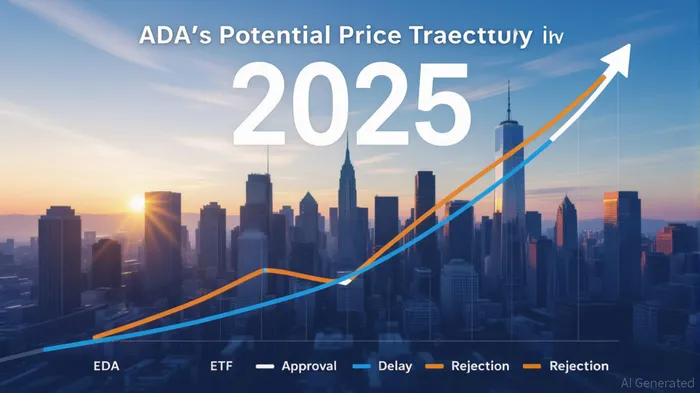
These innovations position ADA as a viable alternative to Bitcoin and EthereumETH-- for investors seeking exposure to a blockchain with a clear roadmap and real-world applications. However, the success of these initiatives hinges on regulatory approval. If the Grayscale Cardano ETF is approved, it could unlock a new wave of institutional capital, driving liquidity and price appreciation. Conversely, continued delays or rejection may prolong uncertainty, dampening enthusiasm for the asset.
Global Regulatory Trends: A Path Forward
While the U.S. remains a regulatory outlier, global trends suggest a growing acceptance of crypto ETFs. The EU's MiCA framework, Singapore's progressive stance, and Canada's approval of Bitcoin and Ethereum ETFs demonstrate that structured, regulated access to digital assets is gaining traction. These developments could indirectly pressure the SEC to adopt a more favorable approach, particularly as global competitors establish clearer frameworks.
For Cardano, this means the October 2025 deadline is not just a U.S.-centric event but a pivotal moment in its global adoption. If the ETF is approved, it could catalyze a bull run by legitimizing ADA as a mainstream asset. If not, the asset may face prolonged volatility until regulatory clarity emerges.
Investment Implications: Balancing Risk and Opportunity
For investors, the key question is whether to bet on Cardano's long-term potential despite regulatory risks. The asset's strong institutional demand, technological roadmap, and ESG alignment make it an attractive candidate for a long-term hold. However, short-term volatility remains a concern, particularly if the SEC's decision is delayed further or if the ETF is rejected.
A prudent strategy would involve a phased approach: allocating a portion of a crypto portfolio to ADA while hedging against regulatory uncertainty. Investors should also monitor global regulatory developments, as approvals in other jurisdictions could provide alternative avenues for exposure.
Conclusion
Cardano's journey in 2025 is a microcosm of the broader crypto market's evolution. While regulatory delays pose a near-term challenge, the asset's institutional adoption and technological advancements offer a compelling long-term value proposition. The October 2025 ETF decision will be a critical inflection point, but investors should also consider the broader global regulatory landscape. For those willing to navigate the uncertainty, Cardano represents a unique opportunity to participate in a blockchain with a clear vision for scalability, sustainability, and institutional integration.

Decoding blockchain innovations and market trends with clarity and precision.
Latest Articles
Stay ahead of the market.
Get curated U.S. market news, insights and key dates delivered to your inbox.


AInvest
PRO
AInvest
PRO



Comments
No comments yet