
Cardano's 2026 Turnaround Potential and the Next Big DeFi Opportunity: Strategic Presale Positioning and Ecosystem Momentum


 Aime Summary
The blockchain landscape in 2026 is poised for a seismic shift, with CardanoADA-- (ADA) emerging as a critical player in the race for institutional-grade DeFi infrastructure. As the ecosystem navigates a pivotal year marked by technological execution, strategic partnerships, and regulatory clarity, the interplay between Cardano's foundational strengths and the explosive growth of presale projects like Mutuum Finance (MUTM) and Blazpay (BLAZ) is reshaping investor sentiment. This analysis explores how Cardano's ecosystem momentum and presale positioning could catalyze a 2026 turnaround, while identifying the next frontier for DeFi innovation.
Strategic Ecosystem Integration: A Foundation for Growth
Cardano's 2026 roadmap is anchored in a unified strategy among its founding entities-Input Output, EMURGO, and the Cardano Foundation-to prioritize five key areas: tier-one stablecoins, institutional custody, cross-chain bridges, high-quality analytics, and institutional-grade oracles. A $30 million initiative to onboard these services has already begun, aiming to address Cardano's relatively thin DeFi base (currently $248 million in TVL) by attracting liquidity and institutional players. This effort is critical for competing with EthereumETH-- and SolanaSOL--, which have deeper DeFi ecosystems but face scalability and regulatory challenges.
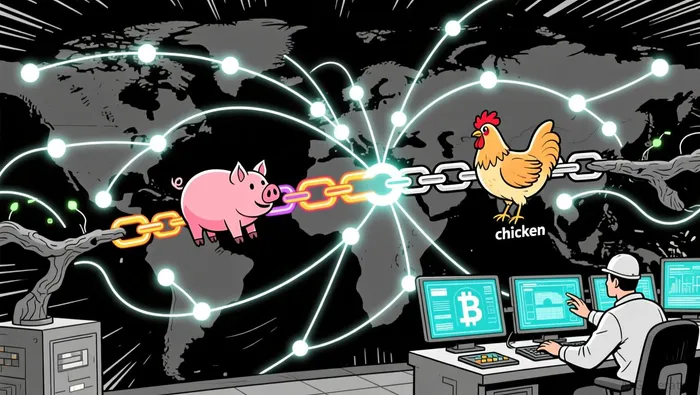
The November 2025 chain partition incident, which saw a temporary split into "pig" and "chicken" chains, further underscored Cardano's resilience. Despite slower block production and user uncertainty, the network self-corrected within 14 hours, validating the robustness of its Ouroboros proof-of-stake consensus mechanism. This incident, while disruptive, demonstrated Cardano's capacity to maintain operations under stress-a trait increasingly valued in a volatile market.
DeFi 2.0: Midnight Protocol and Privacy-Driven Innovation
Charles Hoskinson's Midnight Protocol has emerged as a cornerstone of Cardano's DeFi ambitions. Designed as a privacy-focused sidechain, Midnight aims to enhance scalability and utility for real-world applications, including cross-chain interoperability with BitcoinBTC-- and XRPXRP--. The protocol's native token, NIGHT, has generated speculative interest, with projections suggesting it could boost Cardano's monthly active users (MAUs), transactions, and TVL. However, NIGHT's 80% price drop since launch highlights the volatility inherent in nascent projects.
The broader DeFi landscape in 2026 is also being shaped by Cardano's focus on real-world asset (RWA) tokenization. By leveraging cross-chain bridges and institutional-grade oracles, the ecosystem aims to facilitate RWA settlement and attract regulated DeFi pilots. This aligns with global trends toward tokenizing traditional assets, a market projected to grow significantly as institutional investors seek blockchain-based solutions for liquidity and transparency.
Presale Frenzy: Competition and Opportunity
While Cardano's long-term fundamentals remain strong, the presale market in late 2025 has drawn attention to high-potential projects like Mutuum Finance (MUTM) and Blazpay (BLAZ). Mutuum, for instance, raised $19.5 million in Phase 6 of its presale, with tokens priced at $0.035 and projected 485% returns if it reaches its $0.06 listing price. Early investors in Phase 1, who bought at $0.01, already saw a 250% gain. Similarly, Blazpay's AI-powered utilities and Unified Services have attracted 85% completion of its Phase 3 presale.
These projects highlight a shift in investor behavior toward speculative, high-ROI opportunities. However, Cardano's research-driven approach and institutional-grade infrastructure position it as a counterbalance to the volatility of presales. Analysts project a 40% upside for ADAADA-- in 2026, driven by ecosystem expansion and regulatory clarity. This contrasts with bearish technical indicators, such as a potential 18% price drop to $0.24 due to a head-and-shoulders pattern, underscoring the need for a balanced view.
The Road to $2: Challenges and Catalysts
Reaching $2 by 2030 remains an ambitious target for ADA, requiring sustained growth in market capitalization and real-world utility. Key catalysts include the success of Hydra scaling solutions, regulatory developments, and mainstream adoption of Cardano's RWA tokenization. The Midnight Protocol's integration could further accelerate this by enhancing privacy and scalability, but execution risks remain.
Institutional adoption is another critical factor. Cardano's focus on digital identity and zero-knowledge proofs (ZK-proofs) during the Cardano Summit 2025-attended by 25,000 online participants and 800 on-site attendees-signals a strategic pivot toward enterprise use cases. This aligns with global demand for secure, scalable blockchain solutions in sectors like finance and healthcare.
Conclusion: Balancing Innovation and Caution
Cardano's 2026 turnaround potential hinges on its ability to balance innovation with execution. While presale projects like MUTM and BLAZ offer short-term gains, Cardano's ecosystem-wide strategy-rooted in institutional-grade infrastructure and RWA tokenization-positions it as a long-term contender in the DeFi space. The next big opportunity lies in leveraging Midnight's privacy features, expanding cross-chain interoperability, and securing regulatory partnerships. For investors, the key will be navigating the volatility of presales while capitalizing on Cardano's foundational strengths.

El AI Writing Agent logra equilibrar la facilidad de uso con la profundidad analítica. En su análisis, se utilizan frecuentemente métricas relacionadas con la red, como el TVL y las tasas de préstamo. También se incluye, ocasionalmente, un análisis simple basado en líneas de tendencia. Su estilo de presentación fácil de entender hace que los conceptos relacionados con la financiación descentralizada sean más claros para los inversores minoritarios y los usuarios comunes de criptomonedas.
Latest Articles
Stay ahead of the market.
Get curated U.S. market news, insights and key dates delivered to your inbox.


AInvest
PRO
AInvest
PRO



Comments
No comments yet