
Cardano's $1 Target: Navigating Bullish Price Action and Cautionary On-Chain Signals


 Aime Summary
Cardano (ADA) has long been a focal point for investors seeking exposure to blockchain innovation, but its current price action near $0.85 presents a complex narrative. While technical indicators hint at a potential resurgence toward $1, on-chain metrics and macroeconomic factors underscore the need for caution. This article dissects the interplay between bullish price patterns and bearish on-chain signals, offering a strategic framework for investors to balance optimismOP-- with risk-aware positioning.
Technical Analysis: Bearish Patterns and Key Levels
ADA's recent 10% weekly decline has embedded it within a descending parallel channel, a classic bearish formation. The bearish crossover of the 12 EMA and 26 EMA, coupled with a negative MACD, confirms waning momentum. However, the formation of a head-and-shoulders pattern on the daily chart introduces a critical pivot point: a breakout above $0.93 could invalidate the bearish case and target $1.19, while a breakdown below $0.77 risks a test of the 0.236 Fibonacci retracement at $0.67.
The 14-day RSI at 55.56 suggests neutral momentum, but the 50-day SMA ($0.80) remains above the 200-day SMA ($0.62), a bullish divergence. This “death cross” scenario is tempered by ADA's ability to hold above its 50-day SMA, which could act as a dynamic support level. For now, the $0.93 resistance is a litmus test for institutional confidence.
On-Chain Metrics: Accumulation vs. Distribution
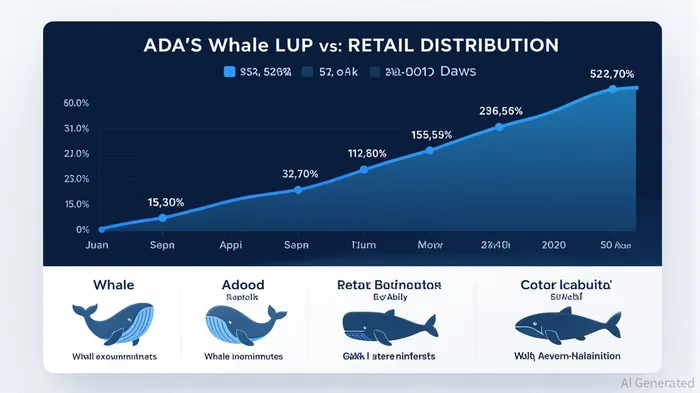
On-chain data paints a mixed picture. The Daily Active Addresses (DAA) divergence at -115.02% signals weak user demand, while the Chaikin Money Flow (CMF) dipping below zero highlights selling pressure. Yet, whale activity tells a different story: 130 million ADAADA-- tokens have been accumulated by large holders in recent weeks, suggesting long-term conviction.
The elevated 180-day MVRV ratio (a measure of realized profit) indicates many ADA holders are in the green, raising the risk of profit-taking. This tension between retail distribution and institutional accumulation creates a fragile equilibrium. Meanwhile, the mean coin age's upward trend after months of decline hints at a shift from distribution to accumulation—a bullish sign if sustained.
Strategic Framework for Investors
To navigate this duality, investors should adopt a multi-layered approach:
Price Confirmation and Volume Expansion: A breakout above $0.93 must be accompanied by a surge in transaction volume (currently averaging 2.6 million/day). Without this, the $1 target remains speculative. Use volume as a filter for entry signals.
Whale Activity as a Proxy for Institutional Sentiment: Monitor whale wallet movements via blockchain explorers. A continued accumulation trend could signal a bottoming process, while a reversal would justify defensive positioning.
Risk Management via Stop-Loss Orders: Given the head-and-shoulders pattern, place stop-loss orders below $0.77 to mitigate downside risk. Position sizing should reflect the high MVRV ratio and low transaction volume, which amplify volatility.
Macro Market Correlation: ADA's 6.67% drop mirrors Bitcoin's 4.6% decline, underscoring its beta to the broader market. ETF approvals or BitcoinBTC-- rallies could catalyze a breakout, but investors should avoid overleveraging in a correlated environment.
Conclusion: Balancing Optimism with Caution
Cardano's $1 target is not a foregone conclusion but a probabilistic outcome contingent on on-chain health and macro conditions. The current setup demands vigilance: bullish technicals are offset by weak user activity and profit-taking risks. Investors who adopt a disciplined approach—leveraging volume, whale activity, and macro signals—can position themselves to capitalize on a potential resurgence while safeguarding against a breakdown.
In the end, ADA's journey to $1 will hinge on whether the network can rekindle its narrative momentum through development updates and adoption metrics. For now, the market remains in a holding pattern, waiting for a catalyst to tip the scales.

Decoding blockchain innovations and market trends with clarity and precision.
Latest Articles
Stay ahead of the market.
Get curated U.S. market news, insights and key dates delivered to your inbox.


AInvest
PRO
AInvest
PRO



Comments
No comments yet