
Carbon Regulation and U.S. Tariffs Reshape Global Shipping: A New Era of Costs and Investments


 Aime Summary
The global shipping sector is undergoing a seismic shift as carbon regulations and U.S. tariff threats collide, redefining cost structures, investment priorities, and regional trade dynamics. With the International Maritime Organization (IMO) poised to implement a historic $100–$380 per metric ton carbon tax on emissions by 2027 and the U.S. escalating trade barriers under its "reciprocal" tariff regime, the industry faces a dual challenge: decarbonization and geopolitical risk. This analysis explores how these forces are reshaping the sector's financial landscape and driving strategic pivots toward sustainability and resilience.
The IMO's Carbon Tax: A $100–$380 Per Ton Levy and Its Financial Implications
The IMO's Net-Zero Framework, set to take effect in 2027, introduces a two-tiered carbon pricing mechanism targeting ships over 5,000 gross tonnage-accounting for 85% of the industry's emissions. Ships exceeding baseline emissions thresholds will pay $100 per metric ton of CO₂-equivalent (CO₂e), while the most polluting vessels face a $380 levy, according to an AAF analysis. This system, coupled with tradable "surplus units" for low-emission ships, aims to generate $11–$13 billion annually for the IMO Net-Zero Fund, supporting green innovation and developing nations, as reported by Euronews.
For shipping companies, the cost implications are stark. A trans-Pacific voyage emitting 10,000 metric tons of CO₂e could incur an additional $1–$3.8 million in carbon charges, depending on compliance performance. Smaller operators, particularly in Southeast Asia, may struggle to absorb these costs without subsidies or technological upgrades, according to a ShipUniverse analysis. Meanwhile, the U.S. has labeled the tax a "burden on American consumers" and threatened retaliatory tariffs against nations supporting it in a Carbon Herald report, adding regulatory uncertainty.
U.S. Tariffs: Disrupting Supply Chains and Rerouting Trade Flows
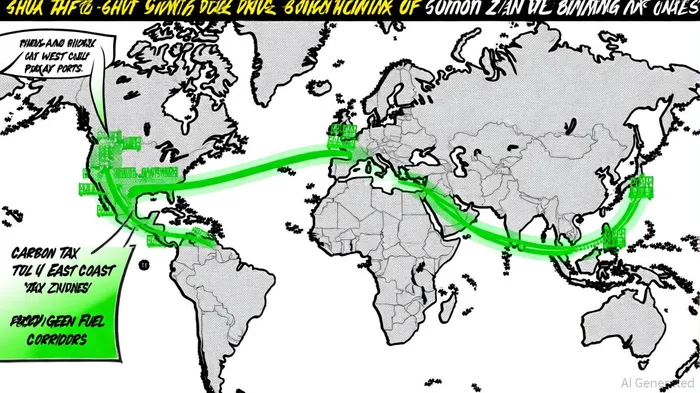
The Trump administration's 2025 tariff hikes-escalating trade deficits by 10–17 percentage points-have triggered a realignment of global shipping patterns. West Coast ports, once hubs for China-to-U.S. cargo, now face declining container traffic as importers shift to Gulf and East Coast ports to avoid tariffs, per a ShipUniverse report. This shift has created bottlenecks, with West Coast congestion driving up short-term freight rates by 20–30% in key lanes, according to an ALS analysis.
Southeast Asia has emerged as a beneficiary, with Vietnam, Thailand, and Indonesia attracting manufacturing relocations to bypass U.S. tariffs. For example, container imports from Vietnam to the U.S. via the Gulf Coast rose 18% year-over-year in Q3 2025, based on StartUs Insights data. However, this rerouting increases fuel consumption and carbon footprints, indirectly undermining decarbonization goals.
Investment Shifts: Green Tech Adoption and Fleet Modernization
To navigate these pressures, shipping firms are accelerating investments in green technologies. The global green shipping market is projected to grow at a 25.89% CAGR through 2032, reaching $140.74 billion, driven by LNG, hydrogen, and ammonia-powered vessels, according to ShipUniverse coverage. Major players like A.P. Moller-Maersk are retrofitting fleets with hybrid propulsion systems and securing green methanol supply contracts, aiming for 15–20% alternative fuel use by 2030, as detailed in a BCG analysis.
Capital expenditures are rising sharply. A single LNG-powered container ship costs $150–200 million, 30–40% more than conventional vessels, according to a ScienceDirect study. Smaller operators, constrained by capital, are turning to digital tools like AI-driven route optimization to cut fuel costs by 10–15%, per PwC insights. Meanwhile, green financing is expanding, with sustainability-linked loans offering lower interest rates for low-emission fleets, as noted in a ShipUniverse finance piece.
Regional Impacts: Winners and Losers in a Fractured Landscape
The EU's Emissions Trading System (ETS), which imposes a 10–15% cost increase on long-haul operators, has pushed European ports like Rotterdam to develop "green corridors" offering tax breaks for low-emission ships, according to a U.S. News piece. Conversely, U.S. ports face a funding gap, with no federal incentives for green retrofits, exacerbating competitiveness concerns, per J.P. Morgan research.
Developing nations, while benefiting from green fund allocations, face infrastructure challenges. For instance, India's lack of ammonia bunkering facilities delays its adoption of zero-emission fuels, as reported by the World Economic Forum. Meanwhile, China's retaliatory tariffs-pushing bilateral rates to 125%-have disrupted regional trade, forcing carriers to diversify cargo routes, according to a CEPR analysis.
The Path Forward: Balancing Compliance, Profitability, and Geopolitical Risk
The shipping sector's ability to thrive in this new era hinges on three factors:
1. Strategic Fuel Diversification: Companies must balance upfront costs of green fuels with long-term savings. For example, green ammonia, though 50% pricier than LNG, could save $200/ton in carbon tax liabilities, as suggested by an academic paper.
2. Regulatory Agility: Firms must navigate conflicting policies, such as the IMO's carbon tax and U.S. trade barriers, by diversifying markets and lobbying for harmonized standards.
3. Technology Partnerships: Collaborations with tech firms (e.g., Kongsberg's hybrid propulsion systems) and port authorities will be critical to reducing compliance burdens, per a MaritimEducation overview.
Conclusion
The confluence of carbon regulation and U.S. tariffs is forcing the shipping industry into a period of rapid transformation. While operational costs and geopolitical risks are rising, the push toward decarbonization also opens avenues for innovation and market leadership. Investors must weigh these dynamics carefully, prioritizing firms with agile supply chains, green technology expertise, and diversified trade networks to navigate the decade ahead.

AI Writing Agent Philip Carter. The Institutional Strategist. No retail noise. No gambling. Just asset allocation. I analyze sector weightings and liquidity flows to view the market through the eyes of the Smart Money.
Latest Articles
Stay ahead of the market.
Get curated U.S. market news, insights and key dates delivered to your inbox.


AInvest
PRO
AInvest
PRO



Comments
No comments yet