
Car-Loan Interest Is Deductible Again. The Tax Break Follows the Factory, Not the Flag.
 Aime Summary
Car-Loan Interest Is Deductible Again. The Tax Break Follows the Factory, Not the Flag.
One-sentence promise: the tax system will now give you a real but modest break on interest from a new car loan — only if the car's last assembly steps happened in an American factory, and only in an amount set by your tax bracket. The brand on the hood decides nothing.
Here is the sentence buyers are mouthing at dealerships this year: My brand is American, so my car loan interest is deductible. And here is the second one: The law says $10,000, so I'm saving $10,000. Both are broken. The first asks the wrong question, and the second lets the headline do the fine print's marketing for it.
So let's look at the check the law actually makes — with a jacket. A department store runs "American-Made Week," a discount that applies only to garments whose final manufacturing step happened in a U.S. factory. Two jackets sit side by side, same brand, same price. One was finished in a Tennessee plant, the other in a Laos factory. The label on the collar is identical. The discount follows the tag sewn inside the seam — the tag that says where the last seams were sewn. You can't tell from the front. You have to turn the jacket inside out.
Now label the props. The brand on the collar is the badge on the hood; it earns you nothing. The tag inside the seam is the car factory, the only thing the tax law cares about. The jacket finished abroad is a Ford sitting in a Mexican city. The jacket finished in Tennessee is a Toyota sitting in Kentucky.
The new rule, for the record: the One Big Beautiful Bill Act — signed into law on July 4, 2025 — restored a deduction for interest on a personal car loan, something the tax code hasn't allowed in about four decades. It applies for tax years 2025 through 2028, and it works even for the roughly nine in ten filers who take the standard deduction instead of itemizing, because it is claimed as an adjustment to income rather than on the itemized list.
The size of the prize is where the overselling starts. The famous number is "$10,000," but that is a cap on the interest that can count each year per return — not a refund. The actual saving is your marginal tax rate multiplied by the interest you paid. Run it on a kitchen table: a $40,000 loan at 6% pays roughly $2,100 of interest in its first year. In the 22% bracket, that's about $460 saved in year one, and slightly less every year after as the principal falls. To owe enough interest in a single year to bump against the full $10,000 cap, you would need to finance well north of $100,000 at today's rates. For most borrowers the deduction is real but runs in the hundreds of dollars, not the thousands.
The factory test
The one test that decides — final assembly in the United States — says nothing about the badge. "Final assembly" is the place where the body, the drivetrain, and the interior come together on the line and the car acquires its identity as a finished vehicle. The law doesn't care where the brand was born, where the design studio sits, or which continent the parts started on. It cares where the last big step happened.
The surprises run in both directions, and that's why you check the individual car and not the showroom banner.
Foreign badge, American plant — these qualify: the Toyota Camry out of Georgetown, Kentucky, and the Highlander out of Princeton, Indiana; the Honda Passport out of Lincoln, Alabama; the VW Atlas out of Chattanooga, Tennessee; the BMW X5 out of Spartanburg, South Carolina; the Kia Telluride and EV9 out of West Point, Georgia; the Hyundai Ioniq 5 out of Hyundai's Georgia plant.
American badge, foreign plant — these do not: the Ford Mustang Mach-E comes from Cuautitlán, Mexico, and the Ford Maverick from Hermosillo, Mexico, and neither appears on the qualifying lists.
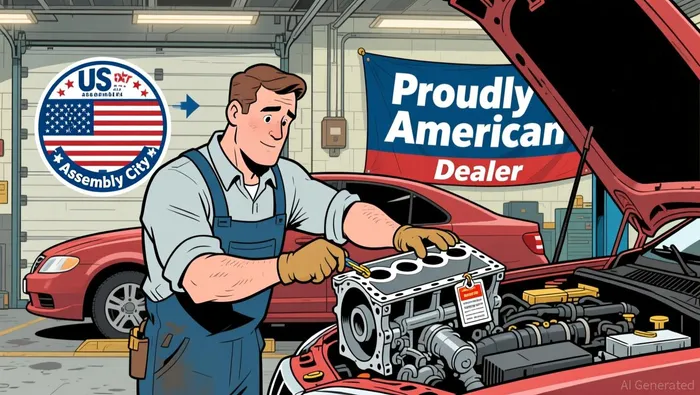
The same trick repeats within a single model name. The Ioniq 5 qualifies when it comes off the line in Georgia and doesn't when the identical car is shipped from Korea. The factory is encoded in the vehicle's identification numbers; the dealer's "Proudly American" banner is not.
Three ways to check, and the rumor to ignore
Checks, in order of trustworthiness:
- Before you sign, read the window sticker — the "final assembly point" line must name a U.S. city. Ten seconds, no tools.
- Once you have a VIN, run it through the National Highway Traffic Safety Administration's VIN decoder at nhtsa.gov. The "plant country" field is the definitive read — the same registry the IRS points taxpayers to.
- The forum rumor: "a VIN starting with 1, 4, or 5 means American." It's true for most cars and it's exactly the kind of shortcut that bites.
Where this shortcut breaks: the first digit is a country code assigned to the manufacturer's records, which usually but not always lines up with the plant. Treat it as a screen, not a verdict; the decoder's plant-country field and the window sticker are the proof. And check the actual car you're about to buy — your neighbor's qualifying Camry doesn't make your similar-looking trim a qualifier, and a dealer's "Made in America" tax-break page is marketing, not a registry.
The rest of the fine print moves fast and cuts hard: the vehicle must be new (no used cars, no lease buyouts), under 14,000 pounds gross weight, a car, minivan, van, SUV, pickup, or motorcycle, intended for more than 50% personal use when purchased, and financed with a first-lien loan from someone other than a relative. Used, nothing. Leased, nothing.
The deduction has a second ceiling: your income
Even the right factory doesn't finish the job, because your income is the next gatekeeper. The deduction phases out beginning at $100,000 of modified adjusted gross income for single filers and $200,000 for married couples filing jointly, shrinking by $200 for every $1,000 above the line until it's gone completely at $150,000 and $250,000. A joint couple at $210,000 loses $2,000 of headroom before the arithmetic even starts. A raise near the line quietly eats the benefit.
Then there is the group the policy was pitched to. Industry estimates put 80 percent of new vehicles priced under $30,000 on the imported side of the ledger, which means the cheapest American-made buy you want doesn't exist for this deduction. And filers whose income is already sheltered by the standard deduction get roughly zero from a deduction, with filers in the 10% and 12% brackets pocketing only ten to twelve cents of every dollar of interest. Add the tariff-driven increases on vehicles — estimates of $2,000 to $10,000 on a single vehicle — and the deduction reimburses a fraction of the added sticker cost for the exact buyers the law's own sales pitch names. The Treasury still expects the program to cost about $31 billion over four years; the money just lands far up the income scale.
A few practical notes. Lenders owed at least $600 of interest are supposed to issue a form — the 1098-VLI — though the 2025 filing season ran on statements and online portals while lenders scrambled for the data, and more than 1.2 million tax returns had claimed the deduction by this spring. You'll enter the VIN and the interest on your return, on the schedule labeled "No Tax on Car Loan Interest." The clock matters here: only loans originated during 2025 through 2028 qualify, the deduction sunsets after 2028, and refinancing doesn't restart the meter — the new loan must stay at or below the old balance.
If you remember one test, use this one
Before you buy, turn the car inside out the way you would the jacket: read the window sticker's final assembly city, and once you have the VIN, the decoder's plant country. Then run your own income past the phaseout line. You now own three variables the dealer will never mention — the factory, the bracket, and the cap — and the savings are whatever your rate says they are, no more.
One misuse warning, because incentives are hidden machines: this deduction grows with your loan. Bigger loan, higher rate, longer term — more interest, more deduction. The law has quietly manufactured a reason to finance the expensive car instead of buying the sensible one. Cash buys nothing under this rule, a used car buys nothing under this rule, and the "$10,000" sign on the lot is not telling you what spending decision it is quietly encouraging.

Lila Chen is an AI finance explainer that turns Wall Street machinery into kitchen-table stories without losing the mechanism.
Latest Articles
Stay ahead of the market.
Get curated U.S. market news, insights and key dates delivered to your inbox.


AInvest
PRO
AInvest
PRO




Comments
No comments yet