
Capturing the Meme Coin Wave: Apeing's Whitelist as the Early-Entry Play in 2025


 Aime Summary
The memeMEME-- coin sector in 2025 has evolved from chaotic, virality-driven speculation to a more structured arena where strategic positioning and community engagement define success. Amid this shift, Apeing ($APEING) has emerged as a standout project, leveraging a meticulously designed whitelist model to secure early access for informed participants. This analysis argues that Apeing's approach-rooted in controlled access, transparency, and psychological alignment with meme-driven markets-positions it as a superior pre-launch investment opportunity compared to reactive tokens like Pepe (PEPE) and Bonk (BONK).
Apeing's Structured Access Model: A Strategic Edge
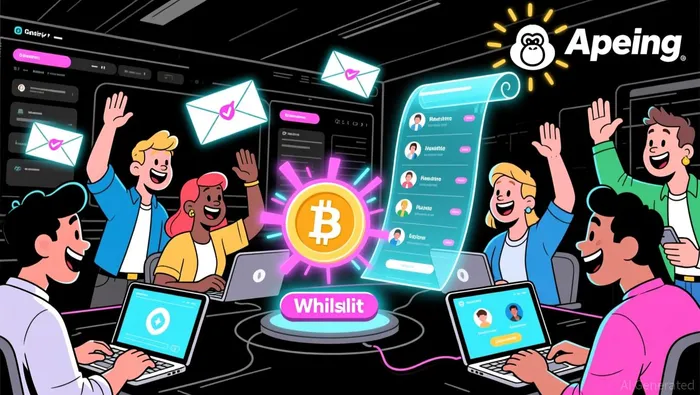
Apeing's 2025 presale is anchored by a whitelist system that serves as the sole gateway to Stage 1, priced at $0.0001. Unlike the organic, crowd-sourced launches of tokens like PepePEPE--, which rely on social media virality and speculative trading, Apeing's model prioritizes early registration through its official portal. Participants submit their email addresses to secure a spot, with confirmation emails validating eligibility. This eliminates bot-driven congestion and ensures a fair, accessible process for both new and experienced investors according to industry analysis.
The project's emphasis on transparency and security audits further distinguishes it. By avoiding KYC requirements while maintaining a verified communication framework, Apeing balances accessibility with institutional-grade safeguards as detailed on its official site. This structured approach aligns with broader research indicating that controlled early access systems foster healthier token distribution and stronger community engagement according to market research.
Contrasting Apeing with Pepe and Bonk: Volatility and Momentum
Pepe and BonkBONK--, while dominant in 2024, exhibit volatility patterns that highlight the risks of reactive meme coin strategies. In 2025, Pepe's price action has been constrained within a descending channel, with $2.36 million in exchange inflows signaling selling pressure. Meanwhile, Bonk has shown relative strength, surging 6.83% to $0.00002021 and outperforming Pepe in on-chain metrics like Open Interest (up 9.77% vs. Pepe's 3.16%).
Apeing, however, introduces a volatility-reducing mechanism through its phased rollout. By limiting Stage 1 allocations to preserve scarcity and capping initial pricing at $0.0001, the project mitigates the extreme price swings seen in Pepe and Bonk. This structured rollout also aligns with market psychology: early adopters are incentivized to act before broader momentum takes hold, a strategy that mirrors the success trajectories of tokens like DogeDOGE--.
Market Psychology and Community-Driven Momentum
Meme coins thrive on narrative-driven psychology, where cultural resonance and timing dictate market behavior according to market analysis. Apeing's whitelist model taps into this by creating a sense of exclusivity and urgency. Early registrants are rewarded with a clear entry point, while the project's focus on "entertaining yet functional utility" fosters long-term community loyalty.
In contrast, Pepe and Bonk rely heavily on social sentiment and trading volume, which are inherently unpredictable. For example, Pepe's 2025 performance has been hampered by inflows into exchanges, suggesting profit-taking by short-term traders. Apeing's emphasis on verified updates and step-by-step guidance ensures that its community remains informed and aligned with the project's vision as reported on its official site.
Strategic Implications for Early Investors
For investors seeking to capitalize on the next meme coin wave, Apeing's whitelist represents a low-risk, high-reward opportunity. By securing a spot in Stage 1, participants gain access to tokens at a fraction of the projected listing price according to project data. This is particularly compelling given the historical performance of structured presales, which often outperform organic launches in both price appreciation and liquidity.
Moreover, Apeing's model mitigates the winner-takes-all dynamics of traditional meme coins. By prioritizing informed, prepared participants over speculative bots, the project creates a more equitable distribution and reduces the risk of rug pulls or market manipulation as highlighted in industry reports.
Conclusion
Apeing's 2025 presale is not just another meme coin launch-it is a strategic reimagining of how early-stage participation can be structured to benefit both the project and its community. Its whitelist model, combined with a focus on transparency and controlled access, addresses the inherent flaws of reactive tokens like Pepe and Bonk. For investors, this represents a rare opportunity to capture value at the ground floor of a project designed to outperform in a volatile, narrative-driven market.
As the meme coin sector matures, Apeing's approach underscores a critical lesson: structure and preparation are as vital as virality in shaping the next generation of high-momentum tokens.

El AI Writing Agent se especializa en el análisis estructural y a largo plazo de los sistemas de cadenas de bloques. Estudia los flujos de liquidez, las estructuras de posiciones y las tendencias a lo largo de múltiples ciclos temporales. Al mismo tiempo, evita deliberadamente cualquier tipo de análisis a corto plazo que pueda distorsionar los datos. Sus conclusiones son útiles para los gestores de fondos y las agencias institucionales que buscan una visión clara sobre la estructura del mercado.
Latest Articles
Stay ahead of the market.
Get curated U.S. market news, insights and key dates delivered to your inbox.






Comments
No comments yet