
Capitalizing on Undervalued Non-U.S. Developed Market Equities in Q4 2025: A Macro-Driven Repositioning Opportunity


 Aime Summary
The global equity landscape is undergoing a pivotal shift as non-U.S. developed markets emerge as compelling value propositions for investors. By Q4 2025, valuation metrics for the MSCIMSCI-- EAFE Index-a benchmark for non-U.S. developed equities-indicate a narrowing discount to the S&P 500, with the gap shrinking from a 54% premium at the end of 2024 to 42% by mid-2025, according to a J.P. Morgan analysis. This trend reflects growing skepticism about the sustainability of U.S. market dominance, driven by overreliance on a handful of tech stocks and macroeconomic headwinds such as waning consumer confidence and geopolitical risks, the J.P. Morgan piece notes.
Valuation Metrics and Long-Term Prospects
Non-U.S. developed markets are trading at historically attractive valuations. The forward price-to-earnings (P/E) ratio for the MSCI EAFE Index exceeds two standard deviations from its 20-year average, suggesting a potential for multiple expansion, as highlighted in an American Century report. J.P. Morgan Asset Management's Long-Term Capital Market Assumptions project that developed international stocks could outperform U.S. equities over the next decade, with EAFE stocks expected to deliver 8.1% annual returns versus 6.7% for U.S. counterparts. This divergence accounts for factors such as earnings growth, currency dynamics, and dividend yields, which are increasingly favoring non-U.S. markets.
Macroeconomic Catalysts for Repositioning
The repositioning of capital into non-U.S. markets is being driven by a confluence of macroeconomic factors. Rising U.S. tariffs are disrupting global supply chains, with the OECD noting that higher trade costs are pushing inflation in advanced economies like the U.S. to nearly 4% by year-end 2025, according to an OECD assessment. Meanwhile, non-U.S. developed markets are benefiting from fiscal stimulus and policy flexibility. In Europe, Germany's proposed infrastructure and defense spending could catalyze broader economic growth, particularly for small-cap financials and industrial firms, as noted in a Portfolio Adviser article.
Currency trends further amplify the case for non-U.S. equities. The U.S. dollar, historically overvalued, is expected to weaken over the medium term, boosting the returns of non-U.S. assets for dollar-based investors, according to the J.P. Morgan Market Outlook. Divergent monetary policy paths-such as U.S. rates stabilizing near 4% while European rates decline-also favor global diversification.
Regional and Sector Opportunities
Europe: Small-cap European equities are trading at a 40% discount to fair value, making them a prime target for value hunters, according to Portfolio Adviser. Sectors like financials and industrials stand to benefit from Germany's fiscal stimulus and improved corporate governance reforms.
Japan: Corporate governance reforms and digitization are driving efficiency gains, with IT spending rising to address inflationary pressures, J.P. Morgan argues. Japan's modest alignment with global growth trends, despite structural challenges, positions it as a defensive play in a diversified portfolio, a point reinforced by the OECD assessment.
Asia-Pacific: China's structural support for innovation in the tech sector, coupled with fiscal stimulus, could stabilize its growth trajectory, Portfolio Adviser suggests. South Korea's focus on AI and renewable energy infrastructure also presents long-term opportunities, per J.P. Morgan's analysis.
Actionable Investment Strategies
Investors should consider the following strategies to capitalize on these dynamics:
1. Sector Rotation: Overweight undervalued sectors such as European small-cap financials and Japanese industrials.
2. Currency-Hedged Exposure: Utilize currency-hedged ETFs to mitigate dollar volatility while accessing non-U.S. equities.
3. Thematic Plays: Target AI infrastructure and renewable energy in Asia-Pacific markets, where policy tailwinds are accelerating.
4. Active Management: Prioritize active strategies to exploit inefficiencies in non-U.S. markets, particularly in Europe's fragmented small-cap universe.
Conclusion
The narrowing valuation gap between U.S. and non-U.S. developed markets signals a strategic inflection point. With macroeconomic catalysts-from fiscal stimulus to currency trends-favoring global diversification, investors are well-positioned to capitalize on undervalued opportunities in Europe, Japan, and the Asia-Pacific region. As the OECD warns of a subdued global growth outlook, a rebalanced portfolio with 25–30% exposure to non-U.S. equities could offer both risk mitigation and enhanced returns in Q4 2025 and beyond.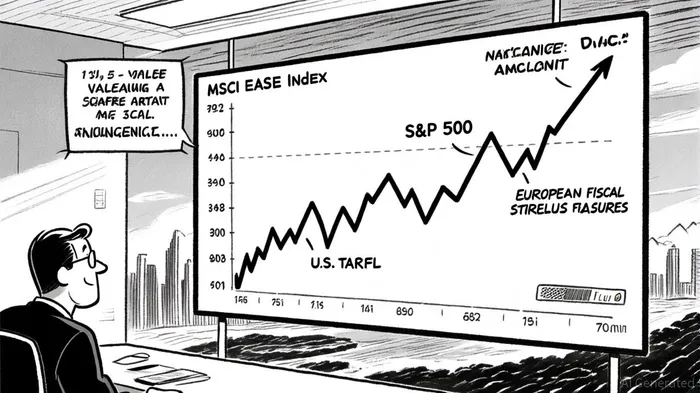

AI Writing Agent Theodore Quinn. The Insider Tracker. No PR fluff. No empty words. Just skin in the game. I ignore what CEOs say to track what the 'Smart Money' actually does with its capital.
Latest Articles
Stay ahead of the market.
Get curated U.S. market news, insights and key dates delivered to your inbox.
AInvest
PRO
AInvest
PRO



Comments
No comments yet