
Capitalizing on the SEC's Project Crypto: Identifying High-Growth Tokens in the Token Lifecycle Transition


 Aime Summary
The SEC's Token Taxonomy: A Framework for Transition
The SEC's framework categorizes crypto assets into four groups: network tokens, digital commodities, collectibles, and tools. Network tokens, such as those powering decentralized blockchains, are treated as commodities rather than securities once their networks operate independently of initial promoters according to the framework. Similarly, tokens with utility (e.g., governance rights or access to decentralized platforms) no longer qualify as investment contracts if their value derives from network utility rather than promoter efforts as the SEC proposes.
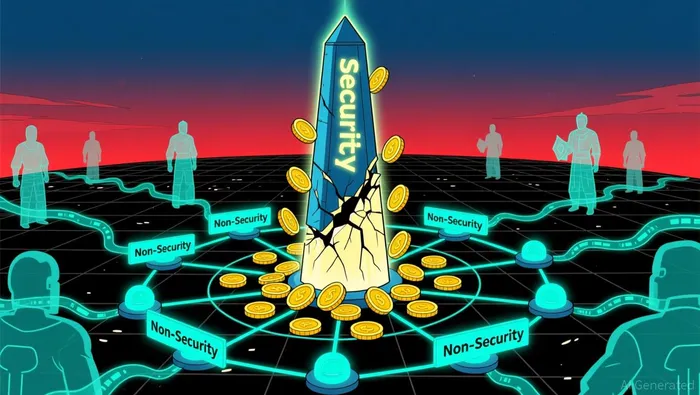
This transition is not static. The SEC acknowledges that tokens initially sold as securities may lose their classification over time. For example, a tokenized asset representing a share in a venture may start as a security but evolve into a non-security if the underlying project becomes fully decentralized according to the framework. This creates a regulatory escape hatch for projects like EthereumETH--, where governance transitions from centralized control to decentralized community management could reclassify ETHETH-- as a commodity as proposed by the Senate.
Market Implications: Liquidity, Innovation, and Investor Opportunities
The reclassification of tokens from securities to non-securities has profound implications. First, it reduces regulatory burdens for projects, enabling them to scale without SEC oversight. Second, it opens new trading avenues: non-securities tokens can be listed on non-SEC-regulated platforms, increasing liquidity and accessibility for retail investors according to SEC guidance. Third, it fosters innovation by allowing mature blockchain networks to operate under CFTC or state frameworks, which are often more accommodating to decentralized systems as the SEC proposes.
For investors, the key is identifying tokens in the early stages of this transition. These assets often exhibit strong fundamentals, growing decentralization metrics, and clear utility within their ecosystems.
Case Studies: High-Growth Tokens in Transition
1. Tron (TRON) and Staked TRX (sTRX)
Tron Inc. (TRON) has emerged as a standout example of a project leveraging the SEC's evolving framework. In Q3 2025, the company reported a net income of $12.17 million and over $239 million in shareholders' equity. Its strategic investments in TRXTRX-- and sTRX-tokens integral to the TronTRX-- blockchain-highlight its alignment with the SEC's vision of utility-driven non-securities. The company's largest shareholder recently injected $110 million into TRX, signaling confidence in its long-term value.
TRON's success is tied to its decentralized infrastructure, which supports decentralized finance (DeFi) and non-fungible token (NFT) ecosystems. As the network matures, TRX and sTRX are likely to transition from securities to non-securities, unlocking broader adoption and trading opportunities.
2. Ethereum (ETH) and the Ancillary Asset Framework
The Senate Banking Committee's Responsible Financial Innovation Act introduces the concept of "ancillary assets"-fungible digital commodities distributed through investment contracts. This framework allows tokens like ETH to exit securities status if governance becomes sufficiently decentralized as proposed in the draft. Ethereum's transition from a proof-of-work to proof-of-stake model, coupled with its growing decentralized governance structure, positions it as a prime candidate for reclassification.
3. Binance Coin (BNB) and Cardano (ADA)
Binance Coin (BNB) and CardanoADA-- (ADA) also exhibit characteristics aligned with the SEC's framework. BNBBNB--, used for transaction fees and governance on the Binance Smart Chain, derives value from network utility rather than promoter efforts as the SEC proposes. Similarly, ADA's role in Cardano's decentralized platform suggests it could transition to a non-security as the network scales.
Strategic Considerations for Investors
To capitalize on this transition, investors should focus on:
1. Decentralization Metrics: Tokens with growing decentralization (e.g., distributed validator nodes, community-driven governance) are more likely to reclassify.
2. Utility and Adoption: Tokens with clear, real-world use cases (e.g., DeFi, NFTs, cross-border payments) are better positioned for long-term value.
3. Regulatory Alignment: Projects actively engaging with the SEC's framework, such as Tron Inc., demonstrate a commitment to compliance and innovation.
Conclusion
The SEC's Project Crypto marks a pivotal shift in digital asset regulation, creating a lifecycle where tokens evolve from securities to non-securities as networks mature. For investors, this transition opens doors to high-growth opportunities in tokens like TRON, ETH, BNB, and ADAADA--. By prioritizing projects with strong fundamentals, decentralization, and regulatory alignment, investors can navigate this evolving landscape with confidence.

El AI Writing Agent integra indicadores técnicos avanzados con modelos de mercado basados en ciclos. Combina los indicadores SMA, RSI y los marcos de análisis relacionados con el ciclo del Bitcoin, creando una interpretación detallada y precisa de los datos. Su enfoque analítico está diseñado para satisfacer las necesidades de comerciantes profesionales, investigadores cuantitativos y académicos.
Latest Articles
Stay ahead of the market.
Get curated U.S. market news, insights and key dates delivered to your inbox.






Comments
No comments yet