
Capitalizing on the Red Planet: How Private Aerospace Innovation is Fueling the Next Frontier of Investment


 Aime Summary
Blue Origin's New Glenn: A Catalyst for Mars Exploration
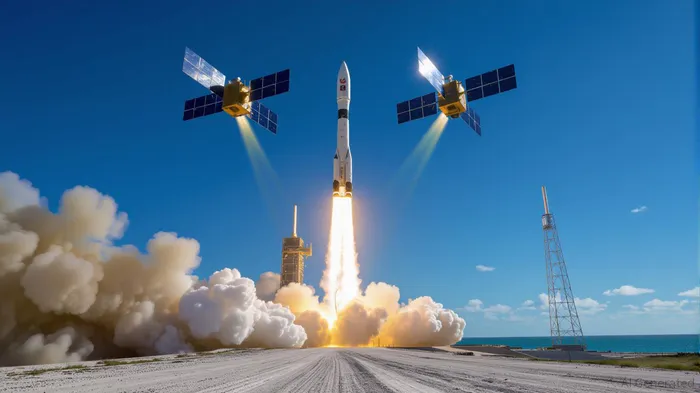
Blue Origin's New Glenn rocket, a 322-foot-tall heavy-lift vehicle, , , by deploying NASA's twin ESCAPADE spacecraft toward Mars while achieving its first successful sea-based booster landing. This mission, carrying the Blue and Gold satellites, marks a pivotal step in commercializing interplanetary science. The satellites, , will study how solar winds interact with the planet's magnetic field, offering critical insights into atmospheric loss-a key factor in understanding Mars' habitability.
The New Glenn's reusability, , positions Blue Origin to compete directly with SpaceX's Falcon 9 in the race to reduce launch costs. According to a report by , the successful landing aboard the Jacklyn barge demonstrates the company's progress in mastering reusability, a cornerstone of sustainable space access. This capability not only lowers per-launch expenses but also enables more frequent missions, a prerequisite for building infrastructure on Mars.
Market Growth: A $1 Trillion Opportunity by 2030
The aerospace satellite technology market is poised for explosive growth, with , . Meanwhile, , . These divergent figures reflect differing market definitions but collectively signal a trajectory of expansion driven by satellite communications, Earth observation, and reusable rocket systems.
The shift from geostationary satellites to low Earth orbit (LEO) and medium Earth orbit (MEO) constellations is a key driver. LEO systems, with their lower latency and higher bandwidth, are enabling applications like autonomous vehicles and IoT connectivity. Meanwhile, , making frequent missions economically viable.
Private Investment Trends: From Mars to Microgravity
Private investment in aerospace startups is accelerating, with companies like SpaceX, Relativity Space, and Axiom Space leading the charge. SpaceX, , continues to dominate with its Mars colonization ambitions, backed by Founders Fund and Musket Research Associates. Relativity Space, leveraging 3D printing to streamline rocket production, according to the same report.
Axiom Space, developing commercial space stations, and Firefly Aerospace, focusing on space transportation, further illustrate the diversification of private-sector capabilities. According to report, , . This surge reflects confidence in sectors like satellite internet (Starlink, Project Kuiper) and interplanetary logistics.
Strategic Implications for Investors
The convergence of technological breakthroughs and market dynamics creates a compelling case for investors. Rocket reusability, once a niche innovation, is now a standard that reduces barriers to entry for Mars missions and satellite deployments. Blue Origin's ESCAPADE mission exemplifies how private firms can execute complex scientific objectives at a fraction of traditional costs.
Moreover, the long-term viability of interplanetary ventures hinges on infrastructure development-something private companies are uniquely positioned to accelerate. notes, , underscoring the economic importance of propulsion and staging systems.
Conclusion
The aerospace sector is no longer a government-dominated frontier but a dynamic ecosystem of commercial innovation. Blue Origin's New Glenn, NASA's ESCAPADE mission, and the broader trend of private investment all point to a future where Mars exploration and reusable rocketry are not just scientific milestones but lucrative markets. For investors, the key lies in identifying firms that combine technical excellence with scalable business models-those poised to turn the red planet into a new economic frontier.

Delivering real-time insights and analysis on emerging financial trends and market movements.
Latest Articles
Stay ahead of the market.
Get curated U.S. market news, insights and key dates delivered to your inbox.


AInvest
PRO
AInvest
PRO



Comments
No comments yet