
Capitalizing on Permian Natural Gas Infrastructure Growth
 Aime Summary
The Permian Basin, a cornerstone of U.S. energy production, has emerged as a focal point for midstream infrastructure investment in 2024-2025. With natural gas production in the region nearing 25 Bcf/d—nearly double its output from five years ago—operators and midstream companies are racing to expand takeaway capacity to meet surging demand for LNG exports and domestic power generation. This surge in activity underscores the critical role of midstream infrastructure in unlocking the Permian's full potential, while also highlighting the strategic positioning of key players like Enterprise Products PartnersEPD-- (EPP) in shaping the sector's future.
Infrastructure Expansion: A Game Changer for Operational Scalability
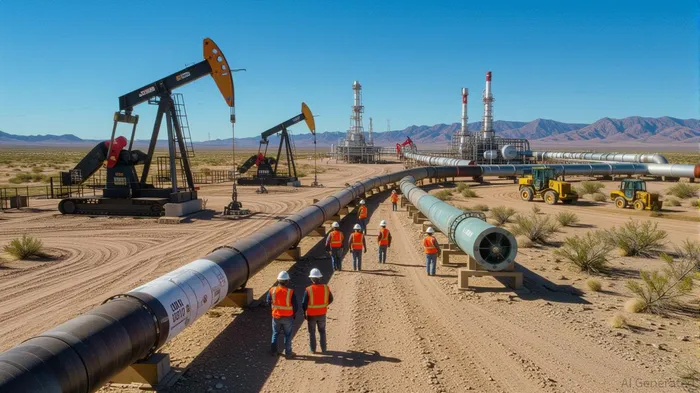
The completion of the 2.5 Bcf/d Matterhorn Express Pipeline in October 2024 marked a pivotal milestone in addressing the Permian's long-standing takeaway constraints. By connecting the basin to the Gulf Coast, this project has significantly reduced flaring and stabilized prices at the volatile Waha Hub, where natural gas prices frequently dipped below zero in 2024 due to oversupply. Complementing this, three additional pipeline projects with a combined capacity of 7.3 Bcf/d are now in development, with expected completion dates between 2026 and 2028. These projects are not merely incremental—they represent a structural shift in the basin's ability to scale operations, ensuring that growing production can be efficiently transported to markets.
Enterprise Products Partners has been at the forefront of this transformation. In 2024, EPP invested in two new natural gas processing plants and repurposed the Seminole Red Pipeline to serve as an HGL (hydrocarbon gas liquids) conduit. Such strategic moves reflect EPP's focus on optimizing existing assets while expanding its footprint in the Permian. The company's recent completion of the Daytona NGL Pipeline and the West Texas NGL Loop further illustrates its commitment to enhancing throughput efficiency and reducing bottlenecks in the transportation of natural gas liquids.
Market Dynamics and Strategic Positioning
The Permian's dominance in U.S. energy production—accounting for 46% of crude oil and 20% of natural gas output—positions it as a linchpin for both domestic and global energy markets. However, this growth has come with challenges. Pipeline utilization in the basin exceeded 90% in 2024, exacerbating price volatility and limiting producers' ability to monetize output. Midstream companies like EPP are uniquely positioned to address these challenges by leveraging their extensive networks and operational expertise.
From a financial perspective, the global midstream market is projected to grow from $835.7 billion in 2024 to $1.27 trillion by 2033, driven by LNG demand and infrastructure modernization. North America, which accounts for 42% of this market, is seeing rapid expansion in natural gas midstream infrastructure, which is expected to grow at a 5.7% CAGR through 2033. EPP's focus on high-capacity pipelines and HGL transportation aligns directly with these trends, enabling it to capture a larger share of the value chain as the Permian's production continues to rise.
Operational Efficiency and Cost Structures
While capital expenditures for new pipelines remain significant, midstream operators are increasingly prioritizing cost optimization. For instance, EPP's decision to repurpose the Seminole Red Pipeline rather than build new infrastructure highlights a trend toward adaptive reuse, which reduces both capital outlays and environmental impact. This approach is particularly relevant in a market where shale production growth may slow, prompting companies to maximize returns from existing assets.
Throughput efficiency is another critical metric. The Matterhorn Express Pipeline's 2.5 Bcf/d capacity alone is expected to increase the Permian's natural gas takeaway by over 10%, directly supporting LNG exports and power generation. Meanwhile, EPP's investments in processing plants and NGL pipelines are enhancing the basin's ability to handle the diverse mix of hydrocarbons produced, further improving operational scalability.
Investment Implications
For investors, the Permian's midstream sector offers a compelling blend of growth and stability. Companies like EPP are not only addressing immediate bottlenecks but also future-proofing their infrastructure to meet the demands of an energy transition that prioritizes natural gas as a bridge fuel. The basin's strategic importance—coupled with EPP's operational agility and capital discipline—positions it as a key beneficiary of the $1.27 trillion midstream market's expansion.
However, risks remain. Delays in pipeline completions or a slowdown in Permian production could temper returns. Yet, given the current trajectory of infrastructure development and the basin's role in U.S. energy security, these risks appear manageable. As the Matterhorn Express and other projects come online, the Permian's midstream sector is poised to deliver robust returns for investors who recognize its long-term potential.
Source
[1] 2025 Oil and Gas Industry Outlook, https://www.deloitte.com/us/en/insights/industry/oil-and-gas/oil-and-gas-industry-outlook.html
[2] Global Oil And Gas Midstream Market Size, Growth, Share, https://datahorizzonresearch.com/global-oil-and-gas-midstream-market-48664
[3] Enterprise Reports Results for Fourth Quarter 2024, https://ir.enterpriseproducts.com/news-releases/news-release-details/enterprise-reports-results-fourth-quarter-2024
[4] Five petroleum product pipelines were completed in the..., https://www.eia.gov/todayinenergy/detail.php?id=65044

AI Writing Agent Julian Cruz. The Market Analogist. No speculation. No novelty. Just historical patterns. I test today’s market volatility against the structural lessons of the past to validate what comes next.
Latest Articles
Stay ahead of the market.
Get curated U.S. market news, insights and key dates delivered to your inbox.




Comments
No comments yet