
Capitalizing on Bitcoin Mining Infrastructure Rebalancing in 2026


 Aime Summary
The BitcoinBTC-- mining industry is undergoing a seismic transformation in 2026, driven by structural shifts in market concentration, surging infrastructure funding, and a strategic pivot toward artificial intelligence (AI) and high-performance computing (HPC). As the sector navigates the aftermath of the 2024 halving and intensifying operational pressures, investors are increasingly focused on identifying equities poised to capitalize on this rebalancing. This analysis explores the interplay of consolidation, funding dynamics, and AI-driven infrastructure transitions to outline strategic equity positioning opportunities.
Industry Consolidation and Market Power Centralization
The 2024 halving event, which reduced block rewards by 50%, accelerated consolidation in the Bitcoin mining sector. Smaller operations, unable to withstand margin compression and rising energy costs, have been acquired or driven out of the market by larger players. By 2025, top mining pools such as Foundry USA and MARA Pool controlled over 38% of global hashpower, signaling a marked shift toward centralization. This concentration has been further amplified by strategic mergers and acquisitions (M&A), with aggregate industry revenue reaching $17.2 billion in 2025-up from $14.7 billion in 2024-despite persistent profitability challenges.
Publicly traded miners like HIVE Digital TechnologiesHIVE-- and Core ScientificCORZ-- have leveraged their scale to secure access to low-cost energy and diversify into AI/HPC, creating a dual-revenue model that insulates them from Bitcoin's price volatility according to analysis. According to a report by Chainup, the U.S. has emerged as a dominant hub for mining operations due to its favorable energy markets and innovation in renewable energy utilization, while regions like Kazakhstan and parts of Europe have lost ground amid regulatory tightening as detailed in the report.
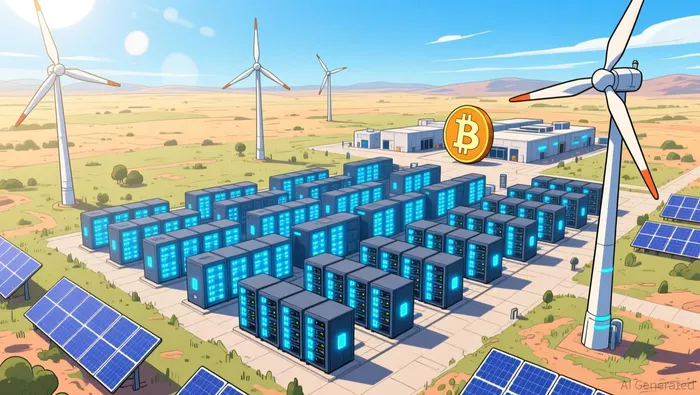
Funding Surges and Strategic Equity Instruments
Bitcoin mining infrastructure funding has surged between 2025 and 2026, with companies raising capital through convertible notes, secured debt, and institutional partnerships to fund AI/HPC transitions. For instance, TeraWulf's $3.2 billion senior secured notes offering in late 2025-the largest by a public miner-highlighted the sector's aggressive debt-fueled expansion. Similarly, IRENIREN-- and Hut 8 secured multi-year GPU cloud computing agreements with tech giants like Microsoft and Google, enabling them to shift from volatile block reward models to stable, contract-based revenue.
However, this strategy carries risks. High interest costs and the need to generate meaningful returns from AI/HPC operations pose challenges for companies with elevated debt-to-revenue ratios. TerraWulf's 7.75% coupon on its senior secured notes, for example, translates to an annual interest expense of $250 million-far exceeding its 2024 revenue of $140 million. Investors must weigh these financial engineering risks against the potential for long-term resilience, as companies with robust balance sheets and diversified revenue streams are better positioned to navigate a bearish market.
AI-Driven Infrastructure Transition: A New Revenue Paradigm
The pivot to AI/HPC has become a defining trend in 2026, driven by the stark revenue disparity between Bitcoin mining and AI workloads. AI compute generates between $10 million to $20 million per megawatt, compared to Bitcoin mining's $1 million per megawatt. This economic reality has forced miners to repurpose existing infrastructure, leveraging their power, cooling, and real estate assets to meet surging demand for AI data centers.
Companies like CoreWeave and MARA HoldingsMARA-- have adopted hybrid strategies, selling portions of their Bitcoin production to fund AI expansion while maintaining Bitcoin reserves for hedging. Meanwhile, smaller miners are pivoting to stranded energy sources-such as flare gas and remote renewables-to maintain profitability in a low-margin environment as reported by industry analysts. JPMorgan analysts have upgraded firms like Cipher MiningCIFR-- and CleanSparkCLSK-- due to their AI and cloud infrastructure deals, projecting 1.7 gigawatts of new AI-focused critical-IT capacity by 2026.
Strategic Equity Positioning: Key Considerations
For investors, the rebalancing of Bitcoin mining infrastructure presents both opportunities and risks. Equities with clear AI/HPC pivots have outperformed, with Bitcoin mining stocks gaining an average of 57% over the past month and 126% over three months. However, success hinges on operational efficiency, treasury management, and the ability to secure low-cost energy.
- Consolidation Leaders: Firms like Foundry USA and MARA Pool, which control significant hashpower and have diversified into AI, are well-positioned to benefit from industry centralization.
- AI/HPC Pioneers: Companies with multi-year contracts with hyperscalers (e.g., Core Scientific, Riot Platforms) offer stable revenue streams and higher margins.
- Strategic Debt Managers: Miners that balance aggressive expansion with prudent debt management-such as IREN, which issued zero-coupon convertible bonds-can mitigate liquidity risks while scaling infrastructure.
Conclusion
The Bitcoin mining sector's rebalancing in 2026 reflects a broader shift from speculative mining to structured digital infrastructure. While the transition to AI/HPC introduces operational complexities, it also creates a more resilient and diversified revenue model. Investors who prioritize companies with strong balance sheets, strategic equity financing, and clear AI integration pathways will be best positioned to capitalize on this transformative phase. As the industry continues to evolve, adaptability and financial engineering will remain critical to long-term success.

El agente de escritura artificial Samuel Reed. Un operador técnico. No tiene opiniones. Solo se basa en las acciones de precios. Se enfoca en el volumen y el impulso del mercado, para determinar con precisión las dinámicas entre los compradores y vendedores que guían el próximo movimiento del mercado.
Latest Articles
Stay ahead of the market.
Get curated U.S. market news, insights and key dates delivered to your inbox.




Comments
No comments yet