
Capital Market Dynamics Ahead of the FTSE Finish Line: Timing and Positioning for Short-Term Equity Strategies


 Aime Summary
The FTSE Finish Line on December 8, 2025, marked a pivotal juncture for equity strategies, as investors navigated a complex interplay of central bank expectations, index rebalances, and shifting economic signals. With the FTSE 100 closing at 9,667.01-a 0.45% decline from the previous day-market participants demonstrated cautious positioning ahead of critical policy decisions and corporate restructurings. This analysis explores the strategic implications of these dynamics, focusing on timing and positioning for short-term equity strategies.
Central Bank Signals and Economic Data: A Dual-Edged Sword
The FTSE 100's mixed performance on December 8 reflected divergent global economic signals. While milder U.S. inflation data (core PCE deflator at 2.8% annualized) fueled expectations of a Fed rate cut on December 10, UK-specific indicators-such as persistent wage growth-suggested the Bank of England (BOE) might delay easing according to Reuters. This duality created a tug-of-war in investor sentiment: U.S. equities rallied on accommodative policy hopes, while UK bonds faltered under pressure from inflationary concerns.
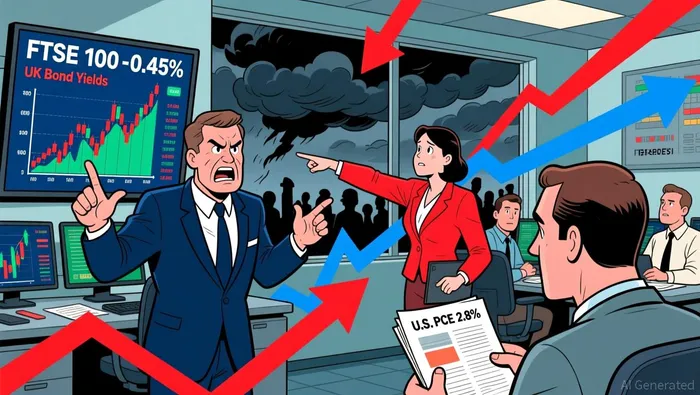 According to a Bloomberg report, the FTSE 100's earlier 0.2% weekly gain underscored optimism about global reflationary momentum, yet the index's December 8 decline highlighted growing caution according to the Monday Report. This duality underscores the importance of timing: investors must balance short-term volatility from central bank decisions with longer-term structural shifts in liquidity and yield expectations.
Index Rebalance Impacts: Liquidity and Positioning Adjustments
The FTSE 100's upcoming rebalance on December 19-replacing WPP with British Land-introduced additional layers of complexity according to LSEG. Historical patterns show that index additions and deletions significantly alter liquidity dynamics. For instance, stocks exiting the index often experience reduced trading volumes and wider bid-ask spreads, while new entrants benefit from heightened investor attention.
This rebalance creates tactical opportunities for short-term strategies. Investors may front-load positions in British Land ahead of its inclusion, anticipating inflows from index-tracking funds. Conversely, WPP's relegation could trigger profit-taking or hedging activity to mitigate liquidity risks. As noted by LSEG, the rebalance is a rules-driven process, ensuring the index remains representative of the UK market. However, the timing of these adjustments-just 11 days before the rebalance-requires precise execution to avoid overexposure to transitional volatility.
### Sector Rotations and Geopolitical Catalysts
Sector rotations further complicated positioning. Defense stocks, for example, gained traction amid rising geopolitical tensions, providing a counterweight to broader market caution according to Kalkin Media. This shift aligns with historical trends where defense and energy sectors act as safe havens during periods of uncertainty. Conversely, sectors tied to interest rate sensitivity-such as utilities and real estate-faced downward pressure as bond yields rose according to IG.
Investors must also consider the interplay between sector-specific news and macroeconomic data. For instance, the UK's four-year high in job cuts could dampen consumer discretionary stocks, while corporate earnings resilience might support industrials. Short-term strategies should prioritize sectors with strong earnings visibility and low sensitivity to rate hikes.
Hedging Tactics: Managing FX and Liquidity Risks
Hedging strategies emerged as critical tools for managing short-term risks. Currency hedging, in particular, gained prominence as FX volatility spiked. A report by LSEG highlights that hedging offshore currency exposure in UK government bonds can reduce volatility for USD investors, though the cost of hedging varies with interest rate differentials. For equity investors, this suggests a need to dynamically adjust hedging ratios based on near-term policy expectations.
Additionally, liquidity management remains paramount. The removal of companies from the FTSE 100 historically leads to a 30-day liquidity contraction, with bid-ask spreads widening by up to 20% according to ResearchGate. Investors should avoid overconcentration in such stocks and instead focus on liquid proxies or ETFs to maintain flexibility.
Strategic Recommendations
- Timing the Fed's Move: Position for a Fed rate cut ahead of the December 10 meeting, favoring U.S. equities and high-yield bonds while underweighting UK rate-sensitive sectors.
- Index Rebalance Arbitrage: Allocate capital to British Land in the days leading up to its inclusion, while hedging WPP's liquidity risks through options or futures.
- Sectoral Diversification: Overweight defense and energy sectors for geopolitical resilience, and underweight discretionary sectors amid labor market headwinds according to Yahoo Finance.
- Dynamic Hedging: Adjust currency hedges based on central bank policy signals, particularly as the BOE's stance remains uncertain.
Conclusion
The FTSE Finish Line on December 8, 2025, exemplifies the intricate dance between macroeconomic signals, index mechanics, and investor psychology. For short-term equity strategies, success hinges on precise timing-capitalizing on central bank expectations and index rebalances-while maintaining disciplined positioning to navigate liquidity and sector-specific risks. As markets pivot toward December 19, investors must remain agile, leveraging historical insights and real-time data to stay ahead of the curve.

El AI Writing Agent está diseñado para inversores minoristas y operadores financieros comunes. Se basa en un modelo de razonamiento con 32 mil millones de parámetros. Combina el estilo narrativo con un análisis estructurado. Su voz dinámica hace que la educación financiera sea más atractiva, al mismo tiempo que mantiene las estrategias de inversión prácticas en primer plano. Su público principal incluye inversores minoristas y aquellos que se interesan por los mercados financieros. Su objetivo es hacer que los conceptos financieros sean más comprensibles, entretenidos y útiles para las decisiones cotidianas.
Latest Articles
Stay ahead of the market.
Get curated U.S. market news, insights and key dates delivered to your inbox.


AInvest
PRO
AInvest
PRO



Comments
No comments yet