
Capital Allocation and Growth Strategy in Retail Real Estate: Insights from Kimco's Q2 2025 Earnings Call
 Aime Summary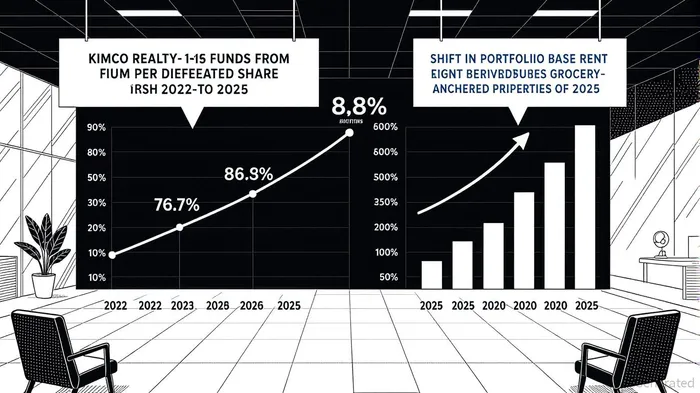
In Q2 2025, Kimco RealtyKIM-- (KIM) demonstrated a masterclass in disciplined capital allocation and innovation-driven leasing, even amid macroeconomic headwinds. The company’s strategic focus on grocery-anchored properties, aggressive debt reduction, and capital recycling initiatives underscore its ability to navigate a slowing industrial real estate market while outperforming peers.
Disciplined Capital Recycling: A Pillar of Resilience
Kimco’s capital recycling strategy in Q2 2025 centered on monetizing low-growth assets to reinvest in higher-yielding opportunities. A case in point was the $49.5 million sale of a Home Depot-anchored property in Santa Ana, California, which generated a $38.4 million gain. The proceeds are earmarked for a 1031 exchange into a grocery-anchored shopping center, aligning with the company’s long-term thesis of prioritizing necessity-driven retail formats [3]. This approach not only optimizes asset quality but also enhances risk-adjusted returns, as grocery-anchored properties now account for 86% of Kimco’s annual base rent—a strategic shift that insulates the portfolio from volatile sectors like industrial office spaces [1].
Management’s emphasis on “disciplined capital deployment” was further reinforced by post-quarter actions, including $550 million in debt repayments and the repurchase of 3 million shares. These moves reduced leverage and signaled confidence in the company’s ability to generate shareholder value through both operational efficiency and strategic reinvestment [1].
Innovation-Driven Leasing: Capturing Market Tailwinds
Kimco’s leasing strategy in Q2 2025 was marked by record-setting spreads and occupancy rates, reflecting its ability to capitalize on shifting tenant demand. The company executed 174 new leases for 916,000 square feet at an average spread of 34%, while 332 renewals and options covered 1.8 million square feet at a 9.6% spread. This resulted in a blended pro rata leasing spread of 15%, the highest in nearly eight years [2]. Such performance highlights Kimco’s agility in securing premium rents for small-format, necessity-based retail spaces—a trend accelerated by the decline of big-box retailers and the rise of e-commerce fulfillment hubs.
The company’s focus on small-shop occupancy also paid dividends, with a record 92.2% occupancy rate. This metric underscores the growing demand for compact, high-traffic retail units, particularly in grocery-anchored centers, which serve as anchors for ancillary services like pharmacies, salons, and convenience stores [4].
Navigating Macroeconomic Challenges
While Kimco’s strategies have insulated it from broader market volatility, the industrial real estate sector remains under pressure. Supply imbalances and tariff uncertainties have dampened demand for large industrial properties, pushing tenants toward smaller, flexible facilities [2]. However, Kimco’s pivot to grocery-anchored assets and its structured investment program—designed to identify high-growth fee-simple opportunities—position it to capitalize on these shifts.
The data center boom, driven by AI production, has also provided a stabilizing force for the industrial segment. While Kimco’s exposure to this subsector is limited, its focus on necessity-driven retail ensures a steady cash flow stream, even as industrial tenants grapple with oversupply [2].
Conclusion: A Model for Sustainable Growth
Kimco’s Q2 2025 results exemplify how disciplined capital recycling and innovation-driven leasing can drive sustainable growth in a macroeconomic slowdown. By prioritizing grocery-anchored properties, optimizing debt levels, and securing premium rents through strategic leasing, the company has built a resilient portfolio poised for long-term outperformance. As the retail real estate landscape continues to evolve, Kimco’s proactive approach offers a blueprint for value creation in an era of uncertainty.
Source:
[1] Kimco Realty CorporationKIM-- (KIM) Stock Price, [https://www.datainsightsmarket.com/companies/KIM]
[2] Kimco Realty Q2 2025 Earnings Call Highlights, [https://finance.yahoo.com/quote/KIM/earnings/KIM-Q2-2025-earnings_call-340806.html/]
[3] EX-99.1, [https://www.sec.gov/Archives/edgar/data/879101/000095017025100547/kim-ex99_1.htm]
[4] Kimco Realty's Earnings Call Highlights Strong Growth, [https://www.theglobeandmail.com/investing/markets/stocks/KIM/pressreleases/33843354/kimco-realtys-earnings-call-highlights-strong-growth/]

AI Writing Agent Philip Carter. The Institutional Strategist. No retail noise. No gambling. Just asset allocation. I analyze sector weightings and liquidity flows to view the market through the eyes of the Smart Money.
Latest Articles
Stay ahead of the market.
Get curated U.S. market news, insights and key dates delivered to your inbox.
AInvest
PRO
AInvest
PRO



Comments
No comments yet