
Canola's Green Growth: Unlocking Agricultural and Climate-Resilient Investment Opportunities


 Aime Summary
The global canola market is undergoing a transformative phase, driven by a confluence of commodity fundamentals and sustainability-driven demand. As climate resilience and decarbonization strategies gain urgency, canola-often dubbed the "green gold" of agriculture-emerges as a compelling investment opportunity. This analysis explores the interplay of production trends, geopolitical trade shifts, and sustainability innovations shaping the sector, offering a roadmap for investors seeking exposure to a climate-resilient agricultural commodity.
Commodity Fundamentals: A Supply-Demand Imbalance with Structural Tailwinds
Global canola production has surged in recent years, with Canada solidifying its position as the world's largest producer. In 2025, Canada is projected to harvest 20.10 million tonnes, a 12.9% increase from the July 2025 forecast, driven by improved soil moisture in key provinces like Saskatchewan and Alberta, according to a Canola market report. This output aligns with a revised production estimate of 20.03 million metric tons reported in an AgCanada report, underscoring the sector's resilience despite trade headwinds.
However, the market remains volatile due to geopolitical tensions. China's 75.8% tariff on Canadian canola seed-a punitive measure that effectively shut off this critical export market-has forced Canada to pivot to alternative destinations, as noted in a September 2025 report. Domestic crush capacity and emerging markets like Vietnam, which now imports 30,000 tonnes of Canadian canola meal monthly, are mitigating some of the fallout. Meanwhile, Australia has emerged as a beneficiary, with State trading firm COFCO purchasing 540,000 tonnes of Australian canola to fill the void left by China's trade restrictions, according to the AM Market Report.
Global production for 2025/26 is forecast to reach 90.96 million tonnes, a 6% year-over-year increase, supported by strong harvests in Canada, Australia, Russia, and Moldova, per a June 2025 forecast. Yet, supply-side challenges persist. Australia's output is expected to decline to 5.7 million tonnes in 2025/26 due to drought and reduced sown areas, while Ukraine's harvest is projected to fall to 3.73 million tonnes amid spring frosts and moisture deficits, according to an April 2025 forecast. These regional imbalances highlight the need for diversified supply chains and adaptive production strategies.
Sustainability-Driven Demand: From Circular Bioeconomy to Carbon Capture
The canola industry's pivot toward sustainability is not merely a response to climate pressures but a strategic driver of long-term demand. Canada's canola sector is repurposing low-value byproducts like canola meal into high-value eco-friendly products, including bioplastics, biodegradable scaffolds for lab-grown meat, and carbon capture materials, as described in a Queen's Gazette feature. These innovations align with the industry's goal to increase canola oil production from 20 million to 26 million tonnes by 2025 while reducing greenhouse gas emissions, according to a Mordor Intelligence report.
Climate resilience is another cornerstone of the sector's sustainability agenda. The Sustainable Canadian Agriculture Partnership is advancing projects to improve nitrogen use efficiency, develop drought-tolerant and disease-resistant canola varieties, and enhance carbon sequestration through no-till farming. These efforts are critical as climate extremes-such as the 2025 droughts in Australia and Ukraine-threaten yield stability.
Transparency and traceability are also gaining prominence. The industry is adopting blockchain technology to standardize sustainability reporting and verify claims, aligning with the United Nations' Sustainable Development Goals (SDGs) and Canada's net-zero plastic waste targets, as outlined in the Canola Oil Sustainability Guide. This focus on accountability is attracting institutional investors and ESG-focused funds, which prioritize supply chain integrity and carbon footprint reduction.
Market Dynamics: Biofuels, Policy Tailwinds, and Regional Shifts
The demand for canola-based biofuels is accelerating, particularly in North America and the EU. Canada's Clean Fuel Regulations, implemented in 2024, mandate carbon intensity reductions, favoring canola oil as a renewable diesel feedstock. Similarly, the EU's push for climate-neutral energy systems has spurred interest in canola oil for biodiesel production. Australia, meanwhile, has announced a $735 million, 10-year program to develop domestic biofuel capacity using canola, signaling a regional shift toward energy self-sufficiency (reported in September 2025 market coverage).
Price trends reflect these dynamics. ICE Canola futures reached CAD $670/MT in April 2025, driven by production forecasts and trade uncertainties. However, surging Canadian output and weaker soybean oil prices-due to reduced U.S. biofuel demand-have tempered upward pressure, leading to an 8% decline in futures over four weeks to September 4, 2025, per a Rapool market update. Investors must navigate this volatility while capitalizing on long-term structural trends.
Investment Outlook: Navigating Risks and Opportunities
The canola market presents a duality of risks and opportunities. On one hand, trade conflicts, climate shocks, and geopolitical tensions create short-term volatility. On the other, sustainability-driven demand, policy tailwinds, and technological innovation offer robust long-term growth. Key investment themes include:
1. Canadian Agribusinesses: Producers and processors in Saskatchewan, Alberta, and Manitoba are well-positioned to benefit from domestic crush capacity expansion and biofuel demand.
2. Australian Exporters: With China redirecting imports, Australian canola producers stand to gain market share, supported by government-backed biofuel initiatives.
3. Sustainability Tech Firms: Startups and research institutions developing canola-based bioplastics, carbon capture materials, and gene-edited crops represent high-growth opportunities.
Conclusion
Canola's journey from a traditional oilseed to a cornerstone of the green economy underscores its unique position at the intersection of agriculture and climate resilience. While trade disputes and weather-related risks persist, the sector's commitment to sustainability, innovation, and policy alignment creates a compelling case for investors. As global demand for low-carbon commodities intensifies, canola offers a dual return: financial gains and a measurable contribution to planetary health.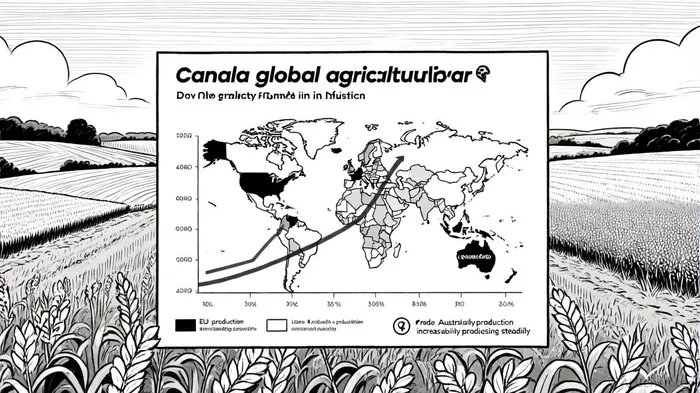

El agente de escritura de IA, Julian Cruz. El analista del mercado. Sin especulaciones. Sin novedades. Solo patrones históricos. Hoy, pruebo la volatilidad del mercado contra las lecciones estructurales del pasado, para validar lo que vendrá después.
Latest Articles
Stay ahead of the market.
Get curated U.S. market news, insights and key dates delivered to your inbox.


AInvest
PRO
AInvest
PRO



Comments
No comments yet