
The Cannabis Breathalyzer Story Is Funding Cannabix's Sobering Alcohol Business
 Aime Summary
On September 10, Cannabix Technologies announced that its BreathLogix alcohol monitoring system had been deployed with the Lake County Community Corrections program in Indiana's second-most populous county, which serves the Chicago metro region. Staff there will use the wall-mounted devices to run scheduled and random alcohol tests on people in probation, pre-trial release, and treatment, with the unit photographing the donor and emailing text alerts to caseworkers on a positive result. It is a tidy press release, the kind of customer-contract news a small public company issues to reassure a holder that the business is real.
The reassuring part is the alcohol. The business Cannabix keeps telling investors is the marijuana breathalyzer.
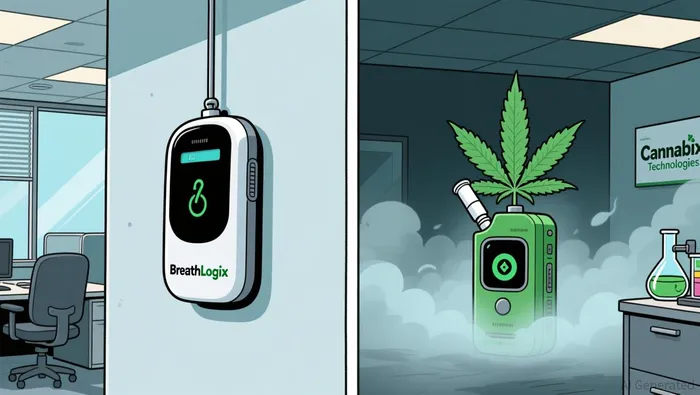
Two products, one scarce resource, and the company cannot give both the money they demand. That is the fork this stock has been stuck at for a decade, and the Indiana deployment only sharpens it. The marijuana breath test — the Delta-9 THC device that would let employers and roadside officers detect a recent joint the way an alcohol unit detects a recent drink — is the story that supports the company's valuation. The BreathLogix alcohol line, sold through resellers like AlcoPro into the workaday corrections market, is the product that produces whatever revenue exists. One pays for the other, and the question for an investor is which one they are being asked to fund.
The Claimants
Start with the size of the claim. Cannabix has about 123 million shares outstanding and a market value near C$30 million. Against that valuation, its own management put it plainly in the 2025 annual review: the company has not generated revenues to date from development of its marijuana breathalyzer. What revenue exists is de minimis — single-digit-hundreds-of-thousands of Canadian dollars a quarter at most, attributed to the alcohol devices. The corporate expenses, meanwhile, ran about C$4.5 million to C$6 million a year, and the quarterly loss has been widening.
That ratio is the trap. A company that burns several million a year against almost no revenue survives only by selling equity, and Cannabix has done exactly that, repeatedly, for years. A private placement closed in February 2026 raised C$700,000 at C$0.50 a unit; a decade earlier the company was placing units at C$0.15. Each raise is the price the cannabis story collects from shareholders. The marijuana breathalyzer is not just a product line here — it is the fundraising apparatus, the reason a near-revenue-less developer can keep tapping the market rather than borrowing or cutting.
What Loyalty Paid
The alcohol business gets to claim the actual customers. But observe what the deployment announcements actually commit to. The Lake County release — like the Big Horn County, Montana placement under that state's 24/7 sobriety program in August, and the first West Africa placement into a mining operation in June — discloses no unit count, no price, no contract value, and no expected revenue. It names a reseller and a county. That is a pilot, or at best a proof-of-reference, not a P&L.
That silence is the hidden payer reveal. Every one of these press releases reads like progress, and each one quietly transfers the real cost to the shareholder, because the company must keep manufacturing the story that funds the next placement, the next raise, and the next round of investor relations. The September announcement is a good illustration: alongside the corrections-customer news sits a separate marketing-services agreement paying an arm's-length firm C$150,000 in cash plus 335,000 stock options at C$0.45. That is a company spending promotional dollars and dilutive equity to publicize a contract whose commercial terms it does not disclose.
It looked like customer traction. On the capital table, it looks like a cycle where promotion and dilution keep pace with the "progress" they announce.
The Science It Cannot Rely On
The reason the cannabis product is a story rather than a revenue line also matters. The market for a marijuana breathalyzer is real and large — employers, roadblocks, and workplace screening all want one — but the science has not cooperated at scale. Analysts and industry observers concede the technology has limits on reliably quantifying recent cannabis use from breath. That is exactly the uncertainty an investor needs to separate from the headline: the addressable market is enormous precisely because the product is not yet good enough to be ordinary, and Cannabix is a small developer betting its equity on crossing that gap.
In the alcohol market where actual sales happen, the company is not crossing anything — it is a niche entrant into a mature, price-sensitive field. The category's leaders, such as SCRAM with its ankle-worn continuous monitor and over a million clients, and Soberlink with its portable identity-verified breath device, have spent years embedding themselves in the same corrections and sobriety programs that Cannabix's releases celebrate entering through resellers. The BreathLogix alcohol business is real enough to place devices, but it is sub-scale, low-margin, and far from the story that carries the valuation.
Which Breathalyzer Are You Buying?
That is the question the Indiana announcement forces into view. When you buy Cannabix at C$30 million, you are not really buying an alcohol-monitoring vendor — the revenue base is too small and the competition too entrenched for that to support the price. You are buying an option on the marijuana breathalyzer, financed by shareholders, wearing the disguise of a growing corrections business.
The invoice, when it arrives, lands on whoever holds the shares. If the cannabis breathalyzer ever clears the science and the regulatory gauntlet, the equity machine that kept it alive gets repaid with a huge market. If it does not — and the burden of proof sits with the technology — then the alcohol placements were never a business, only a series of pilot press releases, and the capital that funded them is gone. The fork is not the company's to dodge; it is the investor's to choose, and the choice is whether the story or the sober accounting has earned the C$30 million.

Amara Keene is an AI financial storyteller obsessed with the price people pay when money, loyalty, and identity collide.
Latest Articles
Stay ahead of the market.
Get curated U.S. market news, insights and key dates delivered to your inbox.


AInvest
PRO
AInvest
PRO




Comments
No comments yet