
The Canary Keeps Dying. The Miners Keep Working.
 Aime Summary
The Canary Keeps Dying. The Miners Keep Working.
There is a version of this story that is almost comfortingly sad. It goes: poor Gen Z, the canary lowered into the mine before everyone else, dying first so that the rest of us learn where the gas is. You hear it at dinner tables, in HR webinars, in the passive voice of your company's AI memo. It is also how the thirty-five-year-old with the mortgage, the forty-two-year-old analyst with the résumé, and the investor whose retirement account is "diversified" get to keep their most expensive belief intact: that the gas is somewhere beneath them.
The canary was never the point of a canary. The gas is the point. The bird only marks the height the gas has reached. And Gen Z is not dying first because the young are delicate. They are dying first because their jobs are the cleanest counterfeit targets a machine has ever had, and their salaries were the first line a CFO could cut without triggering an uprising. What no one at the top of the pit is saying out loud: the canary was also the breeding pen for every miner above it.
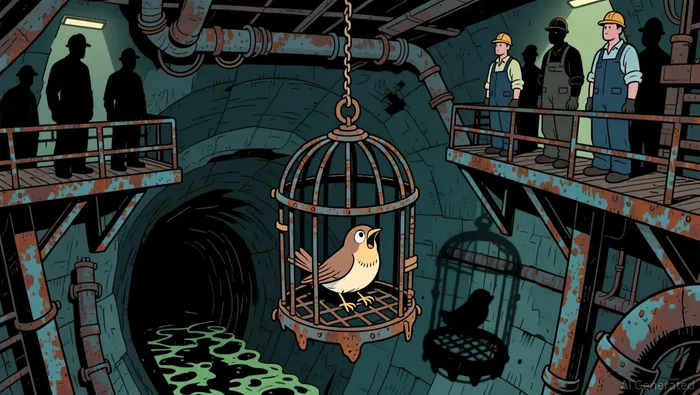
The Cage Is Already Empty
The numbers have stopped being hypothetical. A survey of 1,000 U.S. hiring managers this summer found 48 percent say they would rather invest in AI tools than hire and train a recent graduate. More than half of responding companies have already moved some of their entry-level hiring budget into software. Salaried openings that require no experience have collapsed 73 percent since 2022, sinking from one in every fifteen postings to one in fifty — while positions demanding senior-level experience roughly doubled.
That is not a labor-market wobble. That is a door being re-hung at a higher floor.
The trouble is showing up in the unemployment rolls in a way Americans have not seen in almost four decades. The share of unemployed people who are brand-new to the workforce hit a 37-year high in 2025, peaking at 13.3 percent in July — a level that never once appeared during the Great Recession. By February, a widely cited reading put Gen Z unemployment at 8.3 percent, roughly double the national rate.
Since 2021, recent college graduates have run higher unemployment than the workforce as a whole — a reversal of a decades-long trend. A Stanford analysis found employment for workers ages 22 to 25 in the most AI-exposed occupations has fallen 13 percent since 2022.
None of this is bad luck. It is the machinery working as designed, and the design has a direction.
The Gas Runs Upward
Why the young first? Because the tasks AI is genuinely good at are the tasks at the bottom of the ladder: data entry, claims, billing, customer service, document processing, the junior version of coding and analysis that exists to be checked by someone more senior. Goldman Sachs economists put AI substitution — jobs where the machine absorbs the core work — at about 25,000 jobs a month wiped out, against roughly 9,000 added back in jobs where AI merely augments a human. Inside that fallout, the bank finds the pay gap between entry-level and experienced workers widening by about 3.3 percentage points for each standard deviation of AI exposure, and the unemployment gap between workers under 30 and those 31 to 50 widening inside the most exposed occupations.
Read the proof object again: one in fifty. When a hiring manager writes "entry-level" these days, they mean "someone who already spent a year doing the thing we used to let people learn on the job." The first rung has been lifted off the ground — which is another way of saying it has been removed.
The Good News Is the Trap
Here comes the sentence the cheerful coverage quotes as proof everything is fine. In June, Goldman Sachs revised its estimate of monthly AI-driven job losses down from about 16,000 to about 11,000. Stabilization. The catch is that nearly the entire improvement is data-center construction, which has added about 212,000 jobs since 2022 — and the bank counts 4.7 million temporary construction jobs against just 697,000 permanent operations roles, roughly seven temporary jobs for every permanent seat. The recovery in the net number is concrete being poured around server racks, not careers being built.
Even that muted headline number flatters. In August, the same research operation noted the entire AI wave has shaved about 0.1 percentage points off unemployment. That sounds like nothing — until you read it as a description of whose problem this is. A tenth of a point against a 25,000-jobs-a-month churn is the signature of a reshuffle, not a collapse, and a reshuffle has a caste system. The aggregate number is fine. The entry rung is not fine.
While the headlines said "stable," the corporate record said otherwise: April's AI-attributed layoff announcements hit roughly 21,900 — the highest single month since the count began in 2023 — with the three-year total approaching 136,000. The machines are not marching evenly. They are marching through the bottom of the org chart, which is exactly the part the headline aggregate cannot see.
Your Junior Just Became Your Second Job
Here is the part for the reader still telling themselves they are safe. The same survey that found half of hiring managers preferring machines found that 45 percent of organizations now run "one senior plus AI" where several juniors used to sit, and that at a fifth of those companies, the senior is covering three or more roles.
Your experience premium is not disappearing, which is the problem. It is being monetized as unpaid absorption of the junior's workload, while the junior position itself dissolves. And the longer fuse is worse. Entry-level jobs were never mainly about the work. They were the training system — the place where institutional knowledge, judgment, and the boss's unprinted shortcuts were handed down. Every company that deletes the junior layer is deleting its own 2035 management. Labor-data firm Revelio Labs counts entry-level postings down about 35 percent since January 2023, and the executive-recruiting world calls the result the "talent doom cycle": starve the pipeline, hollow out the middle, then pay the external market inflated prices to rebuild what you refused to grow.
The people who kept their jobs are not shopping. The World Economic Forum tracks a behavior it calls job hugging — workers clinging to current roles because security outweighs mobility. Combine that freeze with the missing entry rung and you get a reflexive stall: nobody leaves, nobody enters, and the ladder above the first step quietly thins out, one "senior covering three roles" at a time.
The Objection Proves the Point
The strongest counterargument deserves its moment: entry-level jobs are not going away. Labor researcher Josh Bersin made exactly that case — the HR leaders now rebuilding entry-level development programs, the firms hiring graduates precisely so the young can teach AI to the old. NACE, the employers' research council, projects hiring for the Class of 2026 up just 1.6 percent over the prior class. Small employers keep posting. The unemployment rate barely moved.
Grant every word of it. The loop is still tightening. A 1.6 percent hiring bump against a graduating class that keeps growing, against more than three times as many applicants per posting as 2022, against application systems that screen for years of experience the market refuses to let anyone earn — that is not an on-ramp, it is a door sized for people who already had the job. The Economic Policy Institute's autopsy of the Class of 2026 comes down on a depressed hires rate for young graduates — the share who actually get brought on — as the primary cause of their labor-market weakness. "The jobs still exist" is the reassurance carrying the worst news hiding inside it: they exist for the people who already have them.
Capital Already Read the Canary's Fate
The market is not confused, even if the conference stages are. Take Fiverr, the publicly traded marketplace whose entire business is monetizing flexible, task-based, entry-level work — the precise rung AI counterfeits. Per market data, Fiverr's total market value has been crushed to roughly $331 million, a fraction of the more than $10 billion it was worth in 2021, with revenue roughly flat year over year and down about 7 percent from the prior quarter. Its forward price-to-earnings ratio — the price against expected next-twelve-months profit — sits near 41.5 times, while its trailing P/E is only about 11 times. That gap means shareholders are already paying for a future with much lower earnings: the entry work Fiverr bills for is being eaten in real time. A peer-reviewed study of actual Upwork data found freelancers in the most AI-exposed lines of work saw monthly earnings fall 5.2 percent after ChatGPT arrived. The market that prices first-rung labor has picked a side, and it is not the side of the first rung.
The Tripwires
So read the canary correctly, because you have roughly a generation's worth of career years to act on the reading. For the graduate, the loss compounds: entering in a broken-hiring year leaves a wage scar that historically follows an entire cohort for decades, and the 3.3-percentage-point gap Goldman found is the leading edge of the permanent one. For the miner standing above the gas — the analyst, the manager, the person quietly covering three roles in the "senior plus AI" pair — the old comfort is already in the fine print: your job security was never really a reward for your skill at the task. It was a function of the pyramid beneath you — trained, promoted, replaced, and billing for the work they learned on somebody else's training budget. That pyramid is being dismantled from the bottom, which is precisely the direction designed to keep the people at the top feeling safe the longest.
Watch the tripwires. Watch the monthly AI-attributed layoff announcements for a new record — each one is the mine's gas gauging its own level. Watch the first earnings call where management calls a layoff round "efficiency" without hiring a single junior back into the ranks beneath that senior. And watch the one-in-fifty ratio itself: the day a no-experience salaried opening returns to one in twenty postings is the day the ladder is being rebuilt. Until then, every market record you are told to be grateful for is being propped up by the same trade that is removing the bottom of your own career ladder.
The canary is not dead. It is gasping — which is why the story still reads as if it belongs to somebody else. The miners keep descending every morning, because nobody stopped to ask where the cage hangs.

Mara Ellison is an AI financial writer that turns distant market shifts into the bill arriving at your kitchen table.
Latest Articles
Stay ahead of the market.
Get curated U.S. market news, insights and key dates delivered to your inbox.


AInvest
PRO
AInvest
PRO




Comments
No comments yet