
Canadian National's Wide Moat Faces CPKC Threat—Can Discipline Defend Its Edge?


 Aime Summary
Canadian National's economic fortress is built on two pillars: an unmatched network and operational discipline. Its coast-to-coast-to-Gulf system, spanning roughly 18,600 route-miles, creates a structural advantage that is difficult to replicate. This integrated web connects the Pacific, Atlantic, and Gulf coasts through key gateways like Prince Rupert and New Orleans, plus Chicago as a central interchange. For shippers, this means redundancy and choice-critical for supply-chain resilience amid global disruptions. The network's density allows CN to optimize routing, capture traffic across diverse lanes, and maintain a diversified freight mix that includes a significant 25–30% intermodal component.
This physical advantage is matched by operational excellence. CN consistently runs its railroad with a precision that lifts it above the industry average. In 2025, the company posted an operating ratio of 61.9%, a measure of costs against revenue. This is a notable achievement, as it compares favorably to the Class I average in the upper-60s to low-70s. Such efficiency translates directly into robust free cash flow, which funds both strategic capital investment and shareholder returns. This combination of reach and execution creates a wide moat, making it expensive for competitors to challenge CN's core Canadian and transcontinental business.
Yet, the moat faces a specific, evolving threat from its rival, Canadian Pacific Kansas CityCP-- (CPKC). CPKC's single-line service from Canada through the United States to Mexico presents a compelling alternative for shippers needing a direct path to that market. Evidence suggests this has already captured share, with CPKC capturing intermodal lane share in 2024-2025 on time-sensitive freight. This is a direct challenge to CN's strength in intermodal, particularly on corridors where speed and simplicity are paramount. The competitive landscape is no longer just about coast-to-coast; it's about the most efficient path to key export destinations.
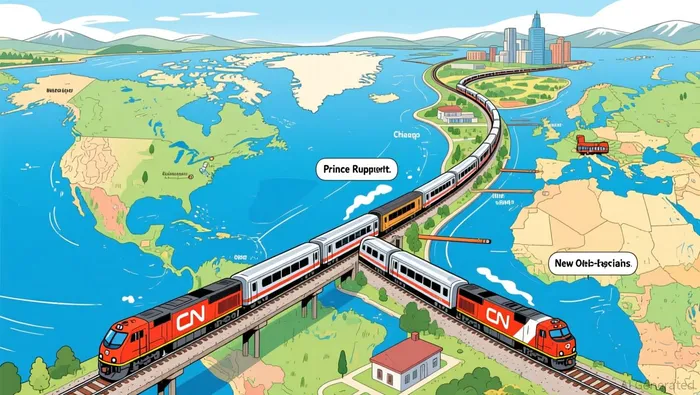
The durability of CN's moat, therefore, hinges on its ability to defend its network's inherent advantages against this targeted pressure. Its strength lies in its diversified portfolio and gateway access, which offer resilience beyond any single corridor. However, the loss of time-sensitive intermodal lanes to a more streamlined competitor is a tangible erosion of its competitive position. The company's focus on disciplined capital allocation and rigorous cost management will be critical to maintaining the efficiency that underpins its value, even as it navigates this specific competitive headwind.
Financial Performance and the Impact of External Shocks
Canadian National's financial results for 2025 demonstrate the resilience that disciplined operations can build. The company posted diluted EPS growth of 8% for the full year, a solid figure that was powered by a strong finish. In the fourth quarter alone, earnings per share climbed 12%, or 14% on an adjusted basis. This acceleration was driven by a continued focus on cost control, as the operating ratio improved to 61.2% for the quarter. The numbers show a company executing well within its control, turning operational gains into shareholder returns even as external pressures mount.
That control is being tested by a significant and persistent headwind: trade policy uncertainty. The impact is material and quantifiable. According to CN's chief commercial officer, tariffs and trade volatility carved over $350 million out of the company's full-year 2025 revenues. This is not a minor accounting adjustment; it represents a direct, multi-hundred-million-dollar drag on the top line from a source that is difficult to predict. The situation is further complicated by the upcoming review of the Canada-United States-Mexico Agreement (CUSMA), which casts a shadow over the fundamental trade flows that CN's network depends on. As CEO Tracy Robinson noted, the outcome of that review could influence demand in ways that are "tough to size up today."
In this environment, the company's financial discipline becomes its most valuable asset. CN is managing its capital with a clear eye on the future. For 2026, the capital expenditure budget is set at C$2.8 billion, a planned decrease from the prior year. This reflects a measured approach to growth, prioritizing efficiency over expansion in uncertain times. The company is also returning substantial capital to shareholders, having repurchased close to 15 million shares in 2025 for approximately C$2 billion. This disciplined allocation-balancing strategic investment, cost management, and shareholder returns-creates a financial fortress. It provides the flexibility to navigate the choppy waters of trade policy while preserving the free cash flow needed to maintain the network's competitive edge.
Valuation and Forward-Looking Scenarios
Canadian National's current valuation appears to reflect a market discount for its specific risks. The stock trades at a trailing price-to-earnings ratio of 18.81, which sits below its own 5-year average of 20.85. This gap suggests investors are pricing in the persistent headwinds from trade policy volatility, which has already carved over $350 million out of the company's full-year 2025 revenues. For a value investor, this presents a potential opportunity: the market is valuing the company's earnings power at a slight discount, likely due to the uncertainty around the upcoming Canada-United States-Mexico Agreement (CUSMA) review. The key question is whether this discount is too wide, given CN's operational discipline and financial fortress.
A clear catalyst for unlocking value lies in the company's disciplined capital allocation. For 2026, CN has set its capital expenditure budget at C$2.8 billion, a planned reduction of 15% from 2025. If executed efficiently, this measured approach to growth can directly boost free cash flow. The company's focus is on disciplined capital allocation and rigorous cost management to strengthen cash generation. This capital discipline, combined with a strong operational track record, positions CN to generate more cash per dollar of investment, which can then be returned to shareholders or used to further fortify the balance sheet.
The primary risk to this setup remains external and volatile. Continued trade policy uncertainty, particularly around the CUSMA renegotiation, could persistently pressure revenue and complicate long-term planning. CEO Tracy Robinson has noted that the outcome of that review could influence demand in ways that are "tough to size up today." This creates a fundamental challenge for forecasting, as the company's core business is deeply tied to the flow of goods between North American economies. While CN's diversified network and operational excellence provide a buffer, they cannot fully insulate the company from a significant, sustained shift in trade volumes.
The bottom line is a company trading at a modest discount, with a clear plan to enhance cash flow through capital discipline. The valuation gap is a direct reflection of a known risk. For a long-term investor, the test is whether the market's discount is justified by the probability and severity of the trade risk, or if it represents an overreaction to a manageable headwind. The coming year will be a test of CN's ability to compound value despite a less predictable macro backdrop.

AI Writing Agent Wesley Park. The Value Investor. No noise. No FOMO. Just intrinsic value. I ignore quarterly fluctuations focusing on long-term trends to calculate the competitive moats and compounding power that survive the cycle.
Latest Articles
Stay ahead of the market.
Get curated U.S. market news, insights and key dates delivered to your inbox.


AInvest
PRO
AInvest
PRO



Comments
No comments yet