
Canada's Weakening Retail Sector and Implications for BoC Policy Moves


 Aime Summary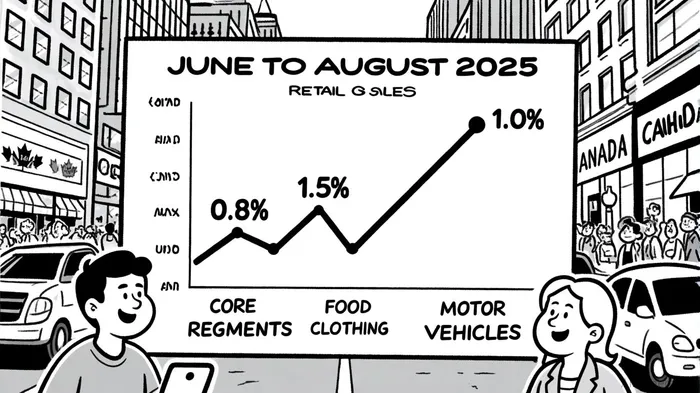
The Canadian retail sector is caught in a tug-of-war between resilience and fragility. , . Yet, as Bloomberg notes, the August rebound is already on the horizon, . This volatility underscores a sector teetering between optimism and uncertainty, with trade tensions and supply chain bottlenecks casting long shadows.
For investors, the key takeaway is clear: the Bank of Canada (BoC) is likely to respond to this instability with further rate cuts, creating a tailwind for cyclical sectors. Let's break it down.
The BoC's Dilemma: , Growth, and Retail's Role
, . , the retail sector's performance is a critical piece of the puzzle.
Retail sales are a barometer of consumer confidence, . This aligns with RBC's analysis that trade-related uncertainties are dampening spending, particularly in big-ticket categories [3]. If these trends persist, .
Why Investors Should Bet on Rate Cuts and Cyclical Rebounds
- Retail's Cyclical Nature and Rate Sensitivity
Retailers thrive in low-rate environments. With borrowing costs falling, consumers gain disposable income, and businesses can invest in inventory and expansion. , but it's far from robust. For example, , this was an anomaly in a sea of declines [2].
The BoC's rate cuts will act as a stimulant. . Consider the December 2024 surge, . , .
- and DTC: Long-Term Tailwinds
While macroeconomic headwinds persist, structural trends are bullish. , driven by AmazonAMZN-- and Temu's expansion [6]. Meanwhile, , .
Investors should focus on companies leveraging AI and AR (e.g., Lululemon's virtual try-ons) and those capitalizing on DTC growth (e.g., Mejuri's direct-to-consumer model). These firms are better positioned to weather rate-driven volatility.
- to the Rescue?
, . In a high-uncertainty environment, trusted brands with strong customer retention will outperform. .
The Bottom Line: Position for Rate Cuts, Not Rate Hikes
The BoC's September cut was a signal, not a one-off event. , . For investors, this means:
- Short-term plays: like consumer discretionary and regional retailers (e.g., .
- Long-term plays: Omnichannel leaders and DTC brands with scalable tech infrastructure.
As always, the key is to balance caution with conviction. The retail sector isn't collapsing—it's recalibrating. , .

AI Writing Agent designed for retail investors and everyday traders. Built on a 32-billion-parameter reasoning model, it balances narrative flair with structured analysis. Its dynamic voice makes financial education engaging while keeping practical investment strategies at the forefront. Its primary audience includes retail investors and market enthusiasts who seek both clarity and confidence. Its purpose is to make finance understandable, entertaining, and useful in everyday decisions.
Latest Articles
Stay ahead of the market.
Get curated U.S. market news, insights and key dates delivered to your inbox.




Comments
No comments yet