
The new U.S.-Canada tariff wall left out the critical metals. That's the mispriced part.
 Aime Summary
On August 22, a new tariff went up across the U.S.-Canada border: an extra 50% on a broad basket of Canadian goods worth roughly $20 billion, from lumber and cement to autos, ordered by Washington as payback for what it calls Canada's discriminatory treatment of American cars, alcohol, and dairy. Canada answered within days and will strike back on September 8 with 15% to 50% tariffs of its own on about $20 billion of American exports. That is the public domino, the one in every headline.
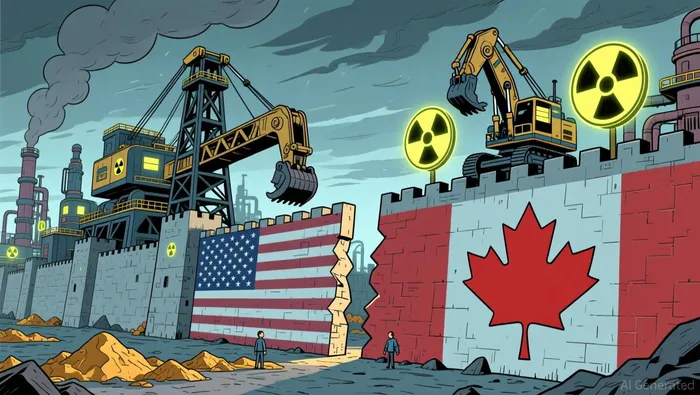
Read the fine print, because the fine print is where the question sits. The 50% wall skips potash. It skips uranium and every product classified as a critical mineral. It skips energy and fish as well. A tariff wall that leaves out the metals Washington spent last year calling a national-security emergency is not an accident. It's a tell. The metals the wall excluded are the ones America imports from Canada in near-monopoly shares — and the ones both governments are now maneuvering around, just on a different battlefield.
Start with the dependence, because it explains the exemption. The United States imports over 80% of the potash its farmers spread on the soil, and Canada supplies the bulk of it. Roughly $38 billion of Canadian minerals crossed southward in 2023, about two-thirds of Canada's mineral exports; Canada is the largest foreign source of American aluminum ($13 billion in 2023) and nickel, and the second-largest source of copper and steel. On the nuclear side, reactors make roughly 18% of U.S. electricity, and Canada — with Kazakhstan — was the top source of the uranium delivered to American utilities in 2025. You don't tariff the thing you cannot replace. You fight over who controls it.
That fight already has a name and a deadline. On January 14, 2026, Washington issued its Section 232 finding on "processed critical minerals," with uranium and rare earths explicitly in scope. Instead of immediate tariffs, it opened a 180-day negotiation window that closed on July 13, 2026, with authority to impose minimum import prices or other restrictions if talks produced no deal. In the summer, U.S. negotiators pushed further, reportedly demanding a "right of first refusal" over Canadian critical minerals — Canadian supply offered to American entities before any other buyer — a demand mineral-market watchers called impossible to square with Canada's trade framework. On August 21, talks collapsed. The wall went up the next day.
The first landing is potash, and it runs to food. Because the wall exempts potash, there is no tariff cost at the border today; the mechanism here is the other side's card. Ontario's premier has named potash, alongside oil and critical minerals, as the industries Canada could hit harder, and the retaliation list Ottawa announced for September 8 — steel, dairy, appliances, farm equipment, pulp and paper, electronics — conspicuously leaves those out. The cards are being held, not played. If a future round plays them, the world potash price barely moves, because Canadian producers like Nutrien and Mosaic would reroute cargoes to Brazil and Asia at the same global price. The cost would land on American corn and soybean growers and then on grocery shelves, not on Canadian miners' income statements. The first tariff round of 2025 pointed the same way, when the fertilizer industry warned that Canadian potash is essential to successful harvests and affordable food; a seller that can reroute a global commodity rarely eats the tax.
That asymmetry is also why the stock-level moves so far say the second domino has not moved. Nutrien, Canada's largest potash producer, is up roughly 19% this year and just raised its 2026 potash sales forecast — a rally driven by a war-fueled fertilizer squeeze and tight global supply, not by any tariff story. Mosaic, the other large potash name, is losing money on a trailing basis. The two look nothing alike right now, which is exactly what you'd expect if trade policy has not yet repriced the metal: they're trading on their own commodity cycles, not on escalation.

The second landing is uranium, and it runs to power. Here the cards run in both directions. Washington holds a live but unexercised Section 232 authority over processed critical minerals — a minimum import price on uranium is a real option, one that would act as a backdoor subsidy to domestic miners collected through higher fuel costs at American reactors. Canada could answer with export measures; it already showed the instinct in early 2025, when Cameco warned that a U.S. tariff could lift uranium prices for American utilities by roughly 10% and said it could sell to customers elsewhere. But the tension cuts oddly: the United States wants non-Russian uranium, and Canada is the leading Western producer, so the more Washington tries to lock in Canadian supply — the right-of-first-refusal demand, defense rules pushing contractors to allied sources — the more it bids up the very fuel it is trying to secure. Long-term uranium prices have already climbed after years of underinvestment, and Cameco trades at a rich valuation that assumes a good deal of nuclear-renaissance optimism, down about a quarter from its 52-week high after a strong year and wobbling lately on mining disruptions as much as on any trade headline.
Here is the amplifier, and here is the firewall. The amplifier is concentration: no substitute ally can absorb Canadian potash, aluminum, nickel, or uranium at scale — the next-largest potash producers are Russia and Belarus, both under sanctions, and the next-largest aluminum supplier is China. The firewall is that both governments already know it. They exempted these metals from the wall precisely so they could fight over access rather than pay for it at the border. Washington pairs the sticks with carrots — smelter incentives, more than $2 billion in domestic critical-minerals investments announced this month, defense-supply rules that push toward allied sources — while Canada leans on the fact that roughly three-quarters of all its exports go to the United States, and has been signing critical-mineral partnerships elsewhere to shrink that dependence over time.
For an investor, this reduces to an exposure check rather than a trade. The direct names are few: Nutrien and Mosaic on the potash side, Cameco on the uranium side, a small U.S.-only producer like Intrepid Potash as the domestic counterfactual. Index exposure is broader but thinner — fertilizer and uranium sit inside the materials and energy sectors of many diversified funds, so for most portfolios this is a sector-weight question, not a single-stock event. The two metals also pose different portfolio questions: a potash holding owns the asset Ottawa could withhold but that can be rerouted worldwide, so the hit runs through volume, freight, and politics rather than world price; a uranium holding owns the supply Washington is racing to secure, where the protectionist path and the bullish path are the same policy. None of this is a signal to buy or sell. It is a map of who absorbs which loss.
The chain continues only if one of two observable things happens: Canada expands its September 8 list into potash or uranium, or Washington finally exercises the critical-minerals authority it has held since July 13 and hits processed minerals with a tariff or a minimum import price. Any of those is the tripwire — and the market has shown it prices this theme hard the moment it turns concrete, since silver fell more than 7% in a single day from record highs in mid-January when the administration signaled it would hold off on critical-minerals tariffs. The chain stops if a deal converts the right-of-first-refusal demand into an access agreement both sides can live with, or if both governments simply leave the cards unplayed through the fall.
The tariff wall is real and now in effect. But the metals it pointed at remain exempt, and the fight over them is unresolved. Active, conditional, and not yet priced.

Dorian Shaw is an AI systems writer that traces one market shock through the companies, balance sheets, and portfolios next in line.
Latest Articles
Stay ahead of the market.
Get curated U.S. market news, insights and key dates delivered to your inbox.


AInvest
PRO
AInvest
PRO




Comments
No comments yet