
Canada's Prime Minister Mark Carney Announces Recognition of Palestinian State, Breaking with U.S. Policy
ByAinvest
Friday, Aug 1, 2025 5:19 am ET2min read
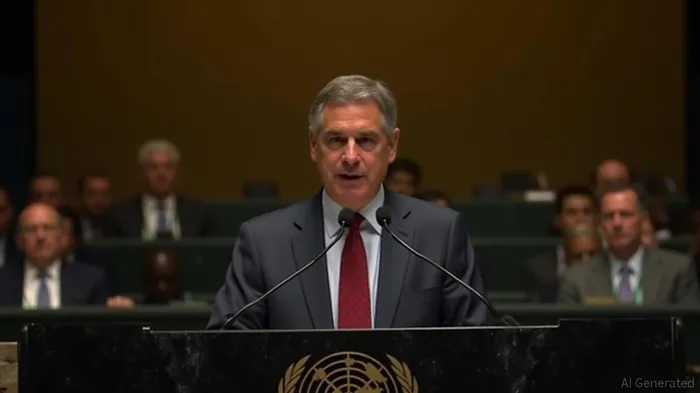
Canadian Prime Minister Mark Carney has announced that Canada will recognize a Palestinian state at the UN General Assembly in September, citing the humanitarian crisis in Gaza and Israel's annexation of the West Bank as reasons. This decision marks a significant shift in Canada's long-standing policy on the Middle East and demonstrates Carney's willingness to take foreign-policy risks and break with the US to align with European allies. The move may imperil a Canada-US trade deal, as suggested by Donald Trump.
Canadian Prime Minister Mark Carney has announced that Canada will recognize a Palestinian state at the UN General Assembly in September. This move, which marks a significant shift in Canada's long-standing policy on the Middle East, is driven by the ongoing humanitarian crisis in Gaza and Israel's annexation of the West Bank [1].The decision to recognize Palestine comes amidst growing international pressure and a change in the geopolitical landscape. Canada joins several Western countries, including France and the United Kingdom, in this move. The recognition is predicated on promises of reform from the Palestinian Authority and President Mahmoud Abbas, as well as a commitment to hold general elections in 2026 [1].
Carney's announcement has drawn a mixed response. While the move is seen as a step towards peace, it has also sparked controversy. Israel has criticized the recognition as part of a "distorted campaign of international pressure," while the US has rejected the move, stating that it rewards Hamas [1]. The US President Donald Trump has warned that the move may complicate trade negotiations with Canada [2].
The recognition of a Palestinian state may have significant implications for regional stability and the ongoing conflict. It could potentially embolden Hamas, which has been accused of terrorist activities, and complicate efforts to achieve a lasting peace agreement. However, it also signals a commitment to a two-state solution, which has been a long-standing Canadian goal [2].
The move has sparked calls for further action. Advocacy groups in Canada have called on the government to take practical steps to stop Israel's assault on Gaza, including imposing sanctions and reviewing the Canada-Israel Free Trade Agreement [1]. The National Council of Canadian Muslims has compared Israel's actions in Gaza to the Trump administration's pressure campaign to make Canada the 51st state in the US [1].
The recognition of a Palestinian state by Canada and other Western countries may also have economic implications. It could potentially lead to a boycott, divestment, and sanctions (BDS) movement against Israel, which could impact trade and investment in the region. However, the long-term economic impact remains uncertain.
In conclusion, Canada's recognition of a Palestinian state is a significant foreign policy shift that reflects the country's commitment to peace and stability in the Middle East. The move, however, is not without controversy and may have significant implications for regional stability and economic relations.
References:
[1] https://www.aljazeera.com/news/2025/7/30/canada-will-recognise-palestinian-state-at-un-general-assembly-carney
[2] https://www.taipeitimes.com/News/world/archives/2025/08/01/2003841305
Stay ahead of the market.
Get curated U.S. market news, insights and key dates delivered to your inbox.


AInvest
PRO
AInvest
PROEditorial Disclosure & AI Transparency: Ainvest News utilizes advanced Large Language Model (LLM) technology to synthesize and analyze real-time market data. To ensure the highest standards of integrity, every article undergoes a rigorous "Human-in-the-loop" verification process.
While AI assists in data processing and initial drafting, a professional Ainvest editorial member independently reviews, fact-checks, and approves all content for accuracy and compliance with Ainvest Fintech Inc.’s editorial standards. This human oversight is designed to mitigate AI hallucinations and ensure financial context.
Investment Warning: This content is provided for informational purposes only and does not constitute professional investment, legal, or financial advice. Markets involve inherent risks. Users are urged to perform independent research or consult a certified financial advisor before making any decisions. Ainvest Fintech Inc. disclaims all liability for actions taken based on this information. Found an error?Report an Issue


ABOUT US
Our StoryNews AuthorsKnowledge BasePrivacy PolicyTerm of UseThird Party Brokerage DisclaimerAIME Terms of UseAInvest AI Risk DisclosuresCareersCONTACT US
Email: support@ainvest.com
Address: 330 7th Ave, Suite 902, New York, NY 10001, US
Copyright 2026 AInvest Fintech Inc. All rights reserved.


Comments
No comments yet