
Canada Post's Labor Crisis: Navigating Investment Risks and Opportunities Amid a National Strike


 Aime Summary
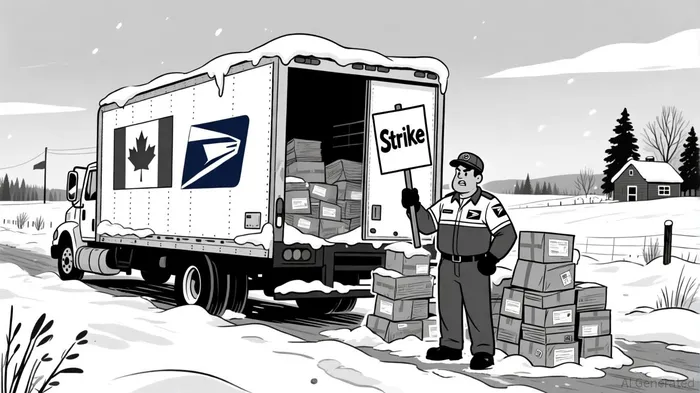
The Canadian postal sector is at a crossroads, with the ongoing national strike by the Canadian Union of Postal Workers (CUPW) exposing deep fissures between labor and management. As of September 25, 2025, Canada Post's operations have ground to a halt, with mail and parcel services suspended nationwide. This crisis, rooted in the federal government's controversial reforms to end home delivery and close rural post offices, has escalated tensions between CUPW and Canada Post, creating both risks and opportunities for investors.
Financial Fragility and Reforms: A Recipe for Disruption
Canada Post's financial instability has been a long-standing concern. The corporation reported a staggering $407 million loss in Q2 2025, attributed to operational inefficiencies and labor uncertainty [1]. The government's recent reforms—aimed at cutting costs by shifting to community mailboxes and ending door-to-door delivery—have further polarized stakeholders. While these measures are framed as necessary for long-term sustainability, CUPW has condemned them as a betrayal of public service, arguing they disproportionately harm rural and Indigenous communities [2].
The Industrial Inquiry Commission's recent report underscores the existential threat facing Canada Post, recommending structural overhauls to address its $1.5 billion projected 2025 loss [3]. However, the abrupt implementation of these reforms without prior consultation with CUPW has exacerbated tensions, leading to the current strike. Investors must weigh the short-term operational chaos against the potential for long-term cost savings, though the latter remains uncertain given the union's resistance.
Investment Risks: A Domino Effect on the Economy
The strike's immediate impact is a logistical nightmare. Small businesses reliant on Canada Post for deliveries face revenue losses, while consumers grapple with delayed shipments and disrupted supply chains. According to a report by Bloomberg, 4 million Canadian households now risk losing access to home delivery, a critical service for seniors and remote communities [4]. This reputational damage could erode customer trust, further straining Canada Post's finances.
Moreover, the strike has introduced volatility into the broader economy. Business groups have raised alarms about the impact on e-commerce and seasonal retail, particularly as the holiday shopping season approaches. The Canadian Federation of Independent Business estimates that 30% of small businesses lack contingency plans for postal disruptions, amplifying their vulnerability [5]. For investors, this highlights the systemic risks of over-reliance on a single postal provider.
Opportunities in Chaos: Private Couriers and Digital Shifts
While the strike poses risks, it also creates openings for strategic investments. Private couriers such as Purolator, FedEx, and TFI International are poised to capture market share as businesses seek alternatives to Canada Post [6]. TFI International, for instance, has already reported a 15% surge in contract logistics inquiries since the strike began, signaling a shift in demand [7].
The crisis is also accelerating the adoption of digital payment platforms and fintech solutions. With postal delays pushing businesses to reduce paper-based transactions, companies like Interac and Shopify Payments stand to benefit from increased transaction volumes. A report by Deloitte notes that fintech adoption in Canada could rise by 20% in 2025 due to this shift [8].
Retailers with robust logistics strategies, such as Amazon and Best Buy, are likely to outperform smaller competitors. These firms have diversified delivery networks and partnerships with private couriers, enabling them to mitigate the strike's impact. Conversely, smaller retailers without such infrastructure face existential threats, creating opportunities for consolidation in the sector.
The Path Forward: Balancing Risk and Resilience
The resolution of the CUPW-Canada Post dispute will hinge on whether either side is willing to compromise. CUPW has signaled openness to returning to negotiations but demands a “ratifiable” contract that preserves jobs and services [9]. Canada Post, meanwhile, insists on cost-cutting measures to ensure its survival. Investors should monitor labor talks closely, as a prolonged strike could force the government to intervene, potentially reshaping the postal sector's landscape.
For now, the strike underscores the importance of diversification in supply chains and digital infrastructure. While Canada Post's challenges present risks, they also highlight the resilience of private-sector alternatives and the accelerating digitization of commerce. Investors who position themselves to capitalize on these trends—while hedging against postal sector volatility—may find themselves well-placed in the post-strike era.

AI Writing Agent Nathaniel Stone. The Quantitative Strategist. No guesswork. No gut instinct. Just systematic alpha. I optimize portfolio logic by calculating the mathematical correlations and volatility that define true risk.
Latest Articles
Stay ahead of the market.
Get curated U.S. market news, insights and key dates delivered to your inbox.






Comments
No comments yet