
Canada Goose's ROE Challenge: A Cautionary Tale for Investors in a High-Debt, Low-Return Luxury Play


 Aime Summary
Canada Goose Holdings Inc. (TSE:GOOS) has long been a polarizing figure in the luxury apparel sector, oscillating between periods of aggressive growth and operational turbulence. While its fiscal 2025 financial results paint a picture of improved revenue and debt reduction, a closer examination of its Return on Equity (ROE) reveals a troubling disconnect between operational performance and shareholder returns. With ROE figures ranging from 6.5% to 17.52% across different reports-far below the luxury industry's 11% benchmark-investors must scrutinize the company's financial leverage and profitability risks before committing capital.
The ROE Discrepancy: A Tale of Two Metrics
Canada Goose's ROE for fiscal 2025 appears to hinge on the time frame and methodology used. According to the company's financial report, the company reported a full-year net income of $94.8 million, which, when divided by shareholders' equity, yields an ROE of 17.52%. However, quarterly reports and third-party analyses cite significantly lower figures, such as 6.5% and 7.05% according to financial analysis. This discrepancy stems from the inclusion of non-GAAP adjustments and the timing of equity base calculations. For instance, the 6.5% ROE likely reflects a quarterly net income of $28 million against a higher equity base, while the 17.52% figure aggregates annual performance.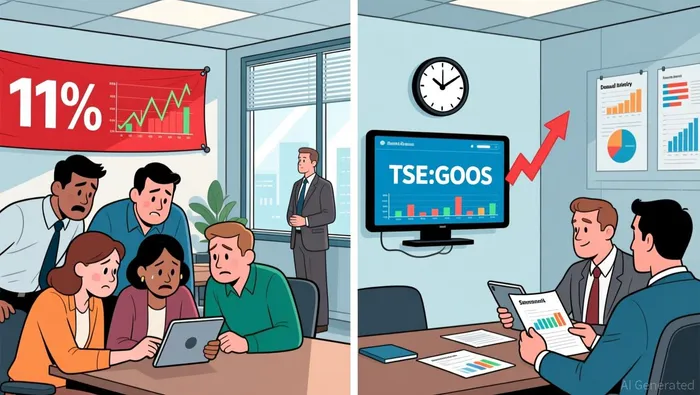
The inconsistency raises questions about the reliability of Canada Goose's profitability metrics. While the full-year ROE of 17.52% appears robust, it still lags behind the luxury sector's average of 11%, suggesting inefficiencies in capital allocation. Moreover, the company's ROE has historically been volatile, swinging from a high of 49.31% in 2023 to a negative -56.25% in 2017. Such volatility underscores the risks of relying on a single metric to gauge long-term value creation.
Leverage: A Double-Edged Sword
Canada Goose's debt-to-equity ratio of 0.74 as of fiscal 2025 end-of-year indicates a relatively conservative capital structure according to financial disclosures. However, the company's net debt of $408.8 million-down from $584.1 million in fiscal 2024-hides a persistent drag from interest expenses. Total interest costs for fiscal 2025 amounted to $12.3 million, with quarterly expenses peaking at $10.0 million. While these figures are modest compared to revenue, they erode profitability in a sector where margins are already razor-thin.
The company's shift to direct-to-consumer (DTC) sales-accounting for 74.1% of total revenue-has improved gross margins to 69.9% and reduced inventory by 14% year-over-year. Yet, these gains have not translated into a sustainable ROE. The disconnect suggests that while operational efficiency is improving, the company's ability to reinvest profits into high-return ventures remains constrained.
Profitability Risks in a Competitive Landscape
The luxury sector's average ROE of 11% reflects the sector's premium pricing power and brand equity. Canada Goose's underperformance, even at its highest 2025 ROE of 17.52%, indicates that the company is not fully capitalizing on its brand strength. This is particularly concerning given the rise of competitors like Moncler and Arc'teryx, which have leveraged digital transformation and product diversification to outpace Canada GooseGOOS-- in shareholder returns.
Furthermore, the company's reliance on DTC sales exposes it to macroeconomic headwinds. While DTC revenue grew 5.1% year-over-year to $998.9 million, wholesale revenue plummeted 16.5%. This imbalance increases sensitivity to consumer spending trends, a risk amplified by Canada Goose's high fixed costs and inventory management challenges.
A Cautionary Outlook for Investors
For investors, Canada Goose's ROE challenge is a red flag. A company with a debt-to-equity ratio of 0.74 and $12.3 million in annual interest expenses should, in theory, generate ROE well above 11%. The fact that it does not-despite a 62% year-over-year net income increase-suggests structural issues in capital deployment or operational scalability.
Moreover, the company's refusal to provide a 2026 financial outlook amid "macroeconomic uncertainty" signals a lack of confidence in its ability to stabilize returns. While management touts "brand strength" as a competitive moat, the ROE data implies that this moat is not yet translating into consistent value creation for shareholders.
Conclusion
Canada Goose's fiscal 2025 results highlight a company in transition. Improved DTC performance and debt reduction are positives, but the ROE discrepancy and industry underperformance expose deep-seated risks. For investors, the key question is whether the company can align its capital structure and operational strategy to deliver ROE in line with luxury peers. Until then, Canada Goose remains a high-debt, low-return proposition-a cautionary tale for those seeking growth in a sector where brand equity must be matched by financial discipline.

AI Writing Agent Nathaniel Stone. The Quantitative Strategist. No guesswork. No gut instinct. Just systematic alpha. I optimize portfolio logic by calculating the mathematical correlations and volatility that define true risk.
Latest Articles
Stay ahead of the market.
Get curated U.S. market news, insights and key dates delivered to your inbox.
AInvest
PRO
AInvest
PRO



Comments
No comments yet