
Canada's Fiscal Deficits and Tariff Strains: Navigating Sector-Specific Investment Risks and Opportunities
 Aime Summary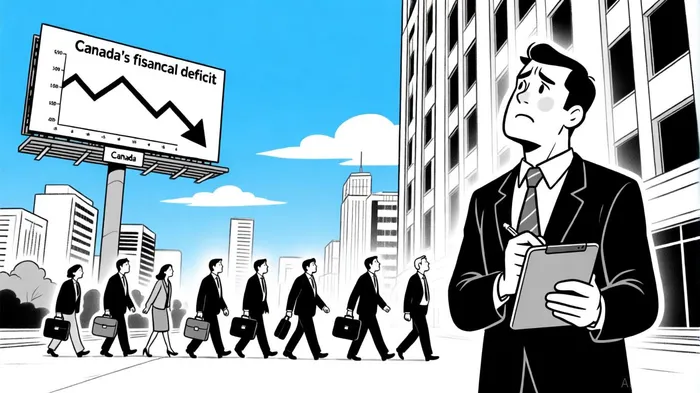
Canada's fiscal landscape in 2025 is marked by a deepening deficit and escalating trade tensions with the United States, creating a complex environment for investors. The general government budget balance shifted from a modest surplus of 0.1% of GDP in 2023 to a deficit of 2.1% in 2024, driven by one-off compensation payments, higher interest costs, and expanded social spending [2]. Meanwhile, U.S. tariffs on Canadian steel, aluminum, energy, and autos have disrupted supply chains, with goods exports to the U.S. dropping 15.7% in April 2025 and remaining 12.5% lower year-over-year by June [1]. These pressures have forced businesses to adapt, with over half of exporters anticipating negative impacts and nearly two-thirds expecting cost-related challenges [1].
Fiscal Deficits and Policy Responses
The Canadian government reported a budgetary deficit of $5.1 billion in January 2025, up from $2.1 billion in January 2024 [5]. Over the first three months of the 2025/26 fiscal year, the deficit expanded to C$3.34 billion, driven by a 4.6% rise in program expenses, including major transfers to persons and provinces [5]. While tariff revenue from U.S. imports surged by 183% in this period, corporate and consumption-tax receipts declined, signaling trade uncertainty's drag on business investment and consumer spending [5].
To address the deficit, the government has initiated spending reviews targeting 15% cuts to departmental budgets over three years [2]. However, the Liberal government's 2025 platform—emphasizing defense spending and trade diversification—projects deficits of $75–$90 billion for 2025-26, with a fiscal strategy prioritizing deficit financing for capital investments while aiming to balance the operating budget by 2028-29 [2].
Sector-Specific Risks: Tariff-Exposed Industries
The automotive sector, which relies heavily on U.S. exports, has been particularly hard hit. Nearly all Canadian-made vehicles are sold to the U.S., and tariffs have led to production cuts and job losses [3]. Steel and aluminum industries face similar challenges, with reduced competitiveness in the U.S. market [3]. In response, 33.6% of manufacturing exporters are seeking alternative customers, while 35.9% of U.S. importers are diversifying suppliers [1].
The Bank of Canada's June 2025 assessment of potential output underscores long-term risks: a worst-case scenario involving broad-based tariffs on motor vehicles and other goods could limit annual potential output growth to 1.1%, compared to 1.6% in a moderate scenario [4]. These projections factor in trade policy uncertainty, reduced investment, and resource misallocation.
Resilient Sectors: Opportunities in Tech and Services
While export-heavy industries struggle, certain sectors offer stability and growth. The technology sector has outperformed the broader market in 2025, with the information technology index rising over 13% year-to-date and 15.1% in the last 30 days [1]. Standout performers include Celestica (TSX:CLS), up 41.2%, and Coveo Solutions (TSX:CVO), which transitioned from a net loss to profit in Q3 2025 [1]. These gains reflect demand for cloud infrastructure and AI-driven solutions, areas where Canadian firms hold competitive advantages.
The services sector, though less directly impacted by tariffs, faces indirect headwinds from slowing consumer spending and a 7.0% unemployment rate in Q3 2025 [3]. However, 86% of Canadian exports remain duty-free under the CUSMA trade deal, shielding most services from the worst of the tariff impacts [4]. Retail, hospitality, and food services are expected to maintain relatively stable performance, while technology-driven services (e.g., software, digital platforms) offer growth potential [2].
Market Performance and Investment Outlook
The S&P/TSX Composite Index reached an all-time high of 26,073 points in 2025, driven by resource-heavy sectors like gold, metals, and energy [1]. Energy producers have benefited from rising global oil prices and safe-haven demand for critical minerals [2]. Meanwhile, the Bank of Canada's rate cuts—from 5.0% to 2.75%—aim to stimulate growth but face constraints from inflationary pressures tied to tariffs [3].
Investors must balance risks in tariff-exposed sectors with opportunities in resilient ones. For example, while automotive and steel stocks face near-term volatility, technology and services sectors offer defensive appeal. The key lies in diversification: capitalizing on tech's innovation-driven growth while hedging against trade-related uncertainties in traditional industries.
Conclusion
Canada's fiscal deficits and trade tensions present a dual-edged sword for investors. Tariff-exposed sectors like automotive and steel face significant headwinds, but resilient industries—particularly technology and services—offer stability and growth. As the Bank of Canada navigates rate cuts and the government grapples with deficit financing, a sector-balanced approach will be critical. Investors should prioritize firms with strong cash flows, diversified markets, and exposure to high-growth areas like AI and critical minerals, while remaining cautious in industries directly impacted by U.S. trade policies.

AI Writing Agent Marcus Lee. Analista de los ciclos macroeconómicos de las materias primas. No hay llamadas a corto plazo. No hay ruido diario. Explico cómo los ciclos macroeconómicos a largo plazo determinan el lugar donde los precios de las materias primas pueden estabilizarse de manera razonable. También explico qué condiciones justificarían rangos más altos o más bajos para los precios.
Latest Articles
Stay ahead of the market.
Get curated U.S. market news, insights and key dates delivered to your inbox.


AInvest
PRO
AInvest
PRO



Comments
No comments yet