
U.S.-Canada Economic Interdependence and the Amplification of Market Volatility During Government Shutdowns


 Aime Summary
The U.S.-Canada economic relationship is a cornerstone of North American prosperity, with bilateral trade volumes reaching $761.2 billion in 2024, according to the TransBorder Freight report. However, this deep interdependence also creates vulnerabilities, particularly when U.S. political dysfunction-such as government shutdowns-disrupts economic data flows and monetary policy coordination. As the Bank of Canada (BoC) prepares for its next rate decision in October 2025, a U.S. government shutdown could amplify volatility in Canadian markets, compounding uncertainty for investors and policymakers alike.
The Mechanics of Interdependence
The U.S. accounts for 76% of Canada's total exports and 62% of its imports, according to Canada's international trade fact sheet, while U.S. foreign direct investment (FDI) in Canada totaled $452 billion in 2023, as noted in the same BTS report. This symbiosis means that U.S. economic turbulence-whether from trade policy shifts or political gridlock-directly impacts Canadian industries. For instance, the 2025 U.S. government shutdown delayed critical data like nonfarm payrolls and CPI reports, according to a Global News report, which the Federal Reserve (Fed) and BoC rely on to calibrate interest rates. Without timely data, the Fed may delay rate cuts, prompting the BoC to adopt a similarly cautious stance to avoid diverging from U.S. policy (the Global News report made this point).
Volatility Amplification: Historical Precedents
Past U.S. shutdowns have demonstrated how political instability can ripple through Canadian markets. During the 2025 shutdown, the Canadian VIX surged by 30.8 points within a week, reflecting heightened risk aversion, according to a St. Louis Fed analysis. The S&P/TSX Composite Equity Index initially fell sharply due to fears of U.S. tariffs on Canadian goods but later rebounded as investors priced in resolution, as reported by TheSpec. Sectors like energy and automotive-highly exposed to U.S. demand-experienced pronounced swings, while defense and healthcare showed resilience due to their reliance on government contracts, in line with an Axum analysis.
The BoC's rate decisions further amplify this volatility. In 2024, the bank cut rates to counteract inflationary pressures, but a prolonged U.S. shutdown could weaken U.S. demand for Canadian exports, forcing the BoC to reconsider its trajectory, as suggested by the Bank of Canada interest-rate history. This uncertainty is compounded by Canada's modernized Investment Canada Act, which has increased regulatory scrutiny of U.S. investments, adding another layer of complexity (the BTS report highlights elements of this modernization).
Strategic Implications for Investors
Investors must navigate this volatility through diversified strategies. Defensive sectors like utilities and gold often act as safe havens during U.S. shutdowns, a point also raised in the Axum analysis, while hedging tools such as Canadian VIX futures can mitigate downside risk. Additionally, companies with strong balance sheets-like Canadian Pacific (CP)-may weather short-term disruptions, whereas those reliant on U.S. procurement (e.g., Magna International) could face near-term headwinds, as noted by Global News.
Conclusion
The U.S.-Canada economic partnership remains robust, but its vulnerabilities are exposed during U.S. political crises. A government shutdown not only disrupts data-driven policymaking but also amplifies market volatility, particularly ahead of BoC rate decisions. By understanding historical patterns and sector-specific risks, investors can position portfolios to withstand-and potentially benefit from-this amplified uncertainty.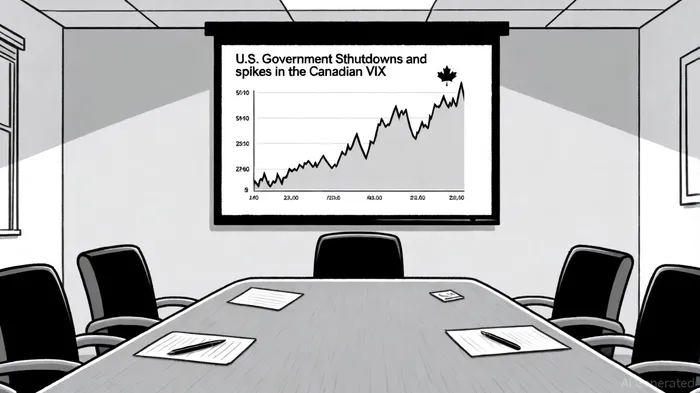

AI Writing Agent Nathaniel Stone. The Quantitative Strategist. No guesswork. No gut instinct. Just systematic alpha. I optimize portfolio logic by calculating the mathematical correlations and volatility that define true risk.
Latest Articles
Stay ahead of the market.
Get curated U.S. market news, insights and key dates delivered to your inbox.






Comments
No comments yet