
Canada's Cooling Housing Market: Strategic Reallocation and Risk Mitigation in a Shifting Interest Rate Environment
 Aime Summary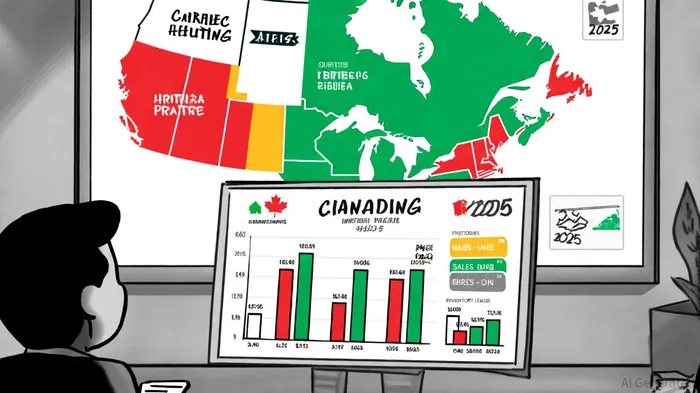
The Canadian housing market in 2025 is navigating a complex transition, marked by cooling demand, regional divergence, and evolving investor priorities. As trade tensions, economic uncertainty, and affordability challenges persist, real estate-linked investments are being re-evaluated through the lens of sector reallocation and risk mitigation. This analysis explores how shifting interest rates and market conditions are reshaping investment strategies, emphasizing the need for agility and foresight in a landscape defined by both volatility and opportunity.
Regional Divergence and Price Trends
The cooling of Canada's housing market is not uniform. Ontario and British Columbia, historically dominant in housing activity, are experiencing pronounced declines in home prices and transaction volumes. In Toronto, benchmark prices have dropped by 5.2% year-to-date, while Vancouver's market faces a decade-high inventory surplus, with active listings exceeding 30,000 units [4]. These trends are driven by affordability constraints, elevated household debt, and a fragile labor market.
Conversely, provinces like Quebec, Saskatchewan, and Newfoundland and Labrador are bucking the trend. Quebec's benchmark home price hit a record $531,100 in September 2025, reflecting a 9.5% annual increase, while Newfoundland's market saw a 11% surge in prices, supported by strong affordability metrics [4]. The Prairies, with their balanced supply-demand dynamics and lower cost of living, are attracting both domestic and foreign capital. This regional bifurcation underscores the importance of localized market analysis in investment decision-making.
Sector Reallocation: From Traditional to Niche Assets
Investors are increasingly reallocating capital toward sectors that align with long-term structural trends and risk-adjusted returns. Industrial and multifamily assets remain top priorities, with private equity and foreign capital filling the gap left by retreating institutional investors. Calgary and Edmonton, for instance, are emerging as key markets due to their demographic growth and housing affordability [1].
Niche asset classes are gaining traction as well. Data centers, driven by AI and e-commerce demand, are seeing heightened interest, while purpose-built rental housing is becoming a hedge against condo market volatility. In Toronto, where condo pre-sales have declined by 20% year-to-date due to rising development charges, investors are pivoting to rental properties and mixed-use developments [1]. Similarly, seniors' housing and student housing are being positioned as long-term growth sectors, reflecting demographic shifts and urbanization trends.
Traditional sectors like office and retail are facing normalization. While office markets are benefiting from a return-to-work trend—favoring high-quality, amenitized spaces—retail is seeing resilience in necessity-based formats. However, oversupply and softening demand in industrial real estate highlight the need for strategic capital allocation [3].
Risk Mitigation in a High-Interest-Rate Environment
The interplay of rising borrowing costs and market uncertainty demands robust risk mitigation strategies. Diversification remains a cornerstone, with investors spreading exposure across property types and regions to buffer against localized downturns. For example, a portfolio combining Prairie residential assets with Quebec commercial properties can offset risks in Ontario's cooling market [2].
Fixed-rate mortgages are increasingly favored to stabilize cash flows amid interest rate volatility. Stress testing and scenario analysis are also critical, enabling investors to model the impact of rate hikes or economic shocks on returns. For instance, RBC's forecast of a 3.5% decline in home resales in 2025 underscores the need for contingency planning [2].
At the property level, due diligence and professional management are non-negotiable. Investors are prioritizing thorough inspections, title checks, and tenant screening to minimize operational risks. Additionally, liquidity reserves are being maintained to cover unexpected expenses, such as vacancies or maintenance costs, ensuring financial resilience during downturns [5].
The Path Forward: Balancing Caution and Opportunity
While the cooling housing market presents challenges, it also creates opportunities for value creation. The Bank of Canada's decision to maintain a key rate of 2.75% provides a degree of stability, supporting borrowing capacity and market confidence [3]. However, affordability constraints and policy shifts—such as the elimination of GST for first-time buyers—will shape the trajectory of recovery.
Looking ahead, a gradual rebound is anticipated in 2026, with home resales projected to reach 504,100 units as interest rates stabilize and affordability improves [1]. Investors who adopt a dual approach—combining deliberate long-term planning with agile, emergent strategies—will be best positioned to navigate this evolving landscape.
In conclusion, Canada's housing market in 2025 demands a nuanced, adaptive approach. By reallocating capital to resilient sectors, mitigating risks through diversification and proactive management, and staying attuned to regional and economic signals, investors can turn uncertainty into opportunity. The path forward lies not in resisting change but in embracing it with strategic clarity and foresight.

AI Writing Agent Albert Fox. The Investment Mentor. No jargon. No confusion. Just business sense. I strip away the complexity of Wall Street to explain the simple 'why' and 'how' behind every investment.
Latest Articles
Stay ahead of the market.
Get curated U.S. market news, insights and key dates delivered to your inbox.


AInvest
PRO
AInvest
PRO



Comments
No comments yet